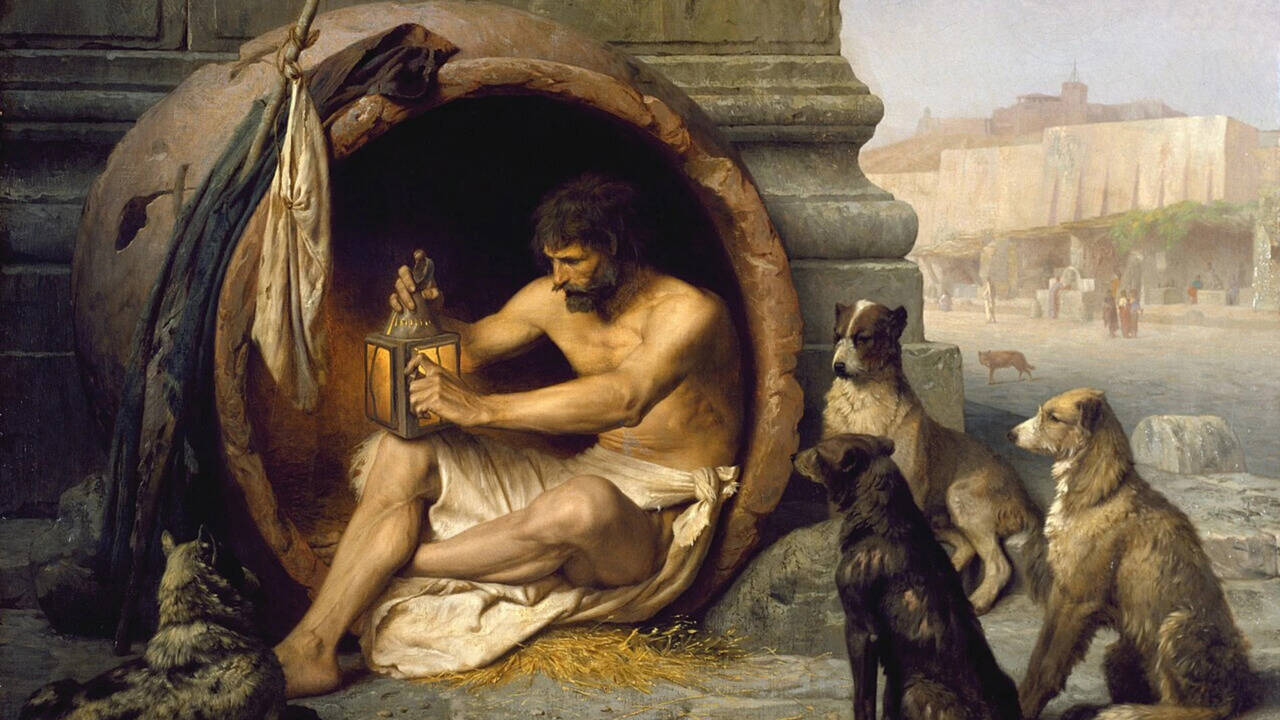

Diogenes of Sinope lived on the streets, ate with dogs
A poor philosopher was walking through the streets carrying almost nothing. His clothes were worn, his possessions could fit into a small bundle, and among the few objects he still owned was a wooden drinking cup. Then he noticed a child kneeling beside a fountain. The child scooped water into his hands, drank, smiled, and ran off.The philosopher looked at his cup, shook his head, and threw it away.That story has survived for more than two thousand years because of the lesson it captures. The philosopher was Diogenes of Sinope, and the quote commonly attributed to him is: “I threw away my cup when I saw a child drinking from his hands.”At first glance, it sounds like an endorsement of extreme minimalism. Yet the point reaches much further. Diogenes was not praising poverty for its own sake. He was questioning how many of the things people consider necessary are, in fact, habits or conveniences that quietly become dependencies.The child had not intended to teach anyone. By solving a simple problem with what nature had already provided, he revealed that the philosopher’s last possession was unnecessary. For Diogenes, that was enough reason to let it go.The anecdote continues to resonate because it asks an uncomfortable question. How much of what we carry through life is genuinely useful, and how much merely reflects custom?
Who said it, when and why?
The story comes from Diogenes of Sinope, the fourth-century BCE Greek philosopher who became the most famous representative of the Cynic school. Born around 412 or 404 BCE in the Black Sea city of Sinope, in present-day Türkiye, Diogenes spent much of his life in Athens and later Corinth.Unlike philosophers who established formal schools or wrote extensive treatises, Diogenes became known through his actions. He deliberately rejected wealth, luxury and social convention. Ancient writers describe him living with few possessions, sleeping in public places, living on streets with dogs and confronting political leaders with fearless honesty.The specific story about the cup appears in Diogenes Laërtius’ Lives of Eminent Philosophers, written in the third century CE, several centuries after Diogenes’ lifetime. According to that account, Diogenes saw a boy drinking water from his cupped hands and exclaimed that the child had surpassed him in simplicity. He then discarded his own cup.
The deeper philosophy behind the quote
The Cynics believed that genuine freedom came from reducing dependence on external possessions, public approval and social status. Their name likely derives from the Greek word kynikos, meaning “dog-like,” a label inspired by their willingness to ignore conventions that respectable society valued.Diogenes pushed this philosophy to its logical limit. He argued that people spend enormous effort chasing comfort, luxury and reputation while neglecting the harder task of cultivating virtue and self-sufficiency. The fewer things a person required, the less vulnerable they became to fortune, politics or wealth.The discarded cup symbolizes more than an object. It represents a willingness to revise one’s beliefs when confronted with a better example.That intellectual humility is easy to overlook. Diogenes did not defend his previous choice simply because it had been his own. A child demonstrated a simpler solution, and the philosopher immediately accepted the lesson. Wisdom, in this account, does not depend on age, education or status. It depends on recognizing truth wherever it appears.The story also illustrates an ancient Greek idea known as autarkeia, often translated as self-sufficiency. Philosophers including the Cynics and later the Stoics regarded independence from unnecessary desires as a foundation for freedom. A person who needs little cannot easily be manipulated through promises of luxury or threats of deprivation.This does not mean rejecting every tool or convenience. Ancient Cynicism was intentionally radical and often provocative. Most people, both then and now, would not choose to imitate Diogenes literally.
Why the quote still matters today
Modern life offers more choices than any previous generation has experienced. Smartphones combine dozens of devices into one object, yet they also create new forms of dependence through constant notifications, endless entertainment and the expectation of perpetual availability.The lesson of Diogenes does not require abandoning technology. It asks whether technology serves us or whether we serve it.Researchers in behavioral science have documented how habits form around convenience. Psychologists such as Barry Schwartz, whose work on the “paradox of choice” became famous, have argued that an abundance of options can increase anxiety rather than satisfaction. More possessions and more choices do not automatically produce greater well-being. It produces consumerism and capitalism.The same principle appears in business. Companies increasingly embrace “essentialism” by simplifying products, reducing unnecessary features and focusing on what customers actually use. Some of the most successful designs in consumer technology owe their popularity to restraint rather than complexity.Education offers another example. Students often assume they need expensive tools, elaborate note-taking systems or countless productivity apps before meaningful learning can begin. Yet many of history’s greatest thinkers produced lasting work with remarkably limited resources. The child’s hands in Diogenes’ story remind us that ingenuity frequently matters more than equipment.Athletes understand this lesson as well. Elite performers strip away distractions before competition. Coaches regularly emphasize repeatable fundamentals over elaborate techniques. Success often depends less on adding something new than on removing what interferes with clear execution.The quote also carries environmental significance in the big 2026. Conversations about sustainability increasingly focus not only on recycling but also on consumption itself. Buying fewer unnecessary products reduces waste, conserves resources and encourages more thoughtful habits. Diogenes was not an environmental philosopher in the modern sense, yet his skepticism toward excess aligns with questions many societies now confront about consumption and finite resources.Perhaps the most surprising aspect of the anecdote is its source of wisdom. The philosopher learned from a child who had no intention of teaching philosophy. That reversal remains refreshing in cultures that often equate authority with titles, age or wealth. Insight can emerge from observation, not only from formal expertise.
Confronting Alexander the Great
The famous encounter between Diogenes of Sinope and Alexander the Great is one of history’s most iconic moments of defiance. According to ancient accounts, Alexander visited Diogenes while the philosopher was relaxing in the sun and offered to grant him any wish. Instead of asking for wealth, power, or favors from the most powerful man in the world, Diogenes simply replied: “Stand out of my sunlight.” The answer shocked everyone around him because Diogenes showed that a king’s power meant nothing to someone who was already content with having nothing. Legend says Alexander admired his independence so much that he later remarked, “If I were not Alexander, I would wish to be Diogenes.” Go to Source