- US revoked Iran’s oil export waiver, raising Mideast tensions.
- India’s crude supply remains secure, due to diversified sourcing.
- Strait of Hormuz attacks raise shipping risks, increasing import costs.
The United States has revoked the temporary sanctions waiver that allowed Iran to export crude oil, petrochemicals and refined petroleum products, marking a fresh escalation in tensions in West Asia after a series of attacks near the Strait of Hormuz. While the decision effectively shuts the door on Iranian oil returning to global markets in the near term, analysts believe the immediate impact on India’s crude supplies is likely to be limited.
The latest development comes after the US Central Command on Tuesday said that it had launched a fresh round of strikes on Iran, hours after three commercial oil tankers, including the Qatari-flagged Al Rekayyat, were reportedly hit by projectiles and a drone while transiting the Strait of Hormuz.
Soon afterwards, the US Treasury withdrew the general licence that had temporarily allowed Iran to legally export crude oil, petrochemicals and refined petroleum products until August 21, 2026. The licence had formed part of the broader ceasefire framework agreed upon after the US-Iran conflict that began in February.
The military action and renewed sanctions together represent one of the biggest reversals since Washington and Tehran agreed to a temporary understanding on June 17 aimed at easing tensions.
Iran’s Brief Return To The Oil Market Ends
The sanctions waiver had briefly raised hopes that Iranian crude could once again find buyers in Asia after years of restrictions.
However, the window of opportunity was barely utilised.
According to Bloomberg, India’s state-run refiners had already secured crude cargoes required for July and August well before the waiver was announced. The companies were instead exploring possible future purchases only if the waiver was extended beyond August or sanctions were eased further.
Citing sources, the news agency reported that refiners had begun informal conversations with traders marketing Iranian crude but had little room to immediately purchase additional cargoes because procurement plans had already been finalised.
Instead, the talks were largely aimed at ensuring access to Iranian supplies should Washington provide a longer-term relaxation of sanctions.
Why Indian Refiners Stayed Away
Even before the latest US decision, Indian refiners had little commercial incentive to return to Iranian crude.
Following the partial reopening of shipping through the Strait of Hormuz after the ceasefire, prices of West Asian crude softened considerably. At the same time, Russia continued supplying discounted crude, keeping Indian refiners well stocked at competitive prices.
Saudi Arabia also intensified competition by announcing its biggest monthly reduction in official selling prices in more than two decades as producers competed for Asian buyers.
Russian crude, meanwhile, continued to offer attractive economics for Indian refiners. Cargoes from Russia were reportedly available at steeper discounts than Iranian barrels, further reducing Tehran’s appeal.
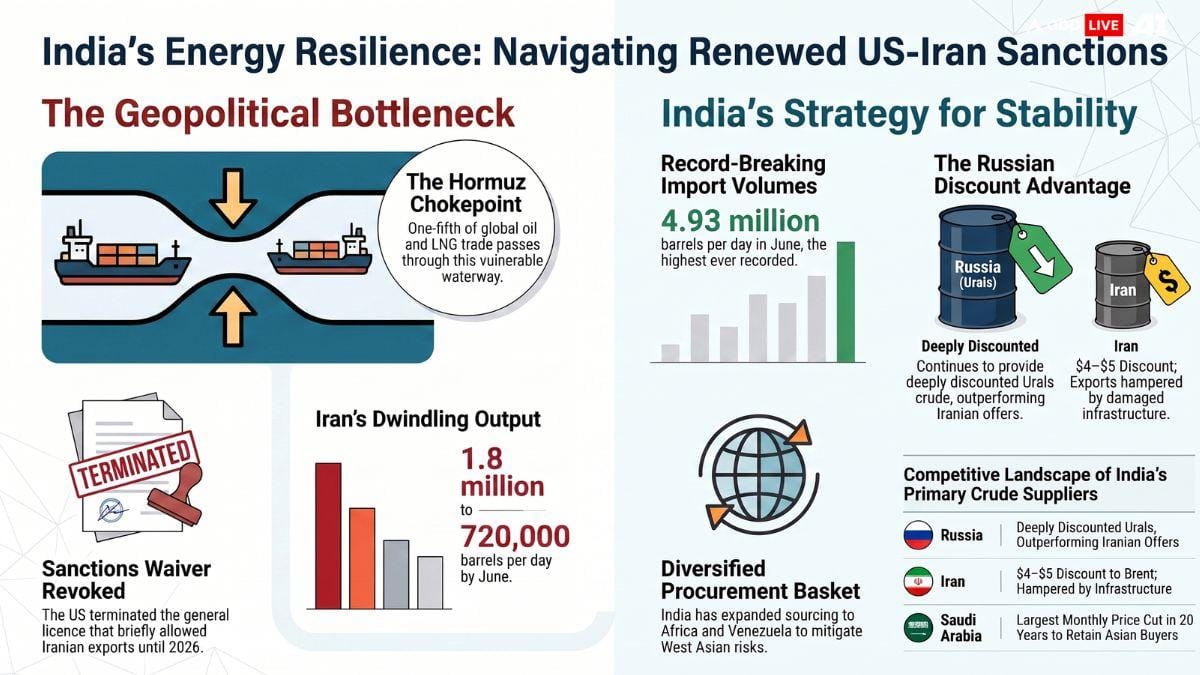
Reportedly, Iranian crude was being offered at discounts of around $4-$5 per barrel to Brent, while Russia’s Urals crude remained even more competitive.
Citing officials familiar with refinery procurement, the report added that Indian buyers also remained cautious about Saudi grades because of relatively higher freight costs.
Also Read : US-Iran Ceasefire Over? Stock Markets Bleed, Sensex Over 350 Points Down, Nifty Under 24,300
Fresh Sanctions Narrow India’s Options
With Washington revoking the temporary licence, importing Iranian crude has once again become a far more complicated proposition.
Any Indian company purchasing Iranian oil now risks attracting secondary US sanctions, making fresh imports highly unlikely despite earlier discussions on potential energy cooperation between New Delhi and Tehran.
The decision comes only weeks after India’s Oil Minister Hardeep Singh Puri met Iranian Petroleum Minister Mohsen Paknejad on the sidelines of the BRICS Energy Summit, where both sides discussed opportunities to expand cooperation in the energy sector.
For now, however, industry observers believe those discussions are unlikely to translate into actual crude purchases.
India Entered The Latest Crisis Well Prepared
Despite renewed geopolitical tensions, India’s immediate energy security remains relatively comfortable.
According to The Financial Express, citing Kpler analyst Sumit Ritolia, Indian refiners imported a record 4.93 million barrels of crude oil per day in June, the highest level ever recorded for the month.
The strong import volumes mean refiners had already secured enough crude to comfortably meet demand through much of July and August before the latest escalation unfolded.
State-run processors generally purchase crude one to two months in advance, reducing the immediate impact of sudden geopolitical developments on domestic fuel availability.
The availability of discounted Russian barrels has reduced the urgency for Indian refiners to seek alternative sources, including Iran.
Apart from Russia, India has diversified its procurement basket by sourcing crude from Africa, Venezuela and other producing nations. Increased production by OPEC+ has also helped improve global availability, offering refiners greater flexibility even as geopolitical risks persist.
Why The Strait Of Hormuz Still Matters
While India’s immediate crude supplies remain secure, the Strait of Hormuz continues to be one of the biggest risks for global energy markets.
Nearly one-fifth of the world’s oil and liquefied natural gas (LNG) trade passes through the narrow waterway, making it one of the most strategically important shipping routes globally.
Although traffic through Hormuz had gradually resumed following the June ceasefire, the latest attacks on commercial vessels have once again exposed the vulnerability of one of the world’s busiest energy corridors.
Analysts say any prolonged disruption could lead to higher freight charges, increased war-risk insurance premiums and longer shipping times, all of which would eventually raise the cost of importing crude.
For India, which imports more than 85 per cent of its crude oil requirement, these additional logistics costs could prove more significant than the loss of Iranian supplies themselves.
Also Read : E20 Fuel Row Deepens: Govt May Delay E25 Petrol Rollout Amid Mileage, Engine Concerns
Iran’s Falling Exports Reduce Immediate Supply Risks
Even before Washington reinstated sanctions, Iran’s ability to significantly increase exports had already weakened.
According to the Atlantic Council, damage to Iran’s energy infrastructure and continued operational disruptions had sharply reduced the country’s crude exports.
Iran, which had been exporting roughly 1.8 million barrels per day earlier this year, was shipping only around 720,000 barrels per day by June, substantially limiting the volume available for international buyers.
That decline meant Iranian crude was unlikely to become a major source of additional supply for India even if the temporary sanctions waiver had remained in place.
Oil Markets React, But Panic Remains Limited
Oil prices strengthened after news of the latest US strikes and renewed sanctions, extending gains already recorded following Iran’s earlier missile attacks on US military assets in Bahrain and Kuwait.
However, analysts note that markets have become more accustomed to geopolitical flare-ups since the conflict began in February.
Earlier in the year, fighting around the Strait of Hormuz had briefly pushed Brent crude above $120 per barrel, before prices eased as OPEC+ increased production and alternative shipping routes around Oman helped restore some oil flows.
The latest developments have therefore prompted caution rather than outright panic, with traders focusing on whether shipping disruptions become prolonged.
Future Contracts Could Feel The Real Impact
Industry observers believe the immediate effect on India’s fuel supplies is likely to remain limited because refiners purchase crude well ahead of delivery schedules.
Instead, any sustained escalation is expected to influence procurement decisions for August and September cargoes, when refiners begin negotiating fresh contracts.
According to Bloomberg, state-run refiners are expected to begin discussions for September deliveries in the coming weeks and may continue keeping the option of Iranian crude open should negotiations between Washington and Tehran produce another sanctions relaxation or a more permanent peace agreement.
For now, however, refiners appear focused on maintaining diversified sourcing strategies while relying heavily on Russian supplies and competitive cargoes from other producers.
The larger challenge will be whether the latest escalation prolongs instability in the Strait of Hormuz, pushes up shipping and insurance costs, and keeps global crude prices elevated. If that happens, India’s oil import bill could rise further even without any interruption in physical crude supplies, keeping pressure on refiners, government finances and domestic fuel prices in the months ahead.
Also Read : Are You Using Your Credit Card For Convenience Or Just To Get Through The Month?