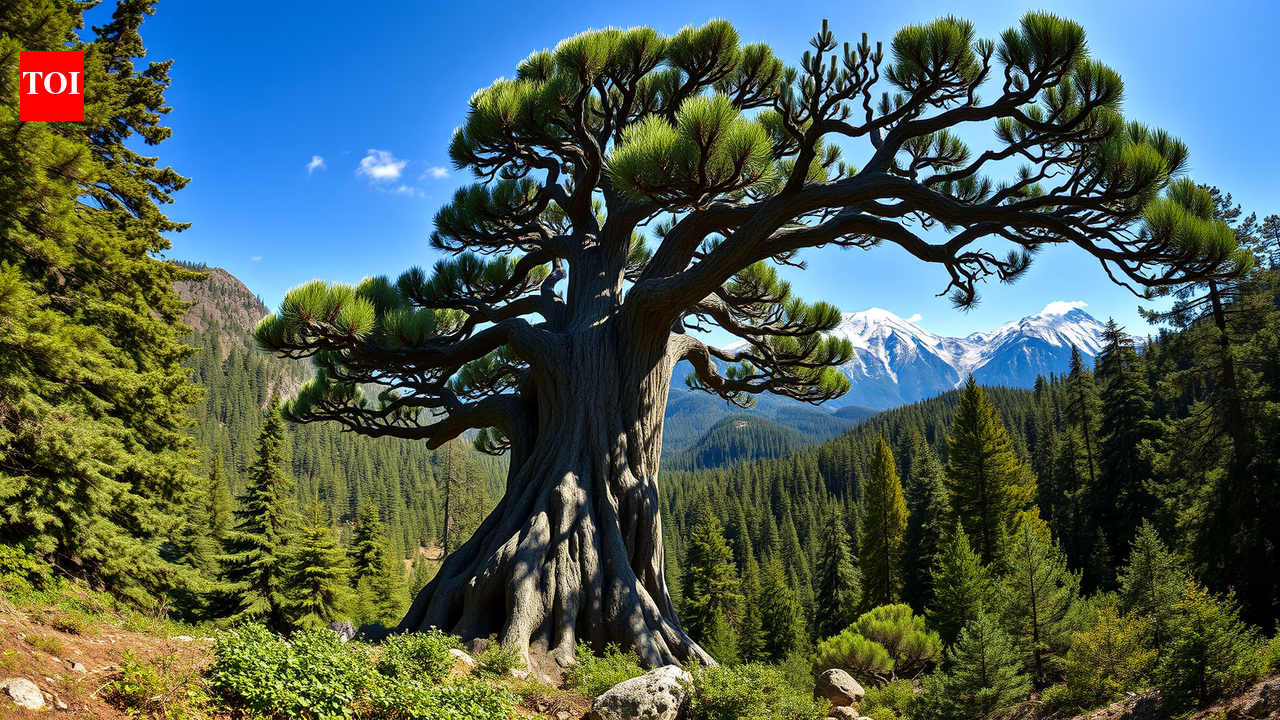

Some trees are remarkable simply because of how long they have been standing. The monkey puzzle tree, known scientifically as Araucaria araucana, belongs to a lineage so ancient that its ancestors shared the planet with dinosaurs, and individual trees alive today can trace their own root systems back nearly two thousand years. Native to the temperate mountain forests of Chile and western Argentina, it is Chile’s national tree, a cultural cornerstone for Indigenous communities who have depended on it for food and ceremony across generations, and one of the most visually distinctive conifers anywhere on Earth. Its name, according to popular legend, traces back to the 1850s, when English lawyer Charles Austin looked at one growing in a garden in Cornwall and reportedly declared that it would puzzle a monkey to climb it, a throwaway remark that somehow outlasted everything else he ever said.
What the monkey puzzle tree actually looks like up close
The monkey puzzle is an evergreen conifer that grows in a strikingly symmetrical, almost architectural shape, with a single straight trunk rising up to 50 metres and a canopy that starts pyramidal in youth before broadening into a wide, rounded umbrella of branches in maturity. The branches spread in distinct horizontal whorls and are covered entirely in tough, triangular, sharply pointed leaves that overlap like scales, spiralling tightly around every twig and stem. These leaves are not soft or temporary in the way most foliage is. An individual leaf can remain attached to the branch for up to 15 years before being shed, giving the tree an almost reptilian texture at close range that immediately explains why Austin’s monkey climbing comment stuck so firmly in the popular imagination.
A lifespan that stretches across human civilisations
Individual Araucaria araucana trees are among the longest lived organisms in South America, with some specimens known to survive for up to 2,000 years in suitable conditions. Research on the ecology and dendrochronology of the species, documented in conservation studies including those compiled by Kew’s Plants of the World Online, confirms that trunks can reach diameters of 1.5 metres and that the species’ ecology is closely tied to periodic natural disturbances including volcanic eruptions, wildfires, landslides and windstorms, all of which the tree is adapted to survive through thick bark, epicormic buds capable of resprouting after fire damage, and a seed biology suited to colonising disturbed ground. A tree alive today and growing well could reasonably have been a young sapling when medieval European kingdoms were forming, a fact that gives the monkey puzzle a historical weight few living things can match.
The edible seeds that sustained Indigenous peoples for thousands of years
One of the most practically important features of the monkey puzzle is its large, nutritious seed, known as the piñon, which has formed a critical part of the diet of the Mapuche-Pehuenche people of the southern Andes since long before European contact. The seeds are rich in carbohydrates and can be eaten raw, boiled or toasted over fire, and are also fermented into a traditional drink called chavid. Research published in Ecology and Society examining Araucaria forest landscapes across South America confirmed that piñones have held deep cultural, economic and spiritual significance for the Mapuche-Pehuenche for millennia, going well beyond their nutritional value to form a cornerstone of the community’s identity, seasonal rituals, territorial connections and harvest ceremonies. During the autumn harvest season, piñones can account for between 10 and 15 percent of a household’s diet, rising to provide the primary carbohydrate source throughout the long Andean winter months from June to September.
Endangered status and the long history of deforestation
Despite its protected status, the monkey puzzle tree is listed as Endangered on the IUCN Red List, a designation it received in 2013 following decades of logging, land clearance, repeated human-ignited fires and overgrazing by cattle that have steadily fragmented and reduced its natural range. Research on the impacts of cattle grazing on Araucaria regeneration, published in Biological Conservation, found clear negative relationships between cattle activity and seedling survival, with grazing pressure significantly suppressing the tree’s ability to regenerate naturally across large portions of its remaining habitat. Chile declared the monkey puzzle a National Monument in 1976, legally prohibiting logging, and the species is also listed under Appendix I of the Convention on International Trade in Endangered Species, which restricts international trade. Protection in Argentina exists as well, though enforcement outside national park boundaries remains inconsistent and logging pressure continues in certain areas.
The Mapuche-Pehuenche people and the sacred tree
For the Mapuche-Pehuenche, the monkey puzzle is not simply a source of food or timber but a sacred presence that occupies the centre of their cosmological and ceremonial life. The tree’s Mapuche name is pewen or pehuen, and it gave one branch of the Mapuche people their tribal name, the Pehuenche, meaning people of the pewen. Families traditionally establish summer camps near Araucaria stands during the harvest season, with each family holding rights over a defined forested area. The piñon harvest is not a casual activity but a structured, communally meaningful event tied directly to questions of territorial sovereignty and Indigenous land rights, as documented in ethnobotanical research on Indigenous resource rights and conservation published in Economic Botany. Researchers have noted that the strength of Indigenous interest in conserving the tree is directly tied to self-determination, and that where communities retain meaningful control over their ancestral forests, Araucaria populations tend to be better managed and more ecologically stable than in areas where that control has been lost.
Why the monkey puzzle became a beloved ornamental tree worldwide
Beyond its native range, the monkey puzzle became enormously fashionable as an ornamental tree across the temperate world during the Victorian era, particularly in Britain, where its bold, alien-looking silhouette appealed to the period’s enthusiasm for exotic botanical specimens. It was introduced to Europe by the Scottish botanist Archibald Menzies in the 1790s, supposedly after collecting seeds from cones served to him at a dinner in Chile, and it spread rapidly through country house gardens, public parks and suburban avenues across the United Kingdom and beyond. Today it remains a familiar and immediately recognisable sight in temperate gardens from the British Isles to New Zealand, and while garden specimens rarely approach the scale of wild Andean trees, they serve as living ambassadors for one of the planet’s most ancient and resilient lineages, a conifer that survived the extinction of the dinosaurs, outlasted entire human civilisations, and still stands, spiny and unbothered, in the mountain forests where it has always grown. Go to Source