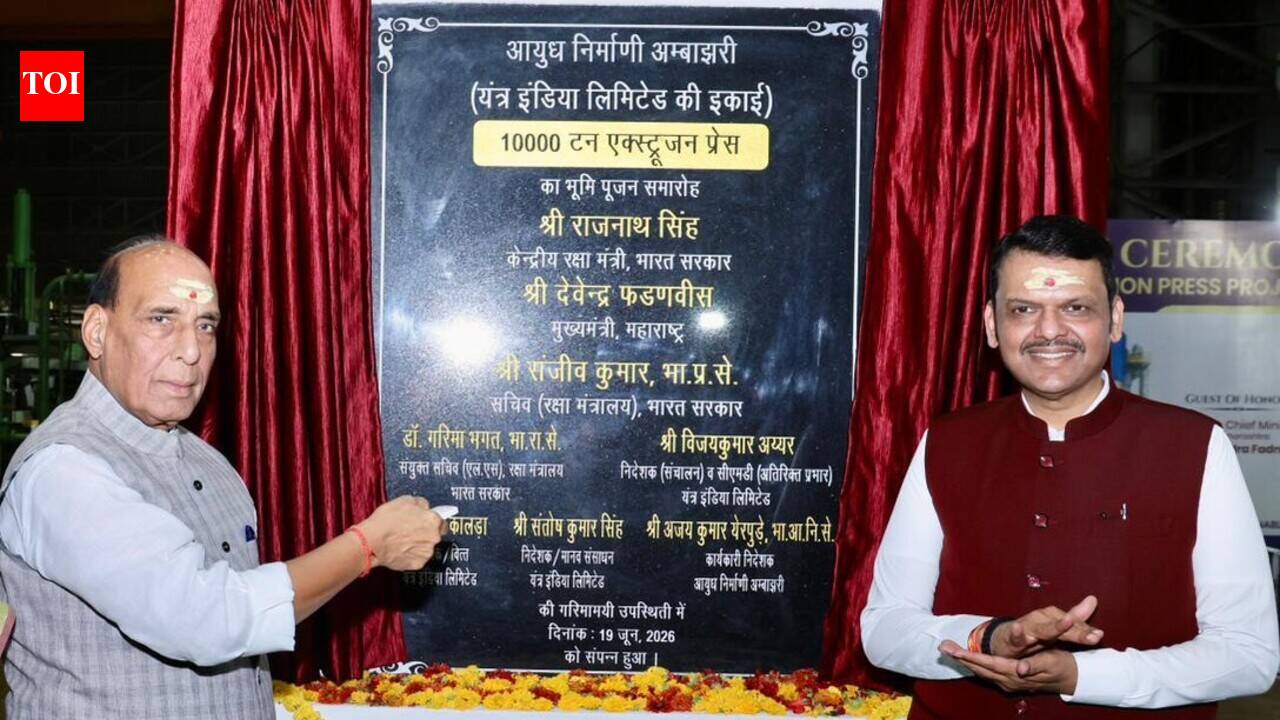

Defence minister Rajnath Singh and Maharashtra CM Devendra Fadnavis at the ceremony in Nagpur
NEW DELHI: Defence minister Rajnath Singh said on Friday “that a nation capable of meeting its own requirements moves forward with the greatest confidence towards safeguarding its interests”. He made the remark while performing bhoomi pujan for a state-of-the-art 10,000-tonne aluminium extrusion press, along with Maharashtra CM Devendra Fadnavis, at Ordnance Factory Ambajhari, Nagpur, a unit of Yantra India Limited (YIL). Stressing that taking control of security-related necessities is imperative in the present geopolitical scenario to remain future-ready, Rajnath said the new facility will support the manufacture of large and complex aluminium alloy profiles required for defence systems and platforms, aerospace and aviation structures, missile programmes, railways and transportation sectors and other strategic industrial applications. The project will help reduce dependence on imports of critical aluminium extrusions and strengthen the domestic supply chain, he said. He asserted that the extrusion press symbolises a shift in the country’s approach from relying on imports to producing critical goods domestically and proposed the press will be one of the most advanced facilities of its kind in the country. It will support the manufacture of large and complex aluminium alloy profiles required for defence systems and platforms, aerospace & aviation structures, missile programmes, railways & transportation sectors and other strategic industrial applications. The project will help reduce dependence on imports of critical aluminium extrusions and strengthen the domestic supply chain, while supporting the future requirements in strategic sectors through indigenous production. “This extrusion press addresses a crucial need. Modern fighter jets, missiles, and advanced space programmes require metals that are lightweight and strong, capable of withstanding even the most extreme conditions. Such metals are produced through specialised processes. If the quality of the metal is superior, it will serve well in every situation,” Rajnath said. Highlighting the significant role played by made-in-India equipment in the success of Operation Sindoor, Rajnath stressed the need to increase the indigenous manufacturing of robust hardware to complement the bravery of defence forces personnel. He underlined that thousands of crucial components constitute the true strength of big machines, and the extrusion press will go a long way in making the nation self-reliant in this critical domain. He said, “Today, while the nature of warfare is evolving and enemies are harder to detect, conventional warfare & its associated means remain just as relevant as they were in 1947, and will retain much of the same relevance in 2047 as well.” He said the importance of a strong military-industrial base will continue for a long time, and the extrusion press is a step towards fulfilling a major national need, keeping the future requirements in mind. Rajnath highlighted that the govt is marching ahead to realise PM Modi’s vision of Aatmanirbhar Bharat by simultaneously working on four key elements – technology, workforce, knowledge, and faith in the nation. He stated that the govt’s persistent efforts are yielding positive results as the domestic defence production, which stood at Rs 46,000 crore in 2014, has risen to a record Rs 1.78 lakh crore in Financial Year (FY) 2025-26. He added that the nation was exporting arms and equipment worth less than Rs 1,000 crore in 2014, which has now skyrocketed to an all-time high of Rs 38,424 crore. “This represents not just a rise in numbers, but a growth in India’s capabilities. It signifies a boost in the nation’s self-confidence. We are poised to achieve the targets we have set for the next 2-3 years – Rs 3 lakh crore defence production and Rs 50,000 crore defence exports ahead of schedule,” he said. The minister acknowledged the efforts being made by YIL in making a significant contribution to advancing the goal of self-reliance. He stated that the corporatisation of the Ordnance Factory Board (OFB) was carried out to make the system stronger and more agile in view of the changing times, and emerging technologies, and YIL is a result of that transformation. “Post-corporatisation, we envisioned that the new entities enjoy sufficient operational autonomy and gain opportunities to excel in innovation, risk-taking, research, and exports. All the new DPSUs have successfully moved in that direction. OFB’s production, which stood at Rs 12,755 crore in the pre-corporatisation year of FY 2019-20, has risen to Rs 26,282 crore in FY 2025-26. In defence exports, the figure stood at a mere Rs 81 crore prior to corporatisation. It has now surged to Rs 4,561 crore, with YIL contributing Rs 397 crore,” he added. Go to Source