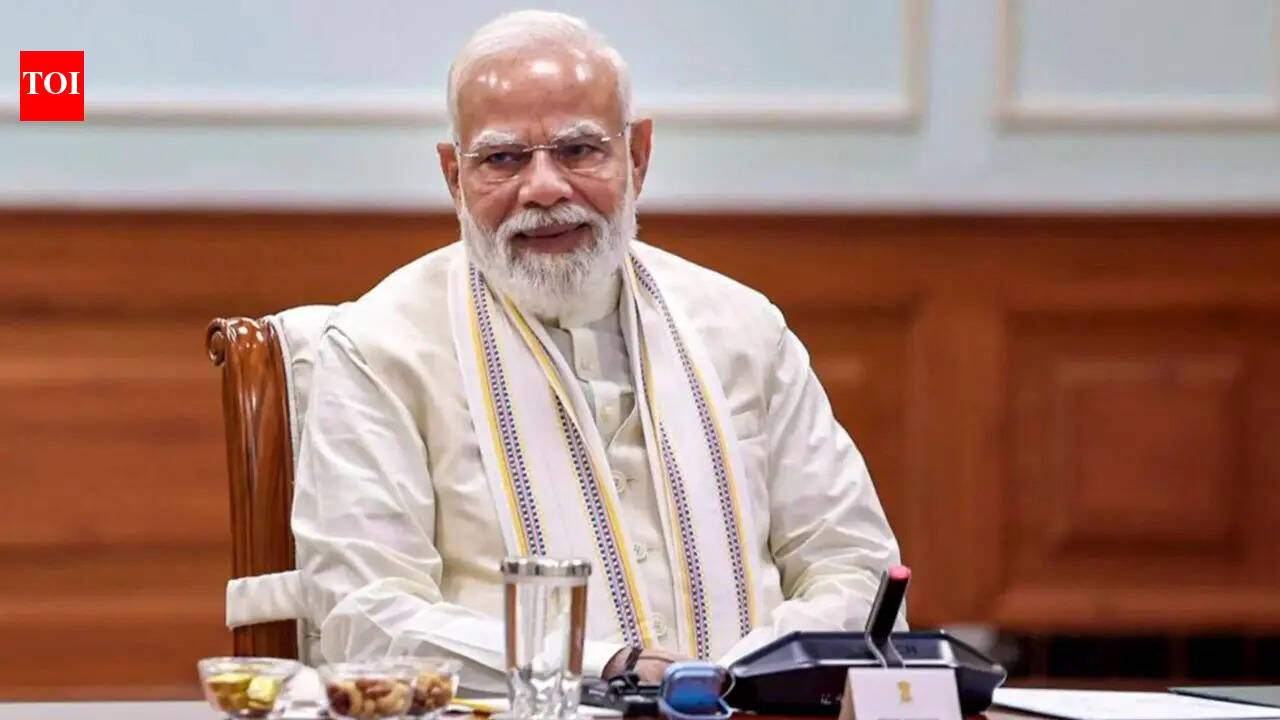

Prime Minister Narendra Modi during the the Economic Advisory Council meeting.
NEW DELHI: As govt gears to undertake a delimitation exercise in the coming month, a working paper by the Economic Advisory Council to Prime Minister (EAC-PM) has suggested India should split Lok Sabha’s 170 large constituencies using a “targeted criterion” instead of a uniform one to raise the total strength of the House from 543 to 824.The paper by EAC-PM member Shamika Ravi and Mudit Kapoor, of the Indian Statistical Institute, has proposed splitting 59 constituencies into two and 111 constituencies into three. This exercise is expected to increase voter turnout in the next general election by between 0.3 and 2.3 percentage points, corresponding to 90 lakh to 2.3 crore additional voters, it said.According to the model proposed, Kerala and Tamil Nadu will account for 22 of the 59 proposed two-way splits. In cases of three-way splits, the lion’s share will be in UP (17), followed by Maharashtra (12), Bihar (10), and Bengal (10). As a result, the number of seats in southern states is expected to rise — in Telangana from 17 to 26, Andhra from 25 to 38, Karnataka from 28 to 42, TN from 39 to 59, and Kerala from 20 to 30. Among northern and western states, seats will rise from 48 to 72 in Maharashtra, 25 to 38 in Rajasthan, 80 to 120 in UP, 29 to 44 in MP, 26 to 39 in Gujarat, and 40 to 60 in Bihar. The paper stated that implementing the formula will keep the share of seats of southern states and the more populous northern and western states in LS broadly unchanged — 23.6% versus 23.7% and 45.2% versus 45.6%, respectively.Highlighting growing constituency size as a challenge, it noted that the median LS constituency in 2024 had 18.2 lakh registered electors, while the largest constituencies had more than 32 lakh voters. It said large constituencies have high voter loads and uneven participation by different groups, which amplify representation gaps.It said ST-dominated constituencies now have among the highest voting rates, while highly urban constituencies have seen turnout fall, with women in these constituencies registering the lowest turnout. The paper advocated measures such as women-only poll booths in metropolitan constituencies, extending polling hours into the evening to accommodate time constraints of urban working women, and improving transport access to boost female participation in elections.