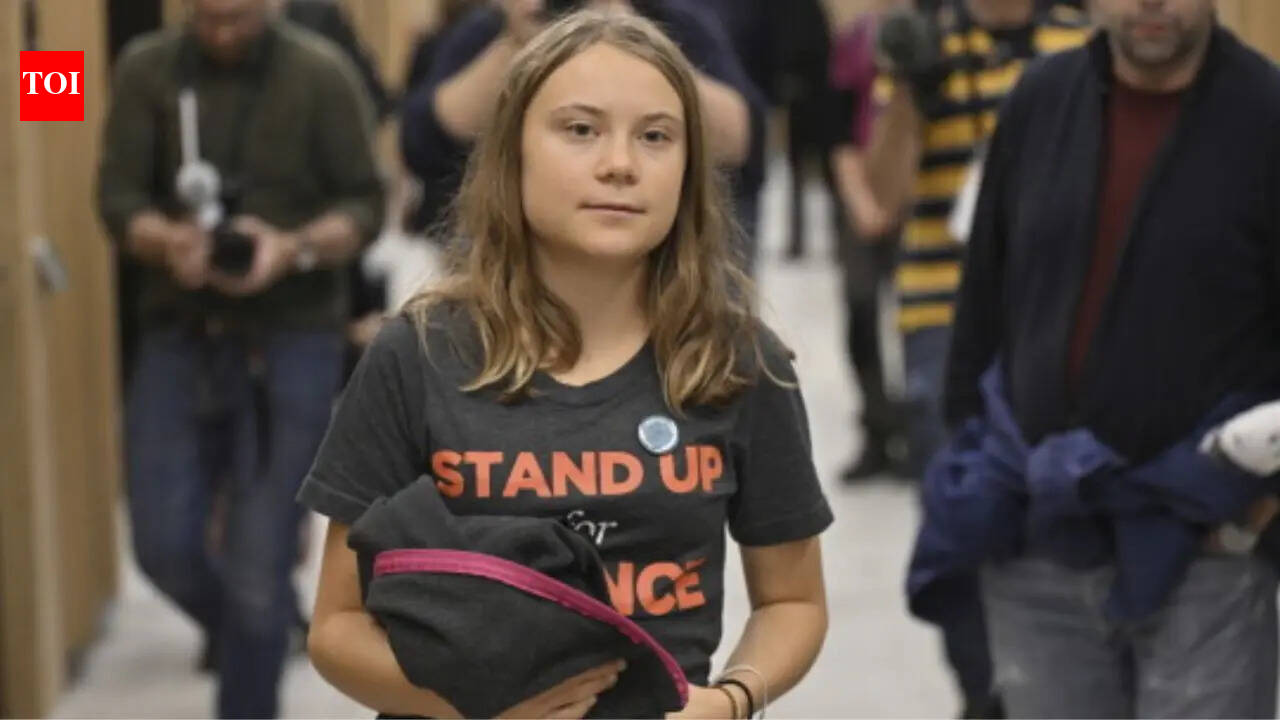

Greta Thunberg
Greta Thunberg has built a reputation for saying things that many politicians would rather avoid. Her speeches rarely wander into careful diplomatic territory. Instead, she tends to strip an issue down to what she sees as its core and then states it in plain language. That approach has earned her both admiration and criticism, often at the same time.The quote above is a good example. It does not contain technical jargon, scientific statistics or complicated arguments. Yet it raises a question that sits at the centre of one of the biggest debates of our time. When discussing climate change, are we talking honestly about responsibility, or have we become comfortable with explanations that spread blame so widely that it loses all meaning?That question is why these words continue to circulate years after they were first spoken.
Quote of the day by Greta Thunberg
“Some people say that the climate crisis is something we have all created. But that is just another convenient lie. Because if everyone is guilty then no one is to blame.”
The story we hear most often
For a long time, climate change has been explained through a simple narrative. Human beings have altered the planet through industrial activity, energy consumption and resource use. Therefore, all of humanity shares responsibility for the problem.At first glance, there is nothing unreasonable about that argument. Every day, people travel, buy goods, use electricity and rely on systems that generate emissions. Few individuals can claim to have no environmental footprint at all.Yet Thunberg challenges the idea that this automatically translates into equal responsibility.Imagine a town where a river has become polluted. Residents use the water. Businesses operate nearby. People throw away rubbish. Then, investigators discover that a handful of factories have been releasing large amounts of waste into the river for decades.Would it make sense to say that everyone carries the same responsibility for the contamination?Most people would probably say no.That example helps explain the point Thunberg is trying to make. Participation and responsibility are related concepts, but they are not always identical.
A closer look at power
One reason the quote attracts attention is that it shifts the discussion towards power.Climate change did not emerge from a series of isolated personal decisions made independently by billions of people. It developed alongside economic systems, industrial expansion, energy policies and political choices that unfolded over generations.The average person has very little influence over how national electricity grids are designed. They do not decide which fuels dominate global energy markets. They are not responsible for negotiating international climate agreements or drafting environmental regulations.Those decisions are generally made by governments, corporations and institutions.This does not mean ordinary citizens have no responsibility whatsoever. Few serious observers would argue that personal choices are irrelevant. The issue is one of scale.A family deciding how to travel on holiday and a multinational company deciding how to power its operations are making decisions that exist in very different categories.Thunberg’s argument begins with recognising that difference.
Why the quote makes some people uncomfortable
Many popular sayings survive because they make people feel reassured. This one does the opposite.If everyone is equally responsible, then everyone can feel equally concerned while avoiding difficult conversations about accountability. It becomes possible to discuss climate change in broad, abstract terms without asking who had the greatest influence over the systems that produced it.Thunberg’s quote removes that comfort.Once responsibility is examined more closely, awkward questions begin to appear. Who knew about environmental risks decades ago? Who had access to scientific evidence? Who benefited financially from activities that contributed to rising emissions? Who delayed action when warnings became harder to ignore?These questions do not have simple answers, which is one reason they are often contested.Yet they remain central to understanding why climate debates can become so heated.
The tension between personal action and systemic change
Walk through any supermarket and you will find products marketed as environmentally friendly. Browse social media and you will quickly encounter advice on reducing waste, cutting energy use or shrinking your carbon footprint.There is nothing wrong with those efforts. Many people genuinely want to make more sustainable choices, and small actions can add up when adopted on a large scale.The problem arises when personal behaviour becomes the entire conversation.A person can recycle diligently and still live in a city powered largely by fossil fuels. Someone can choose public transport whenever possible, but remains dependent on the infrastructure that they did not build and cannot control. Individuals operate within systems that shape many of the options available to them.This is where Thunberg’s criticism enters the discussion.She argues that meaningful progress requires attention to the larger structures influencing everyday life. Focusing exclusively on personal habits risks overlooking the institutions capable of producing change on a much broader scale.
An idea that reaches beyond climate change
Although the quote was directed at environmental issues, the principle behind it appears in many other situations.Consider a workplace where a major mistake has occurred. If managers, supervisors and employees are all assigned the same level of responsibility regardless of their role, the investigation is unlikely to uncover much. Understanding what happened requires examining who made decisions, who had authority and who possessed the information needed to act.The same logic appears in public life.People often expect greater accountability from those with greater influence. A local resident and a national policymaker do not possess the same ability to shape outcomes. A small business owner and a multinational corporation do not operate on the same scale.Most societies recognise these differences instinctively. Thunberg is applying that principle to climate change.
Why the quote continues to resonate
Part of the quote’s staying power comes from its simplicity.Many discussions about climate change become tangled in statistics, projections and policy details. Those topics matter, but they can sometimes obscure a more fundamental question: who should be held accountable when a problem grows over decades despite repeated warnings?Thunberg condenses that question into a few sentences.People may disagree with her conclusions. Some believe she places too much emphasis on institutions and not enough on personal responsibility. Others argue that she has identified an uncomfortable truth about how environmental discussions are often framed.Regardless of where someone stands, the quote forces a pause. It interrupts familiar talking points and asks readers to look more carefully at assumptions they may have accepted without much thought.
Final takeaway from the quote by Greta Thunberg
Greta Thunberg’s statement is ultimately less about blame than about precision. She is challenging the habit of discussing responsibility in ways that are so broad they become difficult to act upon.When responsibility belongs equally to everyone, accountability can become surprisingly hard to locate. When responsibility is examined more carefully, the conversation changes. Attention turns towards power, influence, decision-making and the ability to create change.That shift is what gives the quote its enduring relevance. Climate change may be a global issue, but the decisions shaping it have never been distributed evenly. Recognising that fact does not solve the problem on its own. It does, however, provide a clearer starting point for understanding where solutions are most likely to come from and who has the greatest obligation to pursue them. Go to Source