
National School Mental Health Policy (Image source: ANI)
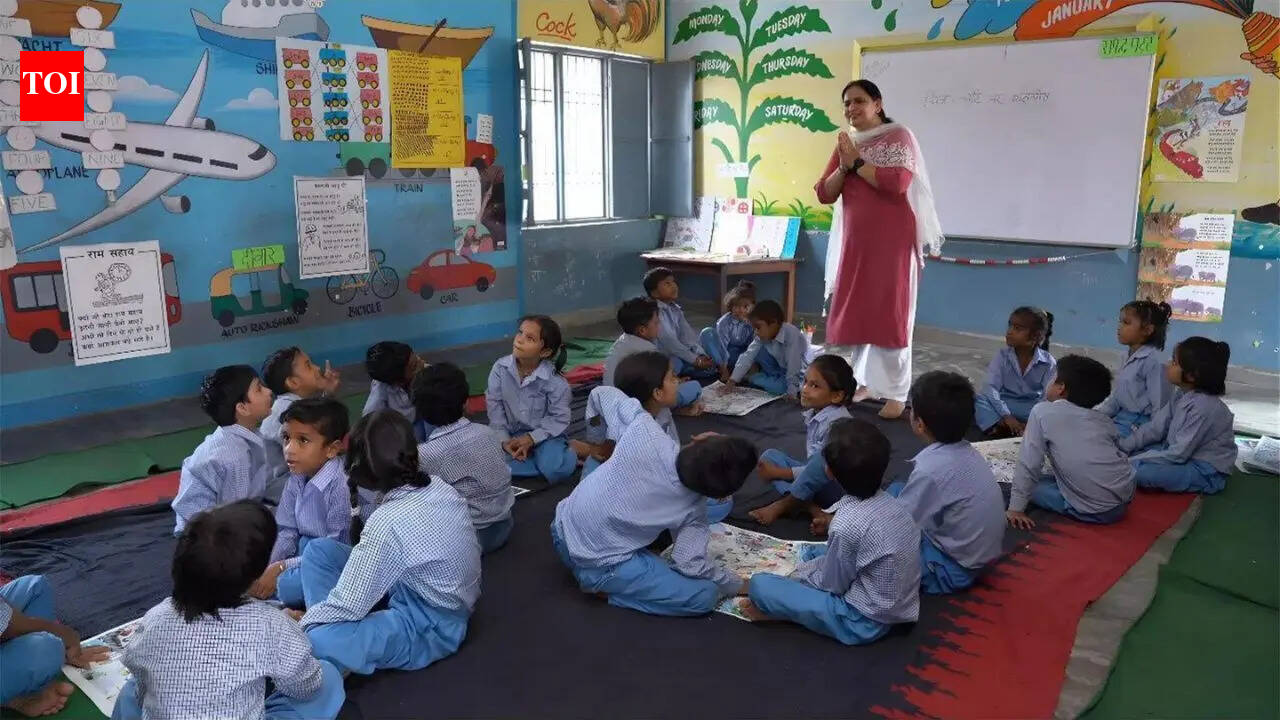
Nandita Bhatla, country director India & vice president, WorldBeing, in an interview with TOI’s Manash Gohain, described education ministry’s upcoming National School Mental Health Policy as a “historic” opportunity to redefine education by making student wellbeing as central as academic learning. She emphasised that the policy could transform schools into spaces where children feel heard, supported and emotionally resilient.Education ministry will announce National School Mental Health Policy by June 1. What does a policy like this mean for 40 million students who have no access to any wellbeing programme?This is a much awaited policy, and I must congratulate the ministry on this historic and bold step. This will re-define the experience of millions of students, where their mental wellbeing and inner resilience will be as important as learning. For 40 million students, our future generation, this means that their everyday school experience becomes one that enables them to thrive. Schools become an ecosystem where everything about them matters, their mindset, inner strengths, their connection to peers and teachers; where they learn and are heard; and where they don’t just write exams, but can practice ways to overcome challenges and stressors, resolve conflicts and be mentally and emotionally ready. By making wellbeing a guaranteed component of education, this policy will reset the very purpose of education — to create whole and happy individuals. For students — and the public at large, who have had concerns about the mental health of the youth and adolescents — this will be a promise of better things to come.At WorldBeing India, this is exactly what the InLight India initiative was built for. Over the past several years, we have been working in partnership with state govts to embed evidence-based wellbeing programming into education systems, not just as a project but as a permanent curriculum. This national announcement gives that work a powerful tailwind.The policy lists teacher capacity building as a core pillar. How can training models be aligned with the national rollout?Too often, attention is paid only to the content to be delivered to students, with the teacher being seen as only a means to do this. Yet we know that the only person who can create ‘magic’ in the classroom is a teacher. And, each of India’s 10 million teachers can do that for every child in their classroom.In our experience of over a decade of working with teachers in state education systems, we have witnessed this ‘magic’ again and again. The personal experience of inner transformation and experiencing wellbeing themselves are the most effective ways to ensure teachers lead this national roll out. In the states we work in, teacher capacity building is built into the system; into institutions and calendars; and into accountability structures. It cannot be treated as an afterthought or an add-on.State education departments, SCERT, DIETS, TTIs have built with us an operational blueprint of how annual training calendars of in-service training and CPD courses can incorporate such training.Through Inlight, we are working across state govts to jointly design and roll out training that is practical, feasible, effective. Mandating dedicated time upfront and investing in deep and transformational foundational training build understanding and perspective that are to stay.The in-service and CPD modules that RIEs offer are one of the most important strategies for the national roll out. Equally important is planning for sustainability — Bihar is the first state to create a module for pre-service course requirements. So every teacher who comes into the system will come with a perspective and understanding of how their classroom transactions can support wellbeing.India has a rich tradition of ‘guru-shishya’, that goes well beyond a transactional relationship of information and knowledge. This policy calls for that wisdom to be adopted at the core of schooling.Only 10.4% of schools offer psychosocial support. The policy promises school counsellors and early identification systems — but how can India fill the gap between announcement and implementation?A comprehensive, or holistic, framework for operationalising the policy must focus on promotive mental health aspects (mental health literacy or wellbeing training) as well as building up mental health services. Both currently have a huge gap in the country.To measure that this policy does not become mere lip-service but is implemented soundly, operational plans must be evidence backed, resourced adequately, and monitored diligently. These three aspects will ensure that this promise is realised. What seems daunting is practically possible by learning from global best practices and adapting to local contexts.Psychosocial support must be understood in the stepped care or tiered model that is globally recognised. There is no way that India can have well trained health care professionals for every child, and it is not needed, as this model grades the support required along the mental health continuum.At the first level — close to 85% individuals need universal strength-based wellbeing programmes, and not specialised care. They build inner resilience among students through a systematic curriculum taught by teachers in class, to handle everyday stresses and challenges. Our research shows that just a weekly class is enough.The second step is to identify students who may need some support — students who exhibit behaviours that require counselling. Every teacher can be trained to identify them, provide basic psychosocial support, and refer them to trained counsellors. Thus, school counsellors or others trained in foundational counselling skills form the second tier of referrals.Finally, those who are then diagnosed with common mental disorders receive treatment through trained psychologists and psychiatrists.Such a model lays out specific skills for specific personnel and can go a long way towards inserting a realistic system of support and referrals.We must also remember that India has well laid out and specifically resourced ‘District Mental Health Program’. This is the point of convergence between education and mental health sectors.The policy speaks directly to SDG 3 (Good Health & Wellbeing) and SDG 4 (Quality Education) goals, which India has formally committed to achieve by 2030. With just 4 years left — and with evidence showing mental health directly impacts dropout rates, early marriage and economic participation among girls — where do you see the country placed?It’s better late than never. Numerous evaluations globally and in India show how a systematic integration of wellbeing sessions by trained teachers can start turning the tide within a year.Our evidence of over six RCTs and our longitudinal data show that it is possible, and changes are lasting. If we prioritise this over the next few years we would be well on our way to showing remarkable progress on both of these Sustainable Development Goals (SDGs).Our country has also set the goal of ‘Viksit Bharat 2047’. The call for investing in healthy and resilient mindsets of students — clear operational frameworks, accountable systems, and dedicated budgets to track their wellbeing — as a core education outcome will help achieve this goal.Govt policies on mental health in schools have been announced before and faded. What must be done to ensure the new programme’s success?A policy is only as good as its implementation.Wellbeing means starting from a position of inner strengths, so let’s talk about them first. It is encouraging to see specific outcome indicators that the policy lays out for tracking. This means that fixing accountability at the state level of a nodal officer, department or committee for tracking wellbeing in the state, will be key along with a robust plan and dedicated funds.Secondly, India robust nationwide systems such as UDISE, NAS and School Quality Index. We know that what gets counted, counts, so these tracking systems at the central and state govt levels must make these as mandatory indicators for reporting.Thirdly, we have valid operational models, being created and owned by the state and embedded within institutions. Our InLight India Initiative has been doing just this — working to build into the architecture and DNA of the system with system actors. The good news is that we know that this is possible to be implemented within the system and at scale.Finally, Indian philanthropy can join hands with the school system to go beyond programmes and make a commitment to long-term investment.What is necessary to ensure the ministry’s national policy reaches hinterlands with the same rigour as urban centres?The hinterland is not a weaker version of the city. It has different languages, different social realities and different barriers. Any model that travels from Delhi to a district school without cultural adaptation will not survive the last mile.National guidelines are an essential blueprint; but state education systems must take ownership. India has placed education in the Concurrent List, precisely because it recognised the diversity of contexts, social realities and languages across the country. The same principle is essential to the success of this policy.In our work across Bihar, Jharkhand, Meghalaya and Assam, genuine contextualisation has meant formative research, sustained conversations with teachers, students and communities, and the flexibility to adapt universal principles of wellbeing to each state’s unique reality.The infrastructure and institutional arrangements may be common, but every state must have the space to draft its own wellbeing blueprint, set state-level indicators, and vest accountability with high-level committees. We are already doing this in these four states, and are in discussions to do this in additional states.This also extends to different school typologies. Residential schools, tribal schools and Kasturba Gandhi Balika Vidyalayas (KGBV) each have their own institutional arrangements and our experience shows that when a policy is adapted to these contexts, rather than imposed uniformly, it is far more effective in reaching marginalised girls and other students who need it the most. The most vulnerable children are often in these schools. A one-size-fits-all rollout will not reach them. A contextualised rollout will.What InLight has demonstrated is that rigour does not require urban resources, it requires relevance. We stand ready to work with the ministry to ensure that this policy reaches every child, especially those the system has historically left the furthest behind. Go to Source