


- India’s merchandise exports show strong growth despite protectionist policies.
- Policy shifts and higher tariffs have reduced export potential significantly.
- Services exports thrive, but merchandise growth remains uneven.
Even as the Government sworn in on 9 June, 2024, prepares to enter its third year in office, a resilient track record in trade performance reinforced by a positive on-year growth of 13.78 per cent in merchandise exports in April 2026 at $43.56 billion, an impressive growth of 13.59 per cent in exports of both merchandise and services at $80.80 billion, rapid signing of trade deals and fruitful outreach to newer export destinations, does little to distract from a lost momentum in India’s post-1991 export surge.
A policy tilt towards protectionism, weaker participation in global value chains (GVCs) and a shift towards greater protection through higher MFN tariffs reflect in a massive missing export potential of goods worth $516 billion in 2022, with the largest gaps observed in India’s immediate neighbourhood and in key markets such as China, going by a CSEP report, ‘Letting the Elephant Dance’, by Baran Pradhan, Sanjay Kathuria and TG Srinivasan.
If policies were consistently export-enabling, India could scale up goods exports significantly and generate up to 24 million additional jobs.
Booming Exports, But Merchandise Growth Remains Uneven
While India’s total exports (goods and services) have shown remarkable growth over the past decade, rising from $468 billion in 2013-14 to $825 billion in 2024-25, marking a substantial increase of approximately 76 per cent in the Modi years, the fact is that, as
Government data shows, this growth was supported by only a marginal increase in merchandise exports, which stood at $437.42 billion in FY2024-25 compared to $437.07 billion in the previous year.
Over the decade, merchandise exports rose from $310 billion in 2013–14 to $437.42 billion in 2024-25, marking a 39 per cent increase, but missing the $516 billion mark.
India logged goods exports of $441 billion in the current financial year and services exports of $421 billion.
(See Fig 1)

The timeline of the findings may seem at odds with the tectonic shifts in India’s exports as well as the global trade and geo-economic landscape.
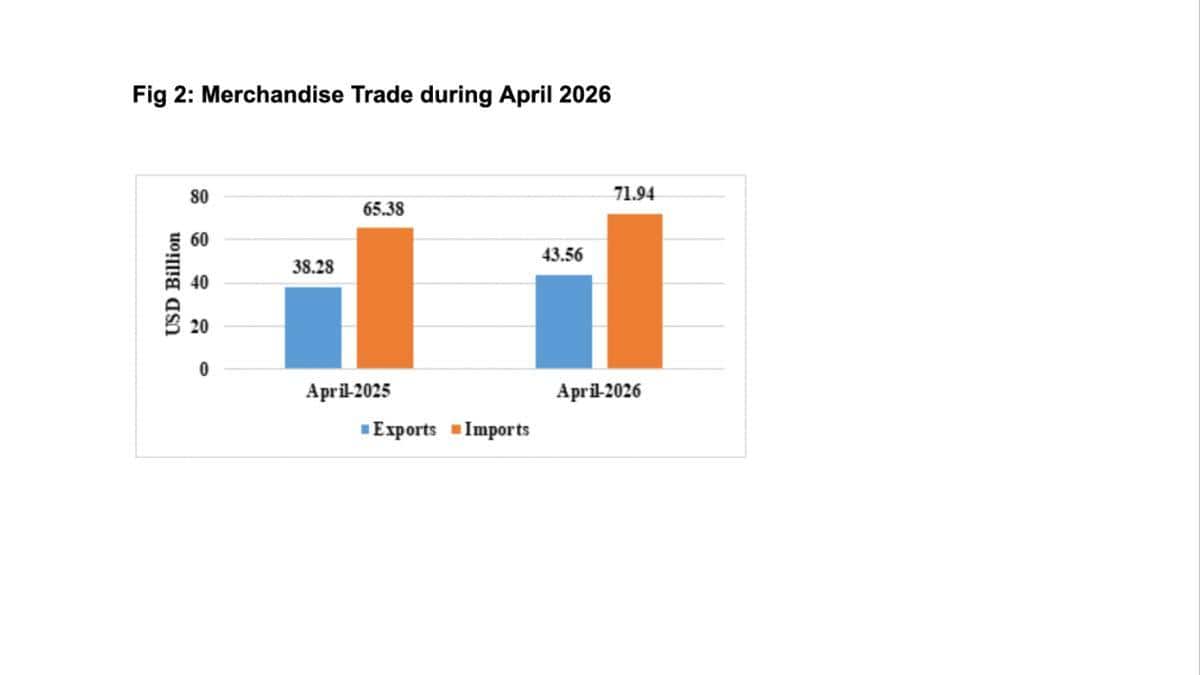
There has, ironically, been a continued and positive show of strength by India’s exports in FY2025-26 and in April 2026, with merchandise exports in April 2026 navigating turbulence at $43.56 billion, an on-year growth of 13.78 per cent over $38.28 billion during April 2025.
Total exports (merchandise and services) at $80.80 billion, as compared to $71.13 billion during April 2025, were up 13.59 per cent in April 2026.
Data by India’s Commerce Ministry shows total goods and services trade rose 5.4 per cent to $1.84 trillion in FY2025-26, which Ajay Srivastava, Founder, Global Trade Research Initiative, sees as “underscoring the economy’s growing integration with global markets”.
More statistics from Rubix Data Sciences show India’s merchandise exports grew at a CAGR of 13 per cent between FY2022 and FY2025, with a correction in FY2026 reflecting demand normalisation.
(See Fig 2)
Exports Defy Global Shocks
Economists and industry are on the same page regarding India’s export resilience, with Aditi Nayar, Chief Economist at ICRA, noting that total merchandise exports rose to a 49-month high of $43.6 billion in April 2026 despite the challenges posed by the conflict in West Asia.
“This came from partly benefiting from higher commodity prices, with the value of oil exports rising to a 24-month high of $9.6 billion. Interestingly, both non-oil exports as well as non-oil non-gold imports grew at a surprisingly healthy pace in the month, despite a disruption in shipping timelines,” adds Nayar.
The CSEP report also comes in the backdrop of a global trade environment which, as leading economist and NITI Aayog member Arvind Virmani puts it, “continues to evolve amid shifting demand patterns, supply chain realignments, and periodic uncertainty in commodity markets, with the recent oil crisis exerting broad spillover effects on inflation, trade costs and external balances”.
Indeed, these developments provide a starkly different context from India’s decade leading up to 2022, as well as the country’s efforts to redefine its trade and export strategy while adapting to successive external shocks in the post-2022 period.
India’s inherent strengths as a diversified export base, strong services competitiveness and calibrated policy responses over the years can be seen to have collectively positioned it well to sustain growth and leverage emerging opportunities amidst a fractious global trade landscape.
President of the Federation of Indian Export Organisations (FIEO), SC Ralhan, also remains firmly supportive of the underlying strength and adaptability of Indian exporters amid geopolitical tensions, supply chain disruptions and rising logistics costs, as visible even in April 2025.
Sectoral Winners and Rising Export Drivers
Among the major drivers of merchandise export growth in April 2026:
- Petroleum product exports increased by 34.66 per cent on-year from April 2025 to $9.59 billion
- Electronic goods exports increased by 40.31 per cent on-year to $5.18 billion
- Engineering goods exports increased by 8.76 per cent on-year to $10.35 billion
- Meat, dairy and poultry product exports increased by 48.03 per cent on-year to $0.55 billion
- Drugs and pharmaceutical exports increased by 7.12 per cent on-year to $2.66 billion
Also Read : Good News For Employees: PF Withdrawals Via Paytm, GPay May Soon Become Reality Under EPFO’s New System
Rising Stars and Missed Opportunities
A deep dive by CSEP into India’s export performance and trends reveals that, notwithstanding the robustness in services and some segments of the goods market, the export trajectory has been marked by a slowdown in merchandise exports over the last decade.
This underlines the biggest challenge coming not from any single tariff, market or sector, but from the cumulative effect of a policy environment that has gradually made exporting more difficult and kept India’s overall merchandise exports well below potential.
The CSEP paper estimates an underperformance of about $516 billion in goods exports in 2022 relative to fundamentals.
(See Fig 3 & 4)
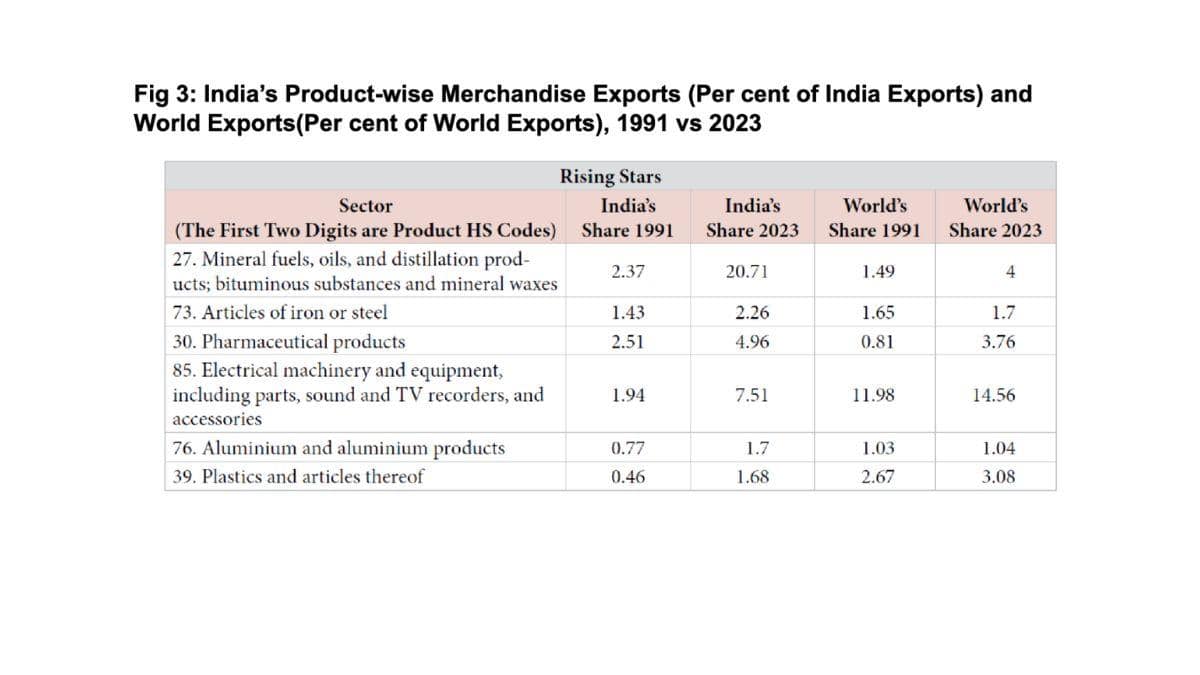
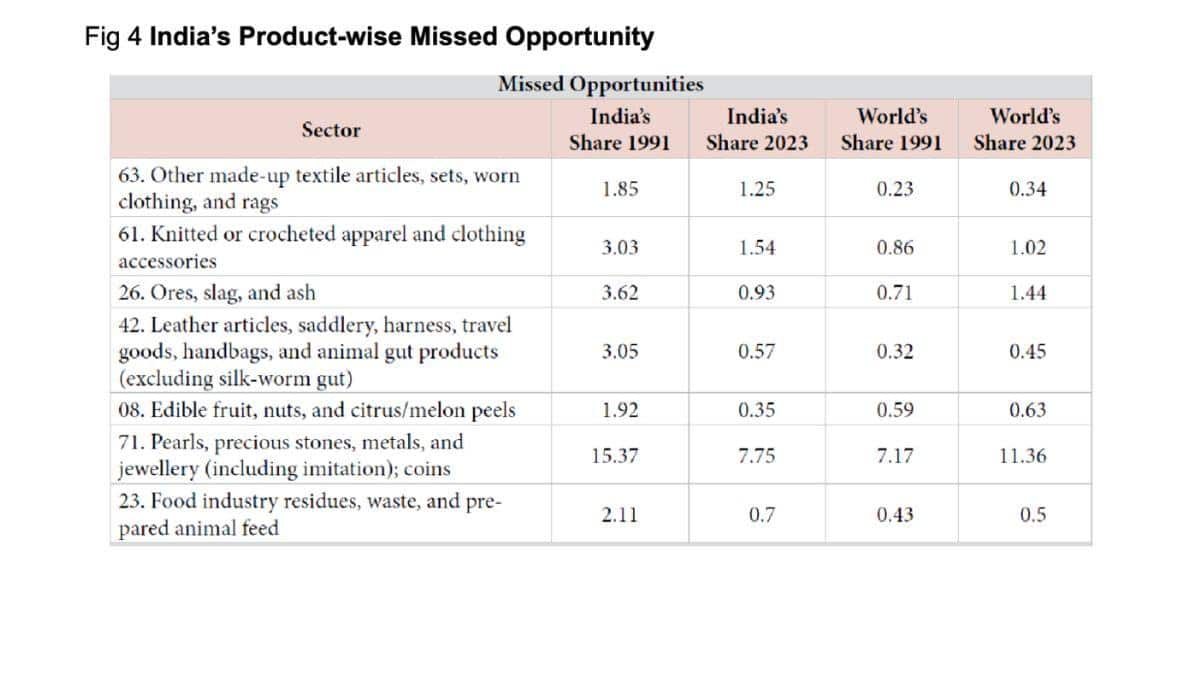
A mixed and worrying trend spilling into the present is the outperformance of certain sectors versus laggards.
In the wake of the 1991 liberalisation, India’s deeper engagement with the global economy led to its share of global exports of goods and services rising manifold from 0.79 per cent in 2001 to 2.56 per cent in 2024, driven by a more than doubling of the export-to-GDP ratio.
However, sectorally, the CSEP report highlights “rising stars” such as pharmaceuticals, mineral fuels, organic chemicals, iron and steel products, and electrical machinery, which have steered India’s increased share in expanding global markets.
At the same time, there have been stark “missed opportunities” in gems and jewellery, knitted garments and leather.
Here, strong global demand contrasts with India’s shrinking presence, pointing to eroding competitiveness, heightened risks of falling behind in rapidly evolving global value chains and a significant loss of potential employment.
Meanwhile, traditional export sectors such as non-knit apparel, footwear, cotton, tea and coffee, spices and raw hides fall into the “Retreats” category, reflecting declining market share.
Given their labour absorption potential, these sectors cannot be entirely disregarded.
(See Fig 5)

Also Read: Bakrid 2026 Holiday: May 27 Or May 28? Which Day Are Banks And Schools Closed In India?
Gems and Jewellery: A Major Missed Chance
The gems and jewellery sector presents a major missed opportunity, with a global market size of $378.1 billion excluding raw gold in 2024, while India’s exports were valued at $29.5 billion, translating to a share of 7.8 per cent.
“Precious metal jewellery and diamonds together account for 54.8 per cent of global demand ($207.3 billion), with India grabbing $26.7 billion of exports, a strong 13 per cent share.
“In contrast, across the remaining products representing 46.8 per cent of demand and valued at $170.8 billion, India’s exports stand at a mere $2.8 billion, translating to a much lower 2 per cent share, highlighting export concentration,” points out Pravakar Sahoo, Programme Director at NITI Aayog.
Sahoo agrees that while India’s gems and jewellery sector shows increasing export diversification, with reduced dominance of diamonds and a rising share of jewellery, import dependence remains concentrated, particularly on gold.
“Overall, the sector needs further reorientation to better align with evolving global demand and strengthen competitiveness,” says Sahoo.
MFN Tariffs, QCOs and GVC Distress
Drawing attention to a deeper problem of India’s shift towards greater protection over the last decade through higher most favoured nation (MFN) tariffs through 2022, alongside a proliferation of other safeguards such as quality control orders (QCOs), the authors of the paper observe that by 2022, the simple average MFN applied tariff had moved up to 18 per cent.
By 2019, tariffs on more than one-third of tariff lines exceeded 15 per cent.
Although mean tariffs were reduced after 2022, falling to 16.2 per cent in 2024, they remain higher than in 2010 and significantly above those of major competitors such as China and Vietnam.
Over the last six years, about 4,000 tariff lines, roughly one-third of the schedule, saw an upward calibration of basic customs duty, the statutory goods import duty charged at the border.
Since 2019, an expanding quality control regime has imposed high testing and certification costs that may push many MSME importers out of business, leaving the market increasingly dominated by large importers, informs Srivastava.
“If a product falls under QCO regulations, the foreign manufacturer supplying it to India must obtain BIS certification after testing by a BIS-authorised laboratory.
“Routine mechanical testing of basic nuts and bolts at Rs 57,000 per sample shows India’s QCO regime is becoming a costly trade barrier. Without reform, India’s QCO framework risks becoming a protectionist compliance barrier benefiting only deep-pocketed firms,” he adds.
Also Read : Retirement Planning: How SWPs Create A Monthly Income From Mutual Funds
India’s Weak GVC Integration Problem
Moreover, tariffs and QCOs have effectively taxed exports and coincided with weaker participation in global value chains (GVCs), hurting India’s quest to integrate better with them.
India’s backward integration in GVCs, measured as foreign value added in exports, peaked around 2012 before declining to about 17 per cent by 2020.
This has left India behind peers and competitors such as Vietnam and Thailand, where long-standing, state-driven, export-oriented policies anchored East Asian firms deeply within component trade networks.
The absence of such policy direction in India, and the resulting slowdown in GVC integration, has coincided with weaker goods export growth and a gradual loss of market share in mid-technology, thin-margin sectors, reducing competitiveness in scale-dependent manufacturing.
India’s Bet on New Markets and Neighbours
Since 1991, India has considerably strengthened its penetration in regions where it previously had limited presence, such as Latin America and the Caribbean, the Middle East and North Africa, Sub-Saharan Africa, East Asia and the Pacific, as well as Europe, Central Asia and North America.
However, as the CSEP report suggests, these regions have become relatively less central in world import demand.
While there are cases of actual shipments far exceeding expected levels, such as exports to the Netherlands, Nepal, Sri Lanka and several African partners, overperformance remains modest compared with India’s underperformance across different export corridors.
(See Fig 6)
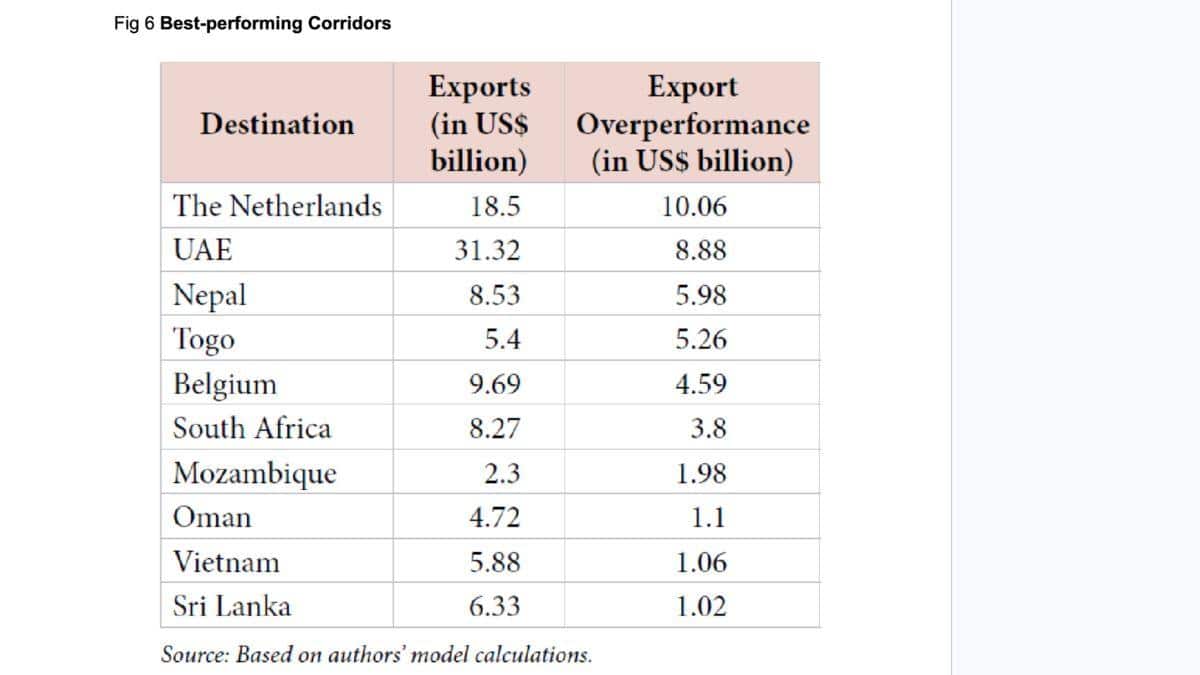
The biggest opportunities lie in the geographical corridors where India is performing poorly.
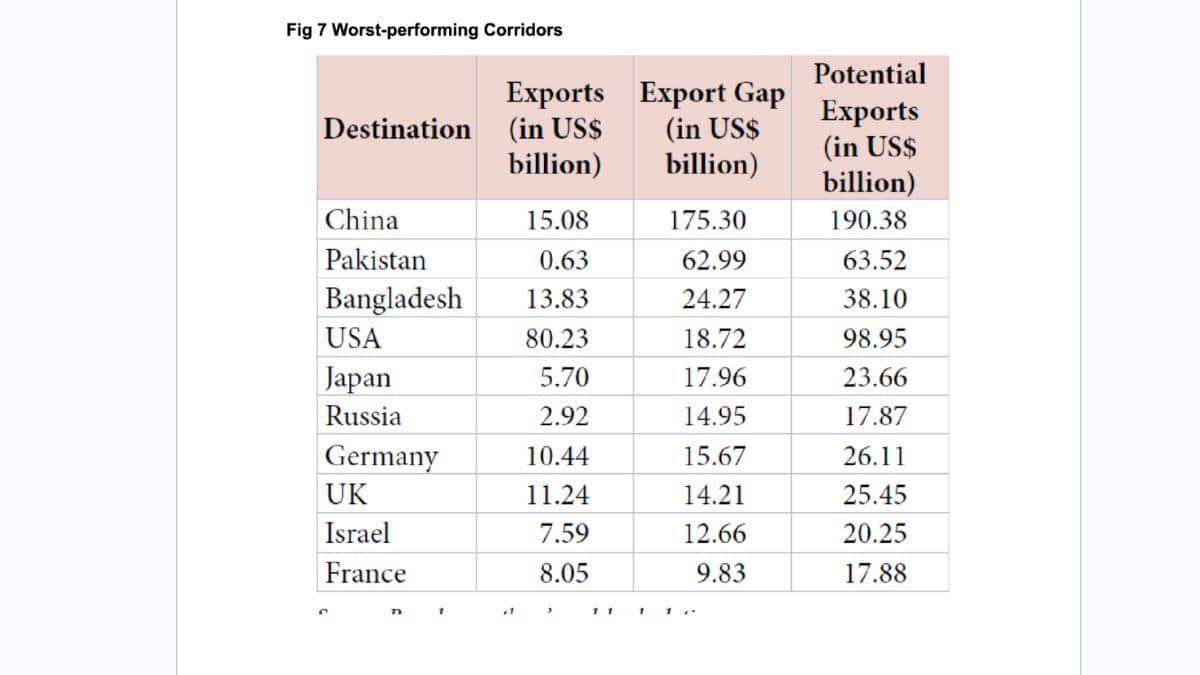
The largest gaps between actual and potential exports lie in India’s neighbourhood, especially in China, Pakistan and Bangladesh. Together, these three countries account for roughly half of the export gap.
For Baran, Kathuria and Srinivasan, the opportunity is not merely geographic.
While India has diversified its export base, expanded into new regions and demonstrated competitiveness in several dynamic sectors, the real breakthrough would come from enabling labour-intensive goods to realise their export potential through a coherent policy framework that rationalises tariffs and standards, ensures reliable access to imported inputs, advances high-ambition free trade agreements and maintains a more export-conducive macroeconomic environment.
(See Fig 7)
FTA Rush and the Search for a Course Correction
One area where CSEP’s mantra of policy proactiveness meets contemporary urgency is in India’s aggressive push for free trade agreements.
New Delhi has been signing and deepening a flurry of trade deals from New Zealand to the European Union as a “more palatable path to faster liberalisation than unilateral measures”, while also allowing India to shrug off allegations of protectionism.
“The bigger climb begins now, making it work on the ground for every exporter, every investor and every job creator across India and Europe,” says Darpan Jain, Additional Secretary at the Department of Commerce and Industry, who serves as India’s lead negotiator for both the India-US and India-EU free trade agreements.
Jain had earlier outlined the commercial architecture of the pact announced in January 2026.
As part of a course correction in policy and trade deals aimed at lifting labour-intensive sectors, some 99.5 per cent of Indian exports will receive preferential tariff treatment, according to Jain.
“$33 billion worth of labour-intensive goods, apparel, textiles, leather, footwear and gems and jewellery, currently facing high EU duties of 10-14 per cent and going up to 26 per cent in some categories will benefit from full elimination.
“The combined imports of India and the EU represent roughly one-third of global trade in goods and services,” says Jain.
Also Read: Gold Silver Rate Today (May 26): Prices Fall, Check Latest Rates In Delhi, Mumbai, Chennai, More
Trade Deficit Concerns Continue
The gap between current trade flows and potential remains a recurring concern.
At a time when India is accelerating FTA negotiations to diversify exports and soften the impact of US tariffs, NITI Aayog has warned that India’s trade deficit with its FTA partner countries is rising sharply, even as sunrise industries such as electronics strengthen their global foothold.
According to NITI Aayog’s ‘Trade Watch Quarterly’ report, India’s trade deficit with FTA partners rose 59.2 per cent between April and June last year compared with the previous year, as imports jumped by 10 per cent to $65.3 billion and exports declined by 9 per cent to $38.7 billion.
Take the India-EU FTA.
The EU imports $263 billion in textiles annually and India supplies only $7.2 billion of that total.
In gems and jewellery, Indian exports of $2.7 billion compare with EU imports of $80 billion.
“With preferential access now secured, the agreement creates conditions for a structural uplift in India’s share of European consumer markets,” Jain argues.
The Big Export Question for India
With the centre of gravity of global trade shifting towards developing economies alongside strengthening regional linkages, India is increasingly positioning itself within these emerging networks while maintaining strong engagement with advanced markets.
The larger challenge, however, lies in shedding its hesitant approach to trade, dismantling self-imposed policy constraints and integrating more robustly into the global economy.


