
Photo/Agencies
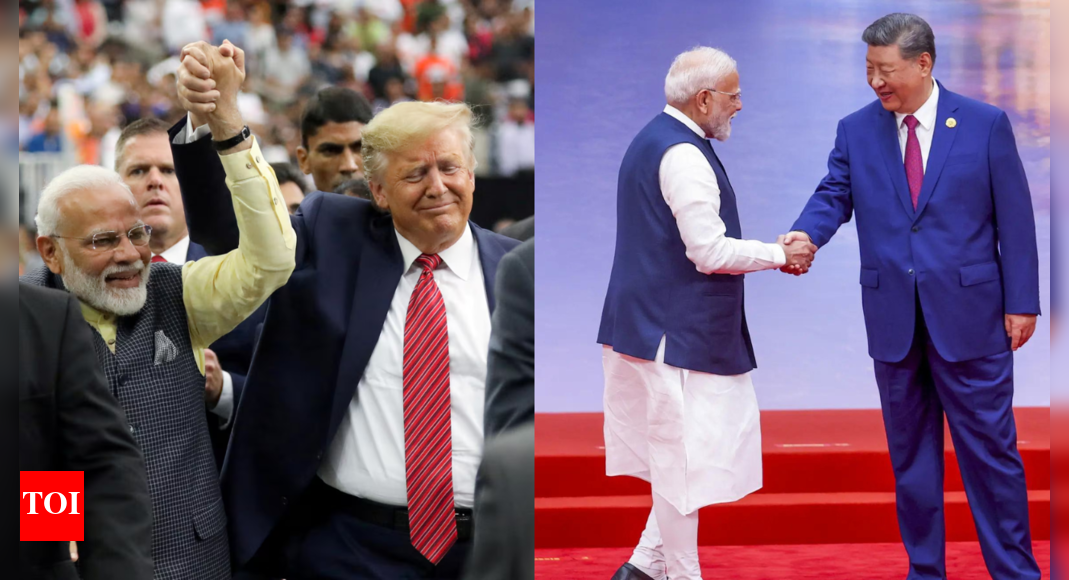
NEW DELHI: When Prime Minister Narendra Modi stood beside Donald Trump at Houston’s Howdy Modi event in 2019, it was more than just a diaspora spectacle. It was the visible embodiment of a strategic bet — that personal chemistry between leaders could fast-track an alignment between the world’s largest democracy and its oldest.That narrative survived Trump’s turbulent first term and carried into his second, when PM Modi returned to Washington on 13 February 2025 for an official working visit that produced warm optics and a joint statement.But from there on, relations between the White House and Lok Kalyan Marg followed a deteriorating trajectory. The so-called “ceasefire” episode during Operation Sindoor, followed by Trump’s boastful claims of brokering a ceasefire in South Asia, dented trust. The rupture deepened with Washington’s tariff barrage on Indian exports and energy imports. What began as a handshake friendship risked descending into a transactional cold shoulder.By late summer 2025, Delhi and Washington were left to manage what diplomats called “the sinking boat of trade.” The tariff chapter is expected to hit Indian businesses hard, and Donald Trump’s demands for visible loyalty irritated policymakers in New Delhi. However, after the RIC (Russia–India–China) display at Tianjin during the SCO summit on 1 September 2025, there were signs that Trump’s tariff tantrums were moderating — a signal that both capitals may still be looking for a revival, even as Delhi hedges with Moscow and Beijing.
June phone call that changed the tone: Report
The first major rupture came on 17 June 2025, in a phone call between PM Modi and Trump. According to a report by The New York Times, Trump repeatedly claimed credit for de-escalating a flare-up between India and Pakistan — a claim PM Modi did not endorse. Trump allegedly asked PM Modi to “acknowledge” his role publicly and even floated the idea of support for a Nobel Peace Prize. PM Modi’s refusal hardened Trump’s mood.The phone call was never officially confirmed in detail, but Indian officials hinted that “unnecessary self-congratulation” had strained the dialogue. For analysts, it marked the point where the personal rapport between the two leaders began to fray.
Operation Sindoor and the ceasefire claim
The backdrop to that phone call was Operation Sindoor, India’s limited but high-visibility military action along the western frontier in early June 2025. New Delhi framed the operation as a targeted counter-terror response, but Trump publicly suggested the US had pressured both India and Pakistan into restraint — an assertion dismissed in Delhi as exaggerated.Trump’s claim of having “secured a ceasefire” created domestic political unease for PM Modi. Critics accused him of allowing India’s sovereignty to be undermined by Washington’s narrative. While Indian officials tried to downplay the rhetoric, the perception that Trump was using South Asia for self-promotion lingered.Dr Ashok Sharma, Visiting Fellow at the University of New South Wales Canberra at the Australian Defence Force Academy, speaking to Times of India, noted that “Donald Trump, in his first term, was not as blunt in his dealings with India, but in his current tenure he appears far more unpredictable and has moved away from the traditional Republican stance on New Delhi. Some experts even describe this shift as a ‘reverse Nixon’ move against India.”
Tariff tantrums: From trade tariffs to a 50% wall
What followed was harsher and measurable: tariffs. On 27 August 2025, Washington slapped Indian goods with up to 50% tariffs, citing unfair trade practices and New Delhi’s refusal to scale back Russian oil imports. The move stunned Indian exporters and undercut years of lobbying by US businesses who had invested in India as a “China Plus One” base.Indian officials called the decision “unjustified,” pointing out that India’s trade surplus with the US was far smaller than China’s and that Indian companies were still major buyers of American goods. More sensitive still was Washington’s explicit linking of tariffs to India’s Russian crude purchases. New Delhi defended its buying spree as an energy security necessity.The tariffs threatened a chilling effect: Industries ranging from textiles and pharmaceuticals to steel and IT services saw immediate cost spikes. Analysts warned that the penalties risked unravelling one of the few bipartisan achievements in US foreign policy — strengthening ties with India to balance China.As Sharma explained, “Trump’s bluntness stems from India’s recent resistance to Washington’s attempts to dictate terms, seen in the Operation Sindoor episode and the ongoing tariff disputes. His aggressive posture has now expanded into a broader offensive against Brics nations, signalling a recalibration of US foreign policy priorities.”
Tianjin optics: Putin’s limousine and Xi’s warm handshake
The SCO summit in Tianjin on September 1 provided the clearest demonstration of how Delhi was recalibrating. PM Modi held bilateral meetings with both Vladimir Putin and Xi Jinping, emphasising long-term ties and regional cooperation. The images that dominated television screens back home in India were not of a wary handshake with Xi, but of PM Modi riding with Putin in his Aurus limousine after the summit — a gesture of camaraderie choreographed for the cameras.Indian officials framed the meetings as pragmatic diplomacy. But the symbolism was unavoidable; after weeks of bruising tariffs from Washington, New Delhi was visibly embracing Moscow and engaging China in a multilateral setting.
Oil at the centre of geopolitics
Energy has been the unspoken driver of this shift. Since 2022, when sanctions pushed Russian crude out of Western markets, India and China have emerged as Moscow’s top buyers. By mid-2025, discounted Russian oil accounted for nearly 40% of India’s crude imports. That cushion allowed Delhi to contain domestic inflation and keep refineries humming.For Washington, those purchases looked like undermining sanctions. For Delhi, they were a non-negotiable necessity. “We will buy where our people’s needs are met,” India’s petroleum minister told reporters in August 2025. The clash of perspectives turned energy into a wedge — one that Russia and China exploited to court India more closely.
The China Plus One dilemma
For global business, the fallout has been stark. The “China Plus One” strategy — moving some production away from China into other markets like India, Vietnam or Mexico took a hit as US tariffs made Indian exports less competitive. Companies that had invested in India expecting favourable access to the US market suddenly faced higher costs and uncertainty.Some Indian economists warned that the tariff shock could slow manufacturing growth just as India was positioning itself as a global alternative to Chinese supply chains. “If the US is unpredictable on tariffs, investors will think twice,” said one Mumbai-based economist.Sharma underlined that “foreign policy always depends on reliability as much as interests, and by tightening trade while demanding alignment, Washington exposed its unpredictability. For Indian policymakers, the message was clear: overreliance on the US carried risks. By alienating India, Washington achieved the opposite of its aim, nudging New Delhi and Beijing toward dialogue.”
Hedging, not aligning
Despite the warmth in Tianjin, India’s strategy is not a wholesale pivot to Russia and China. Security tensions with Beijing remain unresolved after the 2020 Galwan clashes, and mistrust along the Line of Actual Control lingers. Defence cooperation with the US from intelligence sharing to the Quad partnership continues in parallel.What has changed is India’s willingness to publicly hedge. In September 2025, that hedge was displayed in three acts: Trump’s June 17 call; Washington’s 27 August tariffs; and PM Modi’s 1 September SCO appearances. Together they showed how quickly personal frictions and trade measures can spill into the strategic domain.
A sinking boat or a reset ahead?
The story of PM Modi and Trump in 2025 is not just about two personalities falling out. It is a case study in how transactionalism can undermine strategic trust. What began as the much-touted “bromance” of Houston now looks like a fragile arrangement tested by ego, tariffs and oil.Whether Delhi and Washington can patch the “sinking boat of trade” remains to be seen. With signs that Trump’s tariff fury is easing after Tianjin, there may be space for a reset. But the episode has left its mark; India is more willing than before to be seen with Moscow and Beijing, and Washington has learned that economic coercion can backfire in Asia’s most important swing state. Go to Source