
America might be the shining city on the top of the hill, where speech is free and the soda refills are infinite, but it does have its fair share of peculiarities that are reflected in the acrimonious issues that divide the nation, like abortion, gun control, gender theory, and whether Diet Coke is better than Coke Zero. The inanity was perfectly captured in an SNL skit titled Washington’s Dream, in which America’s founding father explains that the real reason Americans needed freedom from the British was not to ensure liberty, but to implement their own measurement system and grammar. Jean-Paul Sartre once said: “Freedom is what you do with what’s been done to you,” and America, with its freedom from Britain and other colonial powers, developed its own peculiarities, one of which is the White House Correspondents’ Dinner, a night where the press and the White House ostensibly bury their differences over a few shots. Normally, those shots are jokes, like Obama’s anger translator or Reagan dialling in after an assassination attempt, but this year they came from the barrel of a deranged gunman who had managed to waltz past security.
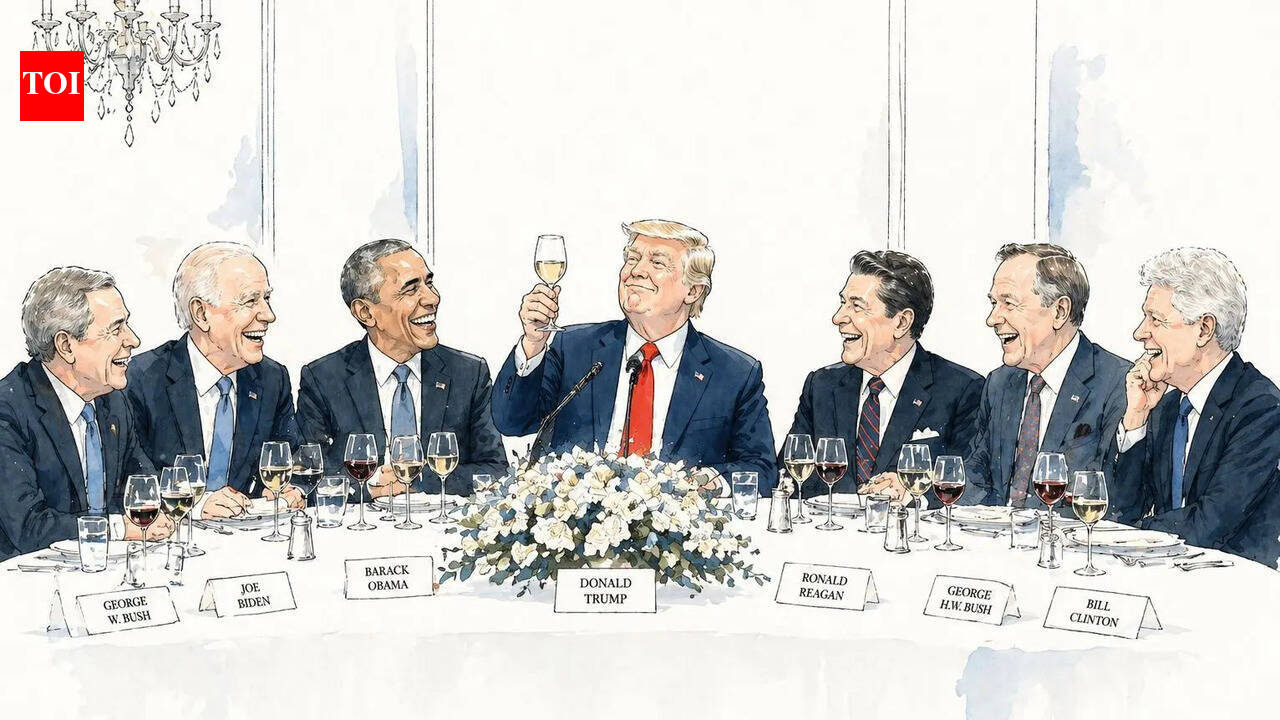
The Friendly Federal Assassin’s manifesto included apologies to everyone involved, had his list of targets, and even his postscript complaints about the poor security at the event. Of course, Trump took the third attempt on his life to be a sign of his own importance in the American pantheon (just take a look at the names), and used it to promote his new ballroom (much more secure and drone-proof), but what exactly is the White House Correspondents’ Dinner? How did it come about? Why are presidents expected to laugh at jokes made at their expense? And why, in a country that invented both the First Amendment and the AR-15 as competing forms of self-expression, does this annual dinner feel like the most American thing ever conceived? It begins, as many strange Washington rituals do, with journalists worrying about access. In 1914, White House reporters heard that President Woodrow Wilson’s administration might decide which journalists could ask the president questions. That was an unacceptable state of affairs, and the White House Correspondents’ Association was born. It was never meant to be a celebrity gala, a scholarship fundraiser, a comedy roast, or a place for cable anchors to pretend not to be thrilled while seated next to actors. It was created because reporters wanted to make sure the White House did not decide who got to question the White House, a sartorially upgraded trade union. The first dinner happened in 1921, and Calvin “Silent Cal” Coolidge became its first guest. The ritual soon grew, with presidents basking in taking potshots at those who asked questions and journalists pretending their views mattered. The early dinners were clubby and reflective of American democracy: cigars, songs, jokes, men deciding the fate of others, and women were conspicuous by their absence. That changed with Helen Thomas pressing the issue and JFK refusing to attend unless the ban on women ended. And soon it became a true American tradition. C-SPAN showed it to the world. That changed the dinner in the way a camera changes everything. A private dinner was suddenly recast as a national performance, becoming more about access and optics.
The format settled into something oddly specific. The president speaks. The comedian speaks. The room laughs, sometimes out of amusement, sometimes out of obligation, and occasionally out of the quiet recognition that the joke is not really a joke but a statement delivered with better timing. It is less a dinner and more a carefully choreographed ritual where the press and the presidency rehearse their relationship in public. That relationship has always been strange. The press is meant to question power. The president is meant to withstand that questioning. The dinner compresses that dynamic into an evening where questioning takes the form of humour and power responds with laughter. It is accountability translated into entertainment, a system that works only if everyone agrees to the translation. For a long time, they did. Ronald Reagan understood the theatre of it, even in absence, calling in after an assassination attempt and reminding the room that American politics prefers wit when it can afford it. Barack Obama refined it into something closer to performance art, nowhere more clearly than when he brought out his “anger translator”, allowing the composed public persona and the imagined private frustration to coexist on stage. It worked because it acknowledged the gap between what is said and what is meant, which is the entire business of politics anyway. Even the sharper moments followed the same internal logic. Stephen Colbert’s performance in 2006 made the room uncomfortable because it did not soften its edges, and Michelle Wolf’s set in 2018 did something similar in a different register. The reaction to both told you something about Washington’s tolerance for being laughed at. The dinner invites mockery, but only within a bandwidth it can recognise. Step outside it and the room forgets how to laugh. More recently, the ritual has continued in familiar form. A comedian like Colin Jost stands on stage, delivering jokes about presidents, about age, and about the absurdity of the entire exercise, while the room does what it has always done: laugh, wince, clap, and move on. It was truly American, like apple pie and the venal obesity it causes, and it became more so with a gunman’s presence, a true tribute to America’s obsession with bearing arms. In his first term, Trump refused to attend, which was deemed un-American. And yet, in a strange and uncomfortable way, it now feels entirely American. Because what is more American than this contradiction: a country that built the First Amendment as a shield for disagreement and the AR-15 as an instrument through which disagreement occasionally expresses itself? A dinner designed to convert hostility into humour, suddenly confronted by someone who refuses the translation and insists on speaking in the original language of violence. The White House Correspondents’ Dinner was meant to be the civilised version of conflict. The place where the president is mocked instead of attacked, where journalists ask questions instead of shouting them, where the tension between power and scrutiny is resolved, briefly, through laughter. But when someone who disagrees decides that disagreement requires a trigger rather than a punchline, the ritual does not collapse so much as reveal its limits. Perhaps that is why the evening now feels more American than it ever has. Not because of the jokes, or the presidents, or the celebrities, but because it contains, in one room, the entire spectrum of how the country expresses dissent, from satire to spectacle to something far less articulate. A dinner where the powerful are supposed to be shot at with jokes, and where, increasingly, someone seems determined to take the metaphor literally. The White House Correspondents’ Dinner is now the perfect metaphor for American democracy, celebrating the two things that are its bulwark and hallmark: free speech and assault rifles. Go to Source