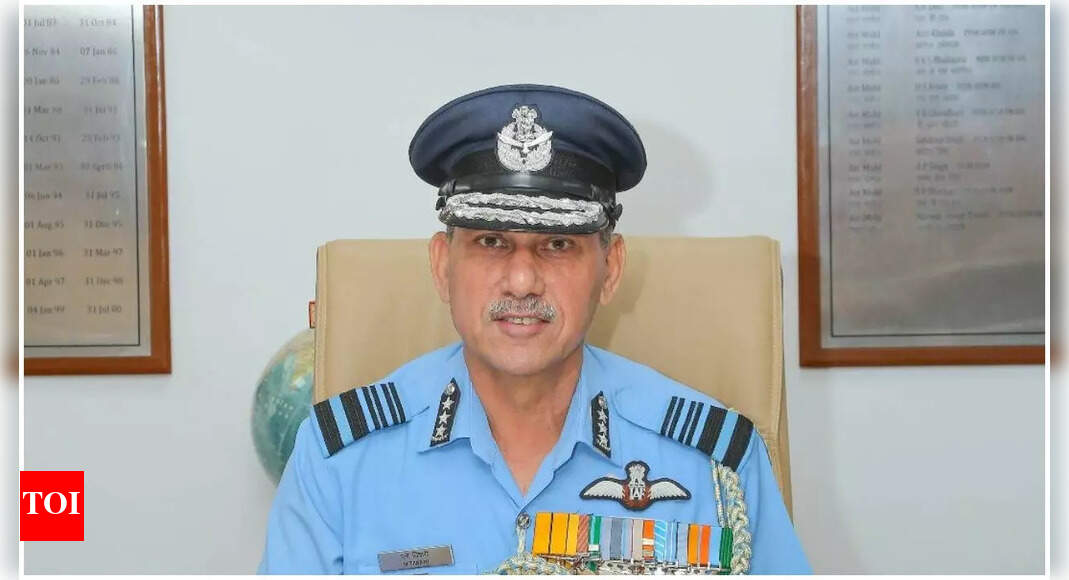

NEW DELHI: Vice Chief of the Air Staff Air Marshal Narmdeshwar Tiwari on Saturday said that fewer than 50 weapons were fired at targeted Pakistani military locations, compelling Islamabad to request the cessation of military hostilities by mid-day of May 10. Recounting the Operation Sindoor, Air Marshal Tiwari, during the NDTV Defence Summit, said that the IAF achieved “complete domination” over the Pakistan military through strikes executed following Pakistan’s attack on the night of May 9 and 10. “I must tell you that it was a key takeaway for us that in less than 50 weapons, we were able to achieve complete domination. It has not happened before,” Tiwari said.The senior IAF officer, who played a key role in Operation Sindoor, mentioned that some Pakistani targets “taken out” during the mission were not hit even during the 1971 war. “We made every weapon count and that is a tacit acknowledgement of the capability of our planners and people who executed the missions,” he added. India launched Operation Sindoor on May 7, targeting terrorist infrastructure in territories controlled by Pakistan in response to the Pahalgam terror attack. The strikes led to four days of intense clashes, culminating in an agreement to halt military actions on May 10. The Vice Chief of Air Staff further elaborated on the sequence of events related to Operation Sindoor and presented graphic details of India’s response to the April 22 Pahalgam terror attack. Air Marshal Tiwari stated that India was not inclined to escalate the situation following its strikes on Pakistani terror infrastructure on the early morning of May 7. “We expected a response and still kept it calibrated, and we engaged only military targets. But when the main attack came on the night of May 9-10, that was the time we decided that we needed to go and send the right message. We hit them pan-front,” he remarked. “There were targets which were taken out, which were not even taken out during the 1971 war. That is the kind of extent and damage to capability that we had caused to them,” he said, adding that the IAF limited its strikes to only military targets. The senior IAF officer explained that the purpose behind the strikes was to eliminate Pakistan’s capability and convey the “right message”. He acknowledged that employing long-range vectors to target enemy positions involves risks, but the IAF executed the mission flawlessly. “The precision targeting from this range is very very essential as it is very risky because the longer the vector, you feel that there are more chances of collateral damage.” “But to the credit of our planners and credit of people who executed the missions, we were able to take out each target precisely. We were able to ensure there was no collateral damage. This is not an easy game,” he added. “You may have a long-range vector, but the work that goes behind making that vector or that weapon hit a target accurately is actually an effort of the whole team, not only the pilots who fired them. There are a lot of people on the ground who make that happen,” he noted. Following the strikes on terror infrastructure, India informed Pakistan of its desire not to escalate the situation, clarifying that the strikes targeted terrorist bases. However, as Pakistan initiated a military retaliation, India responded strongly.