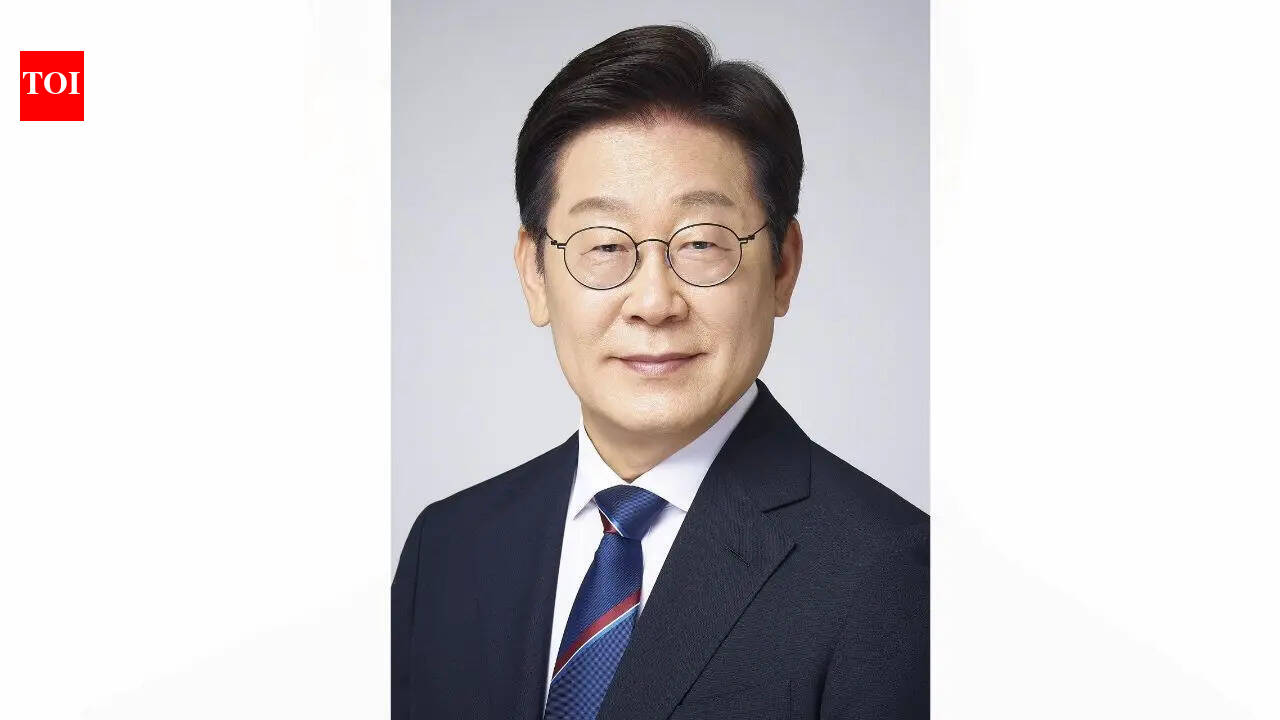

South Korean President Lee Jae Myung
As he arrived in India for a State visit, South Korean President Lee Jae Myung said Koreas and India must work closely as emerging global leaders amid heightened geopolitical uncertainty, and that the 2 countries can give a new direction to multilateralism when it’s faced with mounting challenges. In an exclusive interview to TOI, Lee said while Korea exemplified remarkable economic growth under the multilateral trading system, India stood well placed to shape new global rules with its economic scale and dynamism. On China’s dominance in critical minerals, Lee said that reducing excessive dependence on any single country had become a matter of survival, directly linked to the economic security of both India and South Korea. Speaking on the Hormuz crisis, the president said that ensuring the security of critical maritime routes is essential for the survival of both nations and Korea will work together to ensure freedom of navigation in the key energy waterway. With focus now on defence industrial collaboration, the president said Seoul will fully back India’s “independent production” of defence equipment, while exploring joint technology development and coproduction. IIn an exclusive interview to Sachin Parashar and Alpyu Singh, South Korean President Lee Jae Myung shared his vision for the special strategic partnership with India in key areas like trade, technology, critical minerals, defence and ship-building in which Seoul is a global leader. Excerpts: This is your first visit to India as president. How do you hope to further strengthen the special strategic partnership with India in the current circumstances, especially in key areas like trade, and critical and emerging technology? India – the world’s most populous country, the fourth-largest economy, and a leading voice of the Global South – is an ideal partner for the Republic of Korea. Our partnership rests not only on highly complementary economies, but also on shared core values of democracy and a market economy. At a time of heightened geopolitical uncertainty and mounting challenges to multilateralism, it is more imperative than ever that Korea and India work closely together as emerging global leaders. Building on our Special Strategic Partnership, we will deepen comprehensive ties of cooperation that drives mutual growth and innovation, while expanding our strategic horizons. A key priority is accelerating negotiations to upgrade the Comprehensive Economic Partnership Agreement (CEPA). Beyond traditional sectors such as electronics and automobiles, we will broaden cooperation into shipbuilding, finance, and the defense industry, bringing to life the vision of “Make in India, Together with Korea.” We will also step up collaboration in AI and digital technologies. Korea’s, world-class AI infrastructure and India’s vast pool of AI talent make us natural partners. Together, we will actively identify projects that generate meaningful synergy. At the same time, we will further expand cultural and people-to-people exchanges, the enduring foundation of our relationship. By bringing together India’s rich cultural assets, exemplified by Bollywood, and Korea’s globally influential K-Culture, we aim to create even greater synergy. Since my first meeting with PM Modi in Canada in June last year, I have felt a genuine warmth and familiarity, as if reconnecting with an old friend. I believe in our shared commitment to people-centered politics, holding on to hope even in times of adversity. It’s therefore especially meaningful, and a great pleasure, for me to visit India and meet PM Modi again. I am confident that this visit will mark an important milestone in further strengthening the friendship and trust between our two nations. Like India, South Korea is heavily dependent on safe passage of ships through the Strait of Hormuz for its energy needs. How can both countries work together to aid efforts to keep the key energy route open and minimise the impact of the West Asia crisis on global economy and energy security, as well as to de-risk supply chains globally? Both the Republic of Korea and India depend on the Middle East for a significant share of their energy supplies, including crude oil and natural gas. Accordingly, ensuring the security of critical maritime routes is essential to the safety of our peoples and the very survival of our nations. Korea will maintain close communication with India to ensure that all vessels can navigate the Strait of Hormuz safely and freely. We will also continue to work together in relevant international forums to uphold this shared commitment. Another task that our two countries must undertake together is diversifying energy supply chains. Amid growing uncertainties in the global economy, I am confident that forward-looking and strategic cooperation between Korea and India can substantially further our shared national interests. The strategic defence partnership has been strengthened by the co-production of K9 Vajra howitzers. How do you propose to take this partnership forward, especially in terms of technology-sharing that could boost India’s Atmanirbhar Bharat initiative? The Republic of Korea fully supports India’s Atmanirbhar Bharat initiative. It is a plan of significant industrial and economic potential, and I am confident that it will certainly be realized thanks to PM Modi’s steadfast commitment.However, self-reliance is difficult to achieve entirely on one’s own. Korea’s rapid industrial development and economic growth were made possible through considerable support and assistance from partner countries. In this regard, Korea seeks to serve as India’s key partner in advancing the Atmanirbhar Bharat initiative. In particular, the K9 Vajra howitzer project stands as an exemplary case of our bilateral defense and defense industry cooperation. The contract for the second phase of the K9 Vajra project, signed in April last year, provides for more than 60 percent of the manufacturing process to be carried out in India. It is currently being implemented smoothly, as planned. Building on such examples of cooperation, Korea will continue to provide full support for India’s independent production and operation of defense equipment. Moreover, we will discuss various avenues of cooperation in joint technology development and coproduction as well as operations and maintenance, so that both countries’ defense industry ecosystems can advance together. Both countries are exploring opportunities for cooperation in critical energy transition minerals – amid global efforts for resource diversification to avoid reliance on China – and also in areas like the maritime sector and shipbuilding in which South Korea is a global leader. Is there any roadmap that you have in mind for a more result-oriented partnership in these areas? With global supply chains undergoing reconfiguration, reducing excessive dependence on any single country has become a matter of survival, directly linked to the economic security of both nations. In particular, securing critical minerals, which are essential for cutting-edge industries, and stabilizing the maritime logistics networks for those resources will be key factors in national competitiveness going forward. India possesses critical minerals, while Korea has the capabilities to manufacture them into rechargeable batteries, electric vehicles and other advanced products. This makes our two countries ideal partners for generating synergy. By moving beyond the traditional model of importing raw material and combining Korea’s technology with India’s mining and refining industries, we can work together to establish stable critical-mineral supply chains. There is also boundless potential for bilateral cooperation in the shipping and shipbuilding sectors. For India to emerge as a global logistics and manufacturing hub, securing shipbuilding and maritime transport capabilities is essential. With world-class expertise in shipbuilding and shipping, as well as extensive experience in overseas port projects, Korea is well positioned to become India’s foremost partner. I understand that relevant MOUs are expected to be signed during the upcoming visit. I look forward to the day when vessels jointly built by our two countries sail across the world’s oceans. Now that there are question marks about the US commitment to the Indo-Pacific under President Trump – and with Washington’s focus shifting also to West Asia – how do you propose to work with like-minded countries to ensure a free and open Indo-Pacific? The world today faces complex and multi-layered crises. We are in a time of profound upheaval, as rising protectionism and the restructuring of global supply chains unsettle the foundation of the existing international order. The war in the Middle East has underscored the strategic reality that the Indian and Pacific Oceans form a single, interconnected maritime space – one whose stability no country can secure alone. Despite its intense dynamism and vast potential, the Indo-Pacific, has long remained more a beneficiary than a shaper of the international order, constrained by geopolitical tensions and the lack of institutional frameworks, Today, however, regional countries, including Korea, have the capacity to lead in strengthening multilateralism and advancing a rules-based order. Go to Source