

.
The weight problem in India is getting younger. More than half of those under 30 are now overweight or obese, according to a latest health report. Excess weight gained early increases the risk of metabolic diseases at a much younger age.Government surveys and hospital data across India also show a steady rise in weight, metabolic disorders and early-onset lifestyle diseases.Across cities and small towns, weight gain is becoming more common among young people, driven by changes in diet, reduced physical activity and increasingly sedentary lifestyles.Obesity among young Indians is therefore emerging as a long-term public health concern.
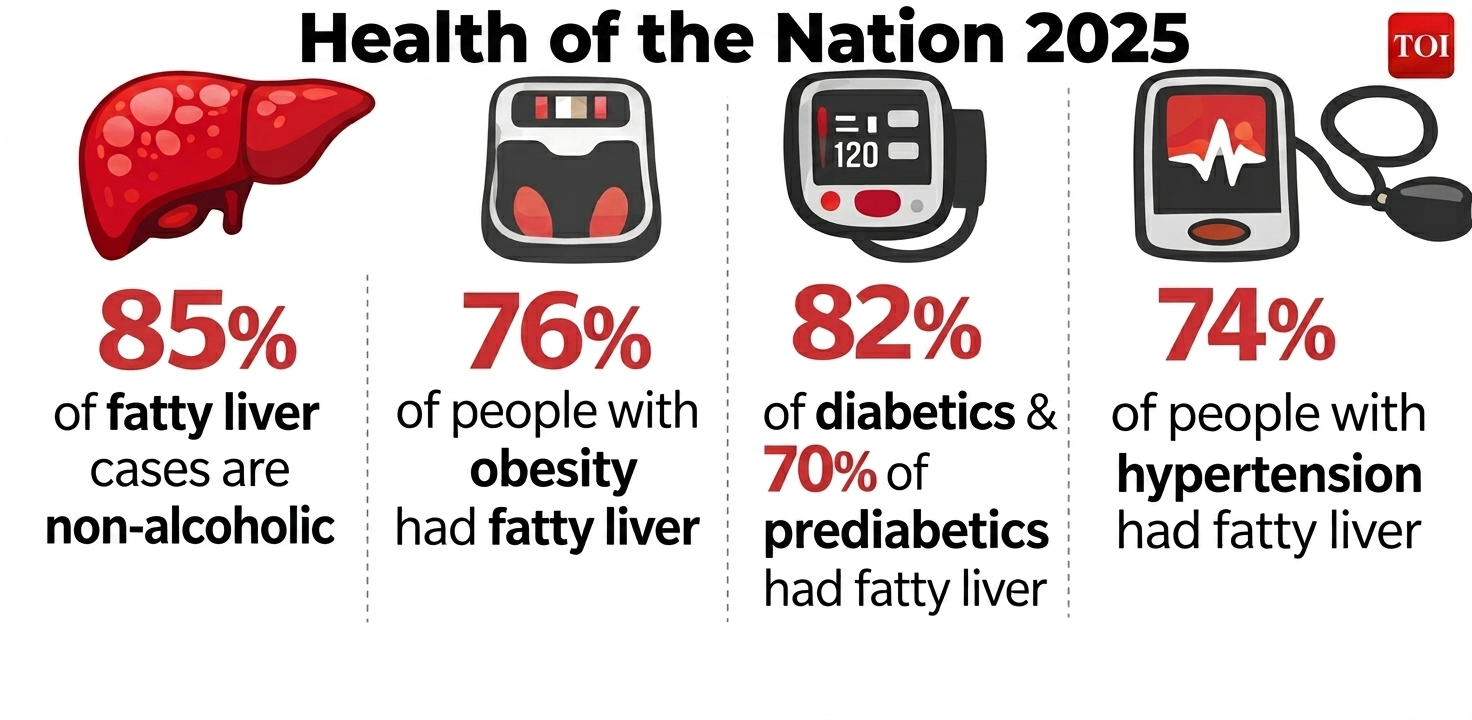
Health of the Nation 2025
The latest Health of the Nation 2025 report by Apollo has drawn attention to a shift that doctors say they have been observing for years.The report notes that more than half of Indians under 30 fall into the overweight or obese category, based on data drawn from preventive health checks.Within younger populations, it also highlights how weight increases sharply with age, especially during the transition from school to college. Among students, the proportion of those overweight rises from 8% in primary school to 28% in college.What makes this finding significant is not just the number, but the timing. Weight gain is happening earlier and accelerating faster than in previous generations.The data also links obesity with related metabolic risks, particularly fatty liver disease. A large share of those with obesity were found to have fatty liver, reinforcing the connection between excess weight and internal organ stress.Doctors say this trend is already visible in hospitals. “It’s easy for people under 30 to slide into obesity-related problems, including insulin resistance and fatty liver, all due to a sedentary lifestyle, increased screen time, poor eating habits, and consuming excessive amounts of processed foods,” said Dr Sukhvinder Singh Saggu, director – Minimal Access, GI & Bariatric Surgery at CK Birla Hospital, Delhi.According to him, many cases go unnoticed early on. “Most people develop these problems silently,” he said, noting that many patients diagnosed today would earlier have been considered low risk. “If these patients do not receive early intervention, their fatty liver or metabolic abnormalities may progress into serious health conditions, such as type 2 diabetes or cardiovascular disease,” he warned.
What govt data says
The report’s findings aren’t the only ones, but the government data also shows a similar trend. According to the National Family Health Survey, overweight and obesity levels have risen steadily across India over the past decade. The survey found that around 24% of women and 23% of men aged 15–49 are overweight or obese, up from previous rounds.What stands out is the pace of increase among younger adults, particularly in urban areas. The survey also shows that weight gain is no longer limited to affluent groups, but is spreading across income categories.Similarly, the Indian Council of Medical Research has flagged obesity as a key driver of non-communicable diseases in India, warning that rising body weight is closely linked to diabetes and cardiovascular risk.
Shrinking timeline
The concern is not just how many people are overweight, but how early it begins. Traditionally, obesity-related conditions such as diabetes or hypertension were seen in middle age. That timeline is changing now. Medical institutions, including the All India Institute of Medical Sciences, have repeatedly flagged the growing number of young patients presenting with metabolic risk factors.The reason lies in how obesity affects the body over time. Excess fat, particularly around the abdomen, interferes with insulin function, leading to insulin resistance. This is often the first step towards type 2 diabetes.At the same time, obesity contributes to higher blood pressure and abnormal cholesterol levels. When these conditions cluster together, they significantly increase the risk of heart disease.If these processes begin in a person’s twenties instead of their forties, the cumulative exposure to risk doubles and that is what makes early-onset obesity more dangerous.
.
What changed in a generation?
The rise in obesity among young Indians is closely tied to changes in lifestyle. Urbanisation has reduced everyday physical activity. Walking and manual routines have been replaced by desk-based work and screen-heavy schedules. Students and young professionals now spend long hours sitting, often with limited exercise.Diet has undergone an equally sharp shift. Traditional meal patterns are increasingly replaced by processed food, frequent snacking, and irregular eating habits. High-calorie, low-fibre diets contribute directly to weight gain.Sleep disruption adds another layer. Irregular sleep cycles affect hormones such as leptin and ghrelin, which regulate hunger. This can lead to increased calorie intake and weight gain over time.These changes are gradual, but their combined effect is dangerous. Over time, they create a sustained energy imbalance that leads to weight gain.
The silent killer
One of the most important insights from the report is the link between obesity and fatty liver disease. The report shows that a large proportion of individuals screened had fatty liver, and that most of these cases were non-alcoholic in nature.Fatty liver often develops silently. Many individuals remain asymptomatic until the condition progresses.“Fatty liver disease is generally asymptomatic during its initial stages,” Dr Saggu said. “Once diagnosed, lifestyle modifications can sometimes reverse the condition and prevent further damage to the liver.”He added that early screening plays a key role. “Liver function tests and ultrasound testing are simple ways of detecting early changes,” he said, especially for those who are overweight, physically inactive, or have a family history of metabolic disease. Over time, fatty live can lead to inflammation, liver damage, and in severe cases, cirrhosis.The growing prevalence of fatty liver among younger individuals shows that obesity is already affecting internal health, not just external appearance.Early onset, longer impactThe most serious implication of rising obesity under 30 is its long-term impact. When weight-related risk begins early, it extends the duration over which the body is exposed to metabolic stress. This increases the likelihood of complications later in life.The Indian Council of Medical Research has warned that India is already seeing a high burden of diabetes and cardiovascular disease, and that early onset will only intensify this trend.In practical terms, this could mean that a larger population requires long-term treatment, higher healthcare costs, and a younger demographic dealing with chronic illness.
Can it be reversed?
The advantage of early onset is that intervention can also begin early. Weight gain in the twenties is often more responsive to lifestyle changes than in later decades. Regular physical activity, balanced diets, and improved sleep patterns can significantly reduce risk if adopted consistently.Public health programmes are increasingly focusing on prevention rather than treatment. Government initiatives like the Fit India Movement, promoting fitness, dietary awareness, and routine screening, aim to address the issue before it progresses.
Not only can early diagnosis help reverse the condition of fatty liver disease through lifestyle modifications, but early event detection can also substantially lower the likelihood of developing a long-term health complication resulting from fatty liver disease.
Dr. Sukhvinder Singh Saggu, Director – Minimal Access, GI & Bariatric Surgery at the CK Birla Hospital®, Delhi
However, the challenge remains behavioural. Awareness alone is not enough unless it translates into sustained lifestyle change.
What next?
The rise of obesity among young Indians reflects a broader transition in the country’s health profile. India is moving from a burden of infectious diseases to one dominated by lifestyle-related conditions. What makes this transition more complex is that it is happening alongside persistent issues like undernutrition. The result is a dual burden, where different sections of the population face different health risks at the same time.The Apollo report provides a snapshot, but multiple datasets back the larger trend. Obesity is rising, starting earlier, and linking more closely with chronic disease. The idea that these are problems of middle age no longer applies. For young Indians, the shift is already underway. It is time the country’s youth begin to see weight not as a cosmetic issue, but as an early warning sign of long-term health risk. Go to Source