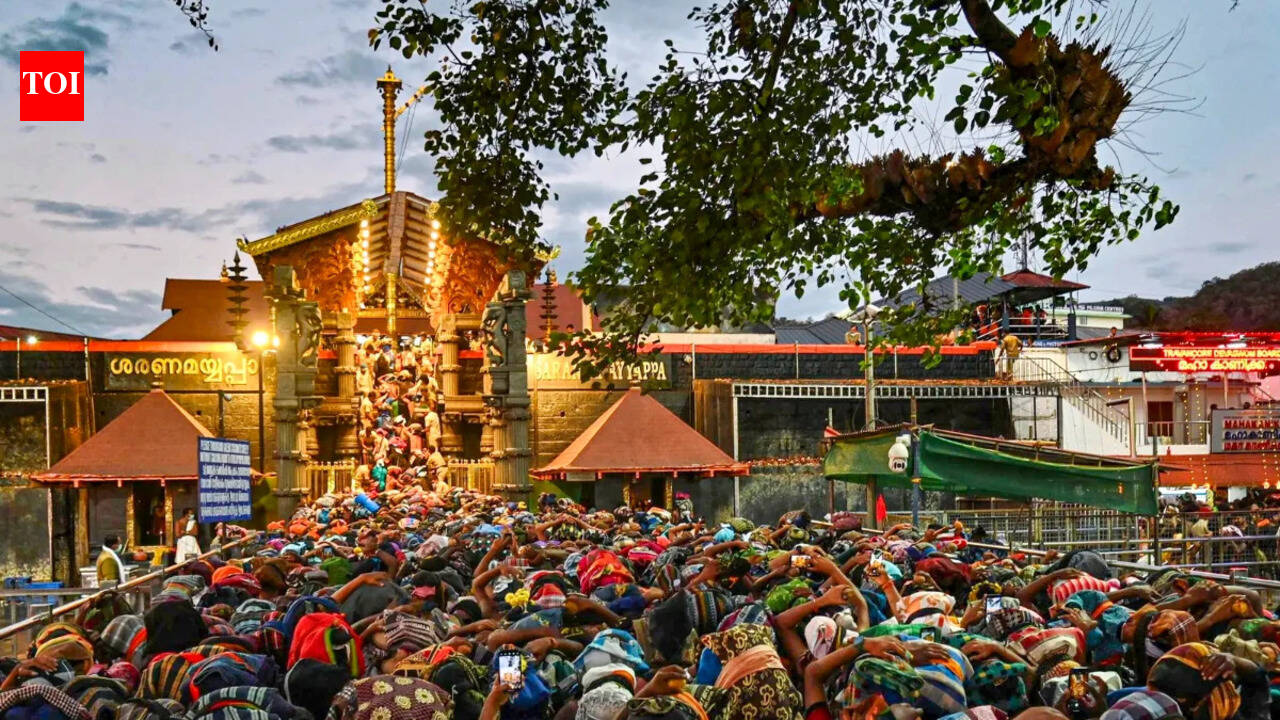

NEW DELHI: The Supreme Court on Wednesday asserted it has the authority to determine whether a religious practice amounts to superstition, setting up a sharp exchange with the Centre during hearings in the Sabarimala-linked cases.A nine-judge Constitution bench led by Chief Justice of India Surya Kant was hearing petitions on women’s entry into religious places and the broader scope of religious freedom.Appearing for the Centre, Solicitor General Tushar Mehta argued that a secular court cannot decide what constitutes superstition in religion. “Judges are experts in law, not religion,” he said, according to news agency PTI. Mehta added that such determinations should be left to the legislature under Article 25(2)(b), which allows reform of religious practices.The bench, however, pushed back. Justice Ahsanuddin Amanullah said the court cannot be reduced to merely endorsing legislative views and does have the jurisdiction to examine whether a practice is superstitious. “What follows may be for the legislature, but the court cannot be bound by it,” he observed.Mehta maintained that in a diverse country, what may be seen as superstition in one region could be a legitimate religious practice in another, cautioning against courts entering that domain. The bench also explored the limits of judicial intervention. Justice Joymalya Bagchi raised a hypothetical: if a practice like witchcraft is claimed as religious and the legislature remains silent, can courts step in under constitutional provisions relating to health, morality and public order?The Centre mentioned that judicial review is permissible on those grounds, but not solely on the basis of labelling a practice as superstition.Justice BV Nagarathna underlined that courts must assess “essential religious practices” through the lens of that faith’s own philosophy, while remaining subject to constitutional safeguards.The hearing is part of a larger reconsideration of issues arising from the 2018 verdict that allowed entry of women of all ages into the Sabarimala temple in Kerala, and the subsequent reference of related questions on religious freedom to a larger bench.