
Did you know the Camry is Toyota’s longest-running nameplate in India? Since its debut in 2002, this luxury sedan has weathered intense competition from multiple rivals and shifting market dynamics with the relentless SUV onslaught. Through it all, the Camry has quietly carved a niche of its own. Backed by Toyota’s reputation for bulletproof reliability and long-term dependability, it has created a loyal customer base, comprising buyers who value comfort and peace of mind over badge appeal.
Since the previous generation, Toyota has committed the Camry exclusively to a hybrid powertrain. With fuel economy figures that remain exceptional for its class, the Camry continues to position itself as the rational alternative to entry-level German sedans.
We take a comprehensive look at the latest iteration to assess whether this understated luxury sedan still makes a compelling case in today’s evolving market.
Toyota Camry Exterior Design and Engineering –
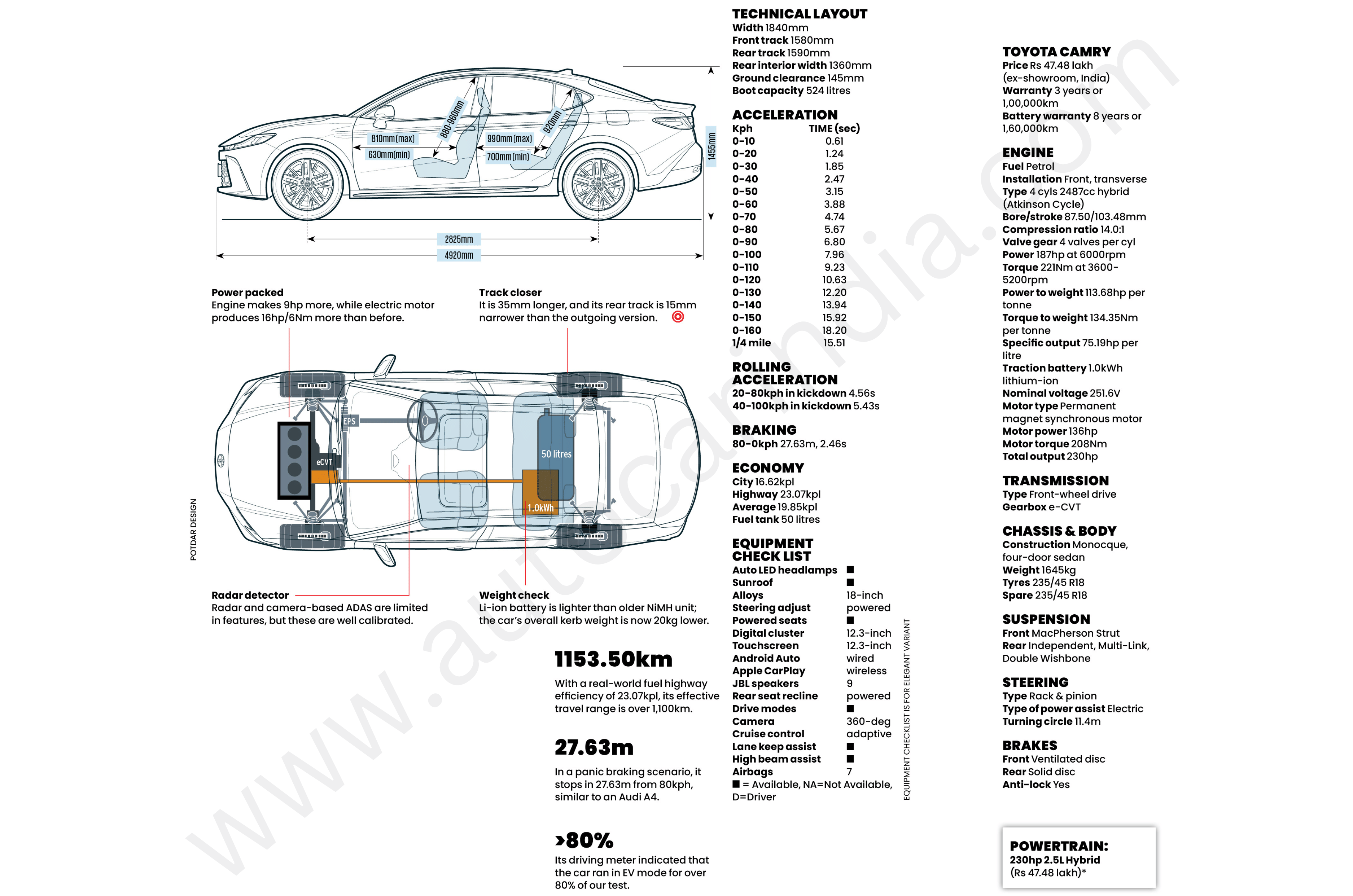
This is the ninth-generation Camry Hybrid globally, and India has seen five generations so far. Like its predecessor, the new model is underpinned by Toyota’s TNGA-K platform, albeit with meaningful revisions. The 2,825mm wheelbase is unchanged, as are overall width, height and front track. However, this version is 35mm longer, and its rear track is narrower by 15mm.
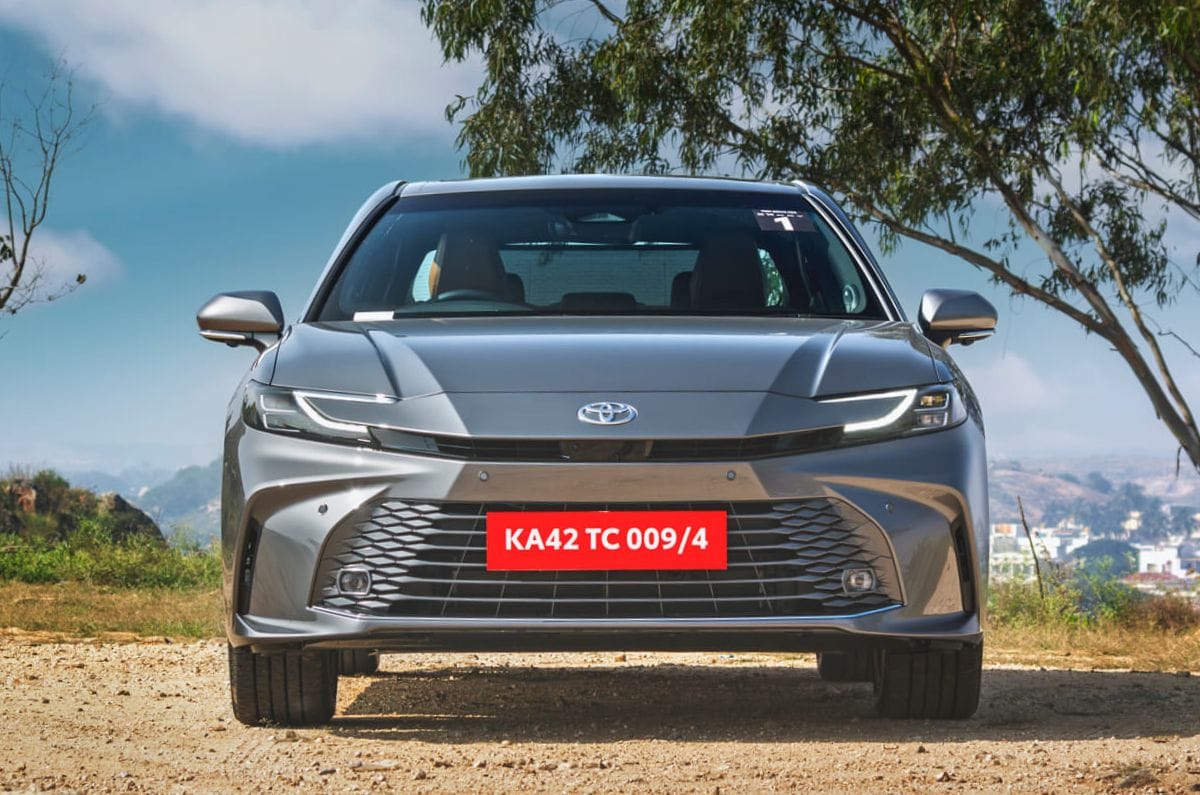
Visually, though, it is a clean-sheet redesign. The new ‘Hammerhead’ front-end design gives the Camry a sharper, more assertive nose, accentuated by slim LED headlamps and distinctive daytime running lamps. The bonnet now features more pronounced creases and flows more decisively into the grille area. The Toyota badge, no longer ringed in blue as before, sits proudly on the nose. The angular lower air dam and its intricate mesh pattern lend a subtle Lexus-like premium flair.
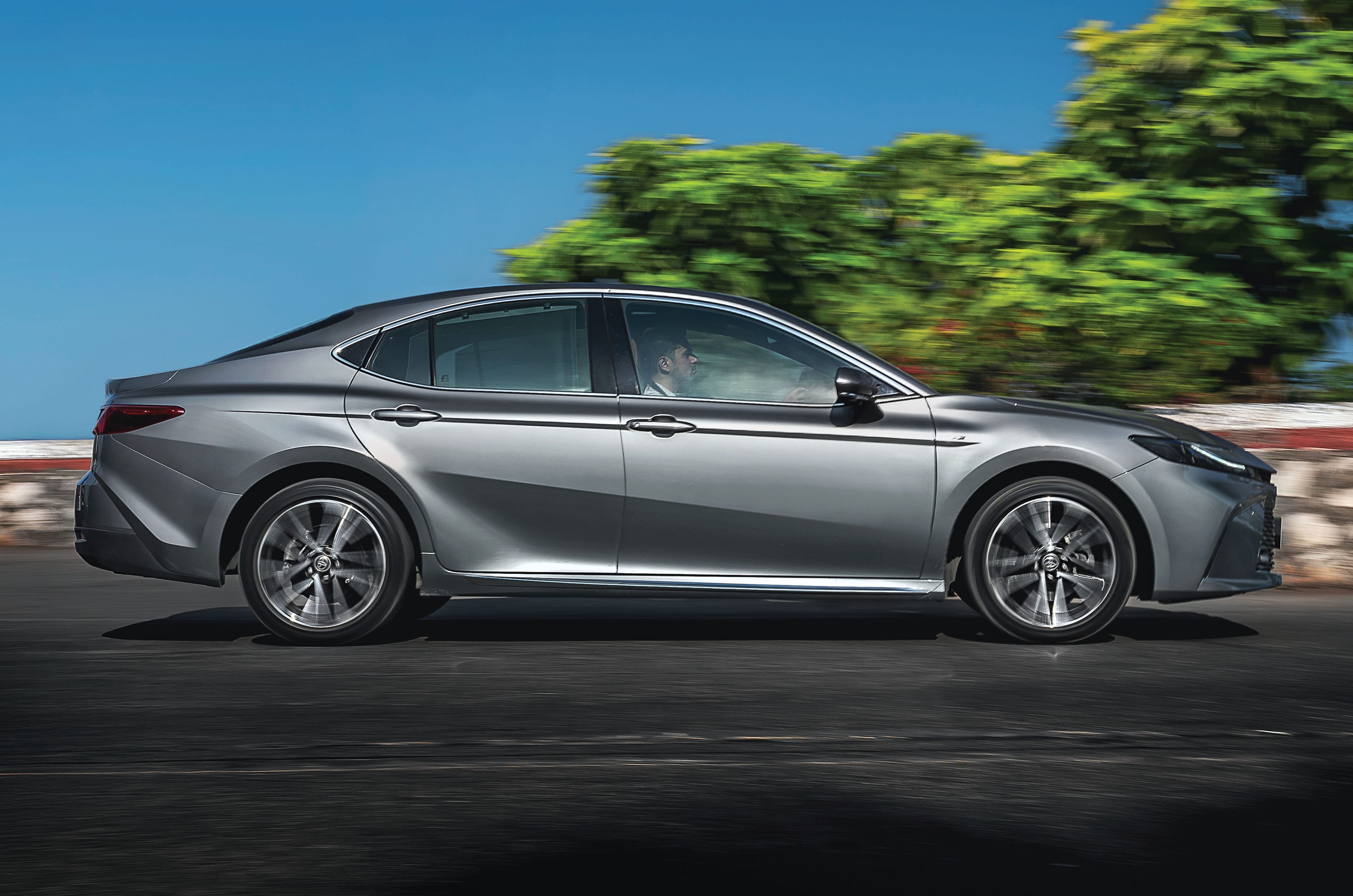
A strong shoulder line now runs cleanly from the bonnet to the bootlid, enhancing visual length. The 18-inch machine-finished alloy wheels add stance, while the rear is characterised by crisp, C-shaped LED tail-lamps. The overall aesthetic remains mature and restrained, but it is undeniably more contemporary and more appealing than the outgoing model.
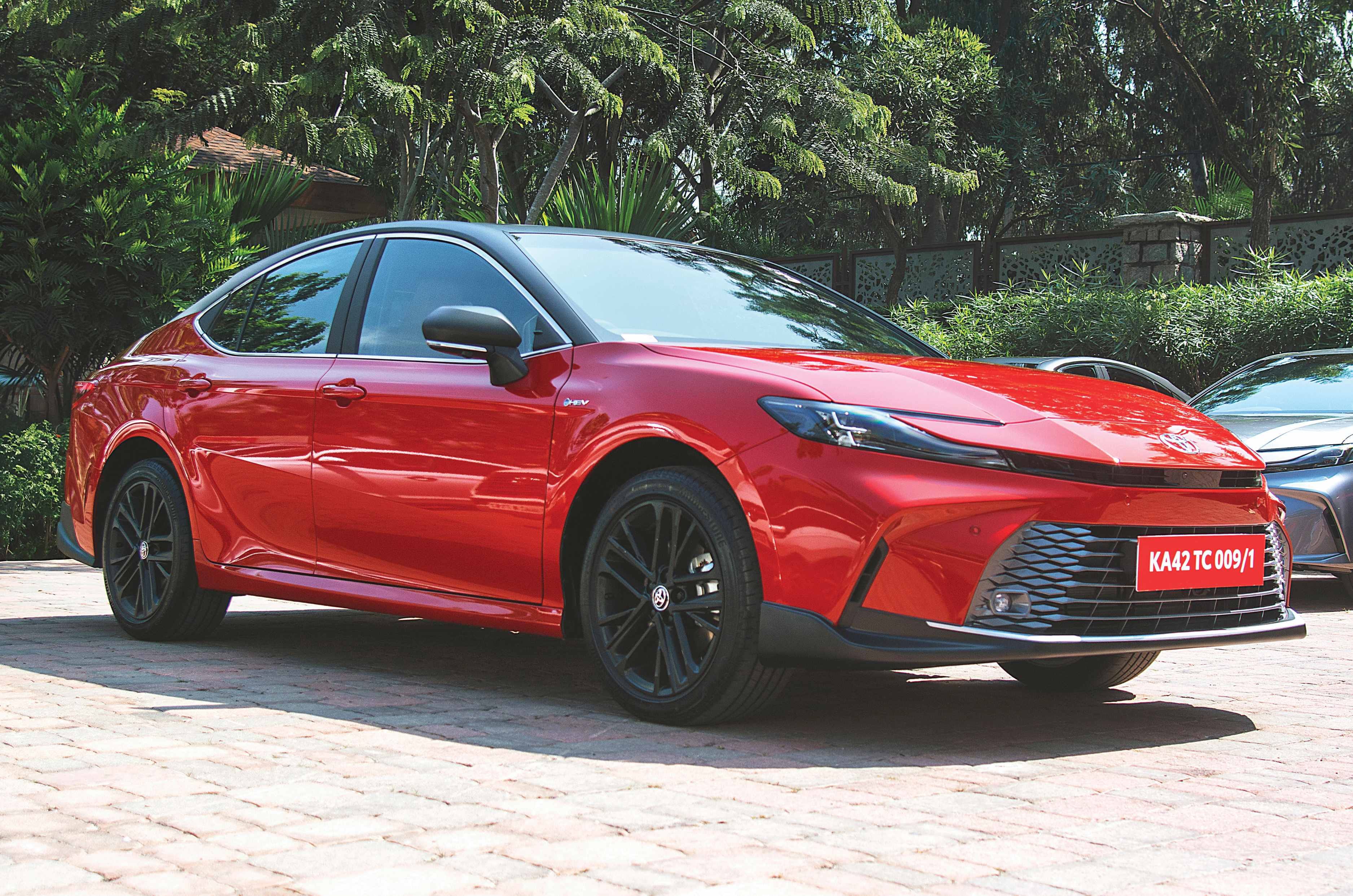
To cater to a younger set of customers, Toyota has also introduced a ‘Sprint Edition’, which features a dual-tone paint shade, a body kit, a boot spoiler and matte black alloys. These enhancements lend this business-like sedan a sportier persona.
Toyota Camry Interior Space and Comfort –
Elegant interiors with superb ergonomics and comfort.
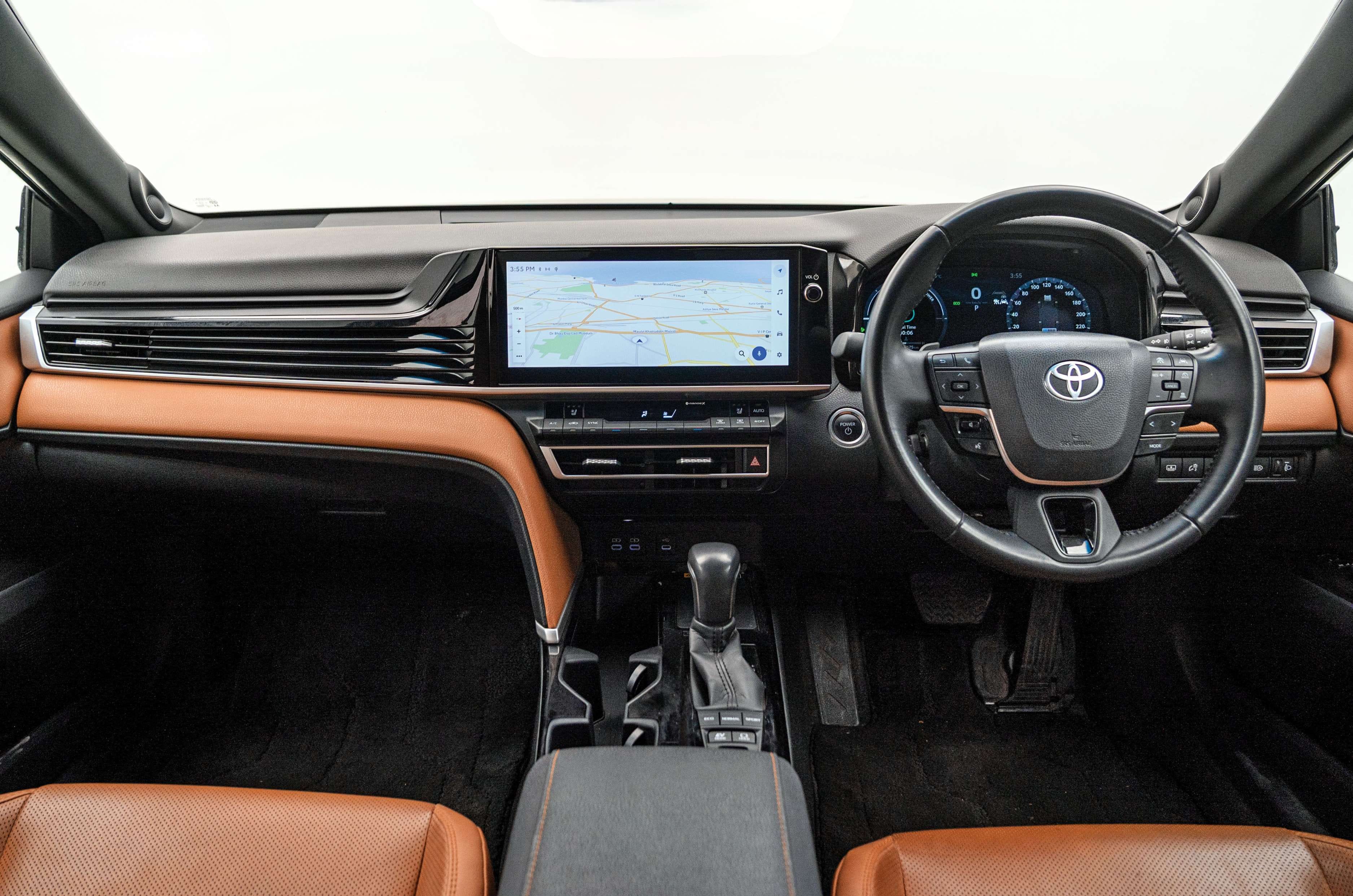
Inside, the Camry has taken a decisive step towards understated elegance. The dramatic Y-shaped centre console of the previous model makes way for a cleaner, more conventional layout. Dominating the dashboard is a 12.3-inch, horizontally oriented touchscreen. Crucially, Toyota has retained physical buttons for climate control, drive modes and key functions, along with a proper volume knob – a pragmatic decision that enhances usability.
The new tan-and-black colour scheme adds warmth without appearing flamboyant, and being darker than the earlier beige theme, it should prove easier to maintain. The redesigned steering wheel and slatted dashboard look fresh, though the piano black trim – while visually premium – will inevitably attract dust and fingerprints.
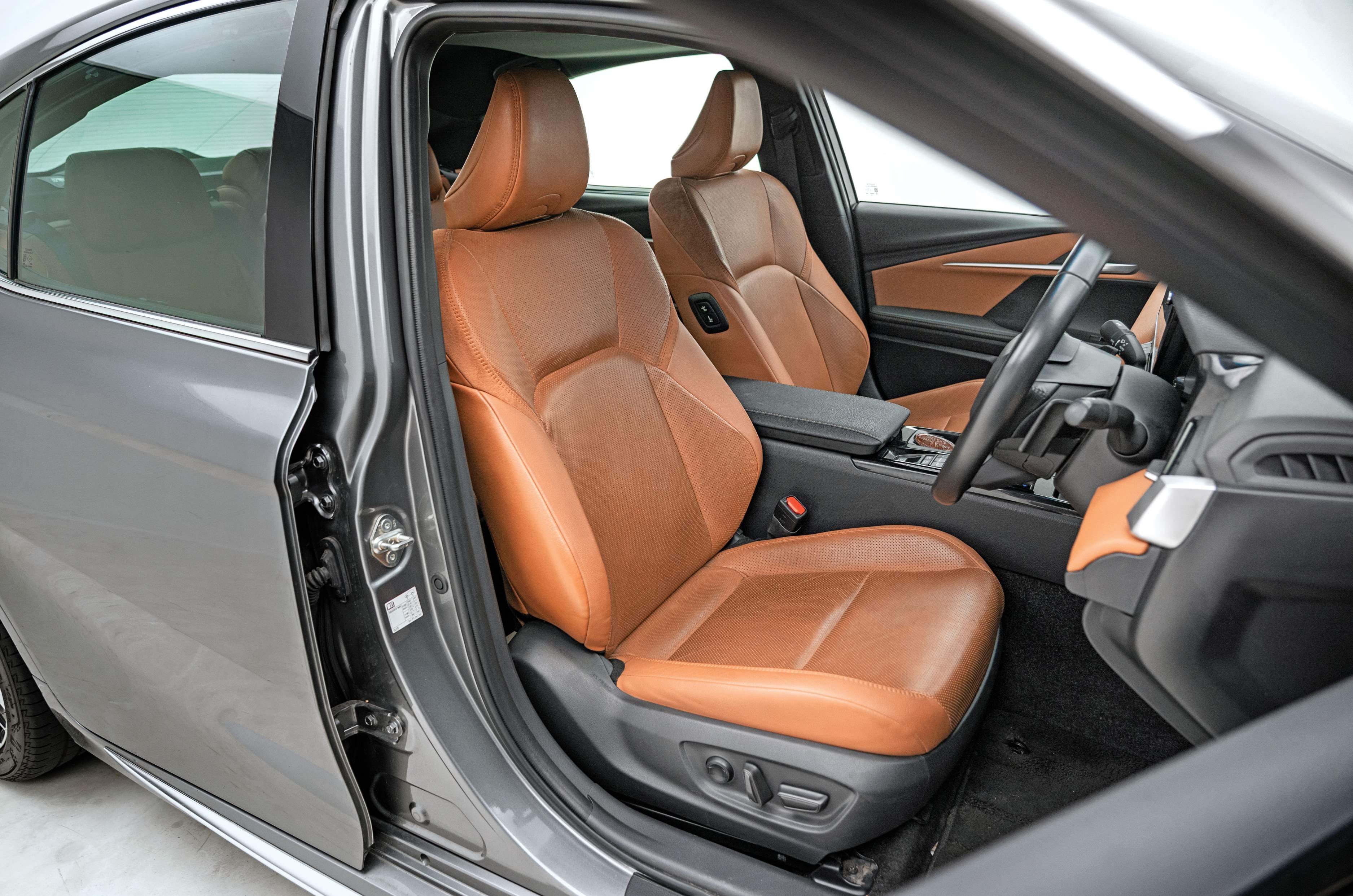
As before, seat comfort remains a core strength. The front seats are broad, superbly cushioned and highly supportive. Both are ventilated, and the driver benefits from 10-way electric adjustment with memory. Storage spaces are generous, charging options are plentiful, and the cabin layout is intuitive. An electrically adjustable steering column further enhances ergonomics.
Visibility is another highlight. Slim A-pillars reduce blind spots, particularly useful when negotiating roundabouts or dense city traffic. Ahead of the driver sits a crisp 12.3-inch digital instrument cluster with clear fonts and selectable display layouts, complemented by a head-up display.
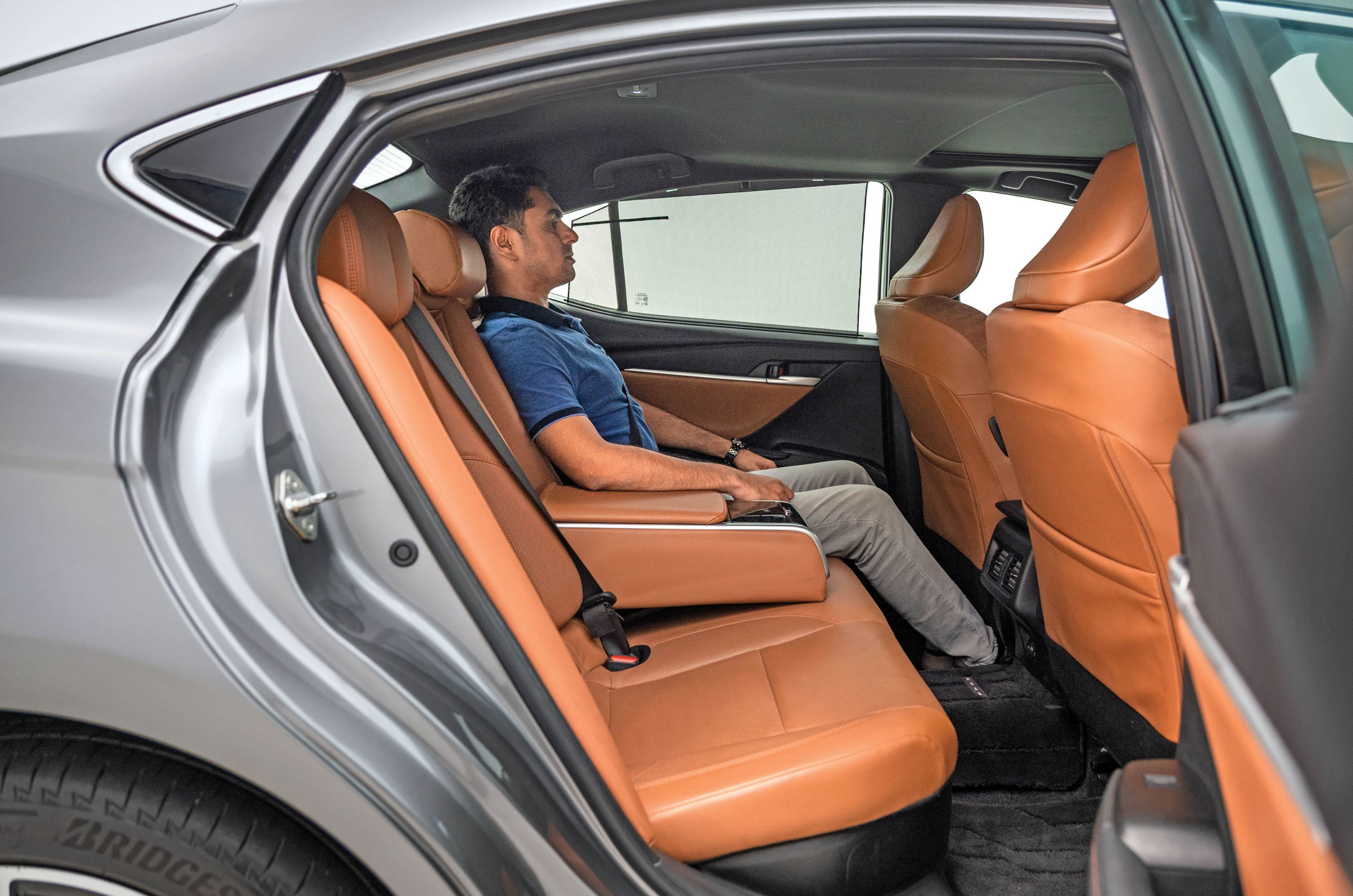
Rear-seat comfort continues to be a standout trait. The backrest angle is naturally relaxed, and passengers can electrically recline it further for added comfort. The ‘boss function’ allows rear occupants to slide the front passenger seat forward to liberate extra legroom. That said, unless the front seats are positioned higher, footroom under them can feel slightly constrained. While ideal for two, accommodating a third passenger is less pleasant thanks to a pronounced floor hump and a firm central backrest.
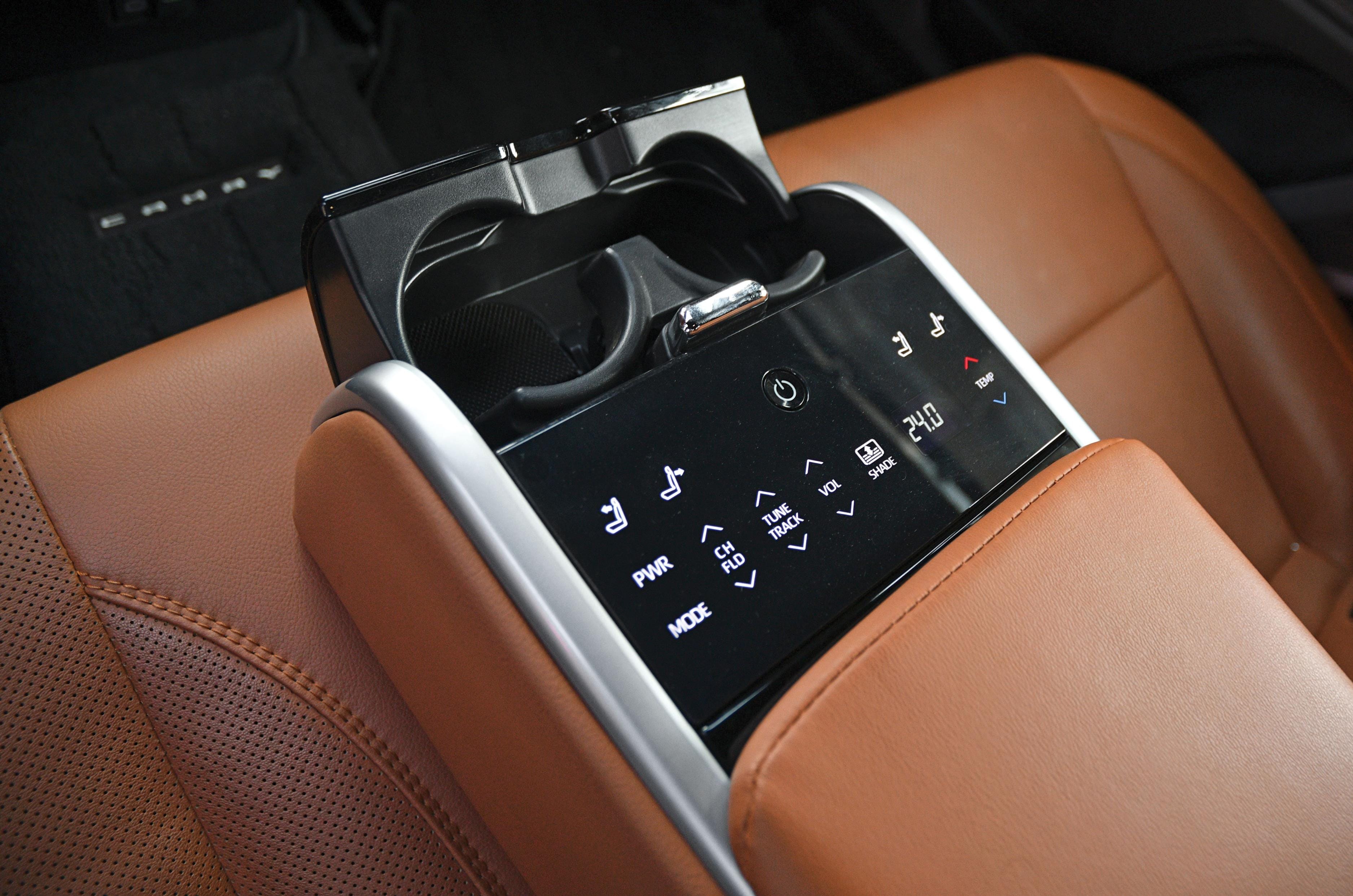
Uniquely in this segment, rear occupants also get a touch-operated control panel housed in the centre armrest, allowing control over the three-zone climate system, audio setup and rear sunshades.
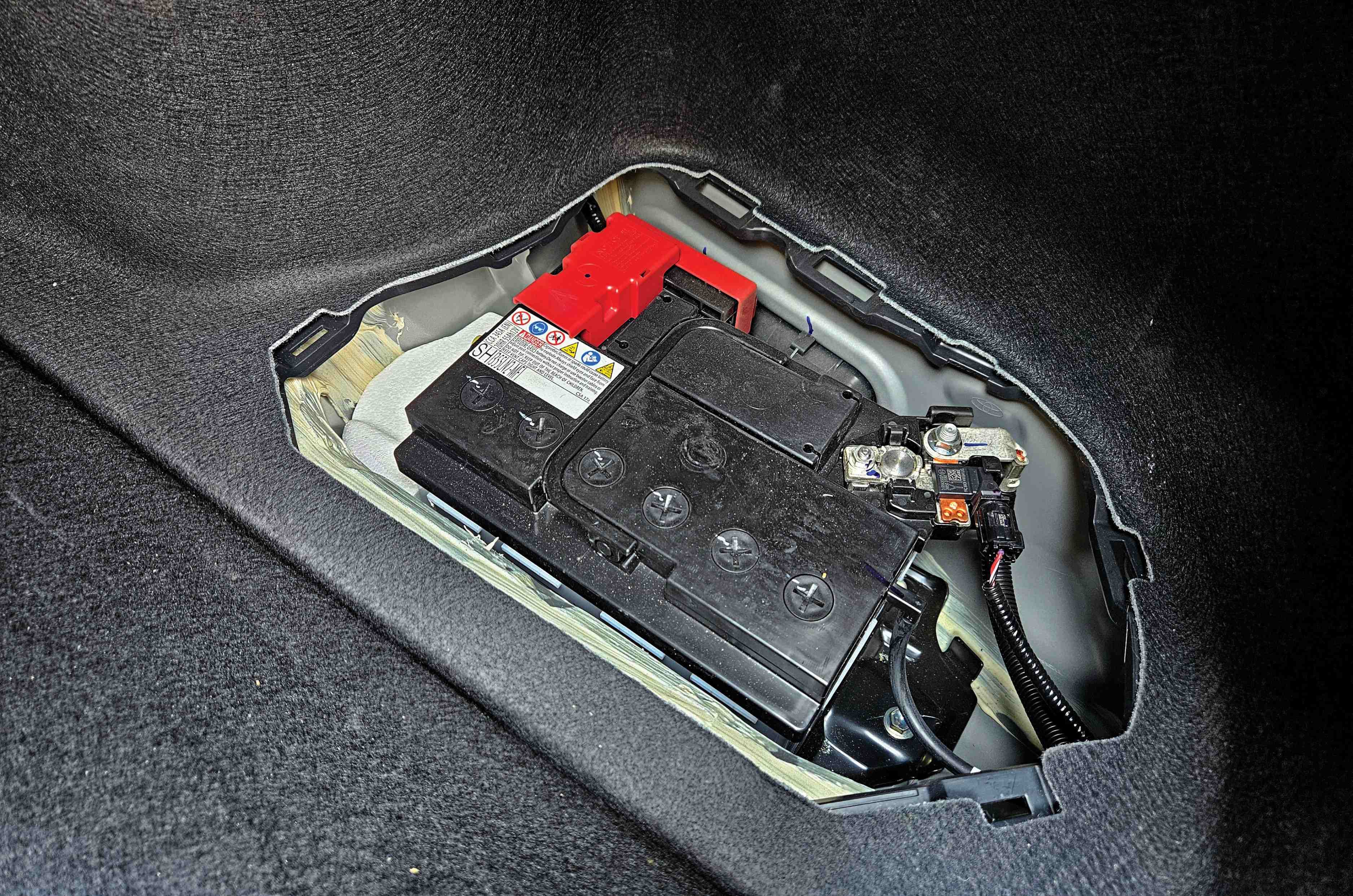
The 524-litre boot is both deep and tall, offering impressive practicality. A pass-through hatch behind the rear armrest enhances flexibility. Notably, beneath the boot floor sits a full-size alloy spare wheel – increasingly rare at this price point. However, a powered boot lid is conspicuous by its absence.
Camry Features and Safety –
Packs the basics, but some nice-to-have bits are missing.
The new Camry is equipped with Toyota Safety Sense 3.0, bundling five key ADAS features: adaptive cruise control, lane centring, lane departure warning, pre-collision warning and automatic high beam assist. Operating via radar and camera systems, these features are well-calibrated for Indian conditions. Importantly, physical buttons on the steering wheel allow easy activation or deactivation.
As for the Camry’s comfort and convenience features, highlights include ventilated and powered front seats, wireless charging, a sunroof, head-up display, a 360-degree camera, three-zone climate control, a 9-speaker JBL audio system, electrically reclining rear seats and an electric rear sunshade.
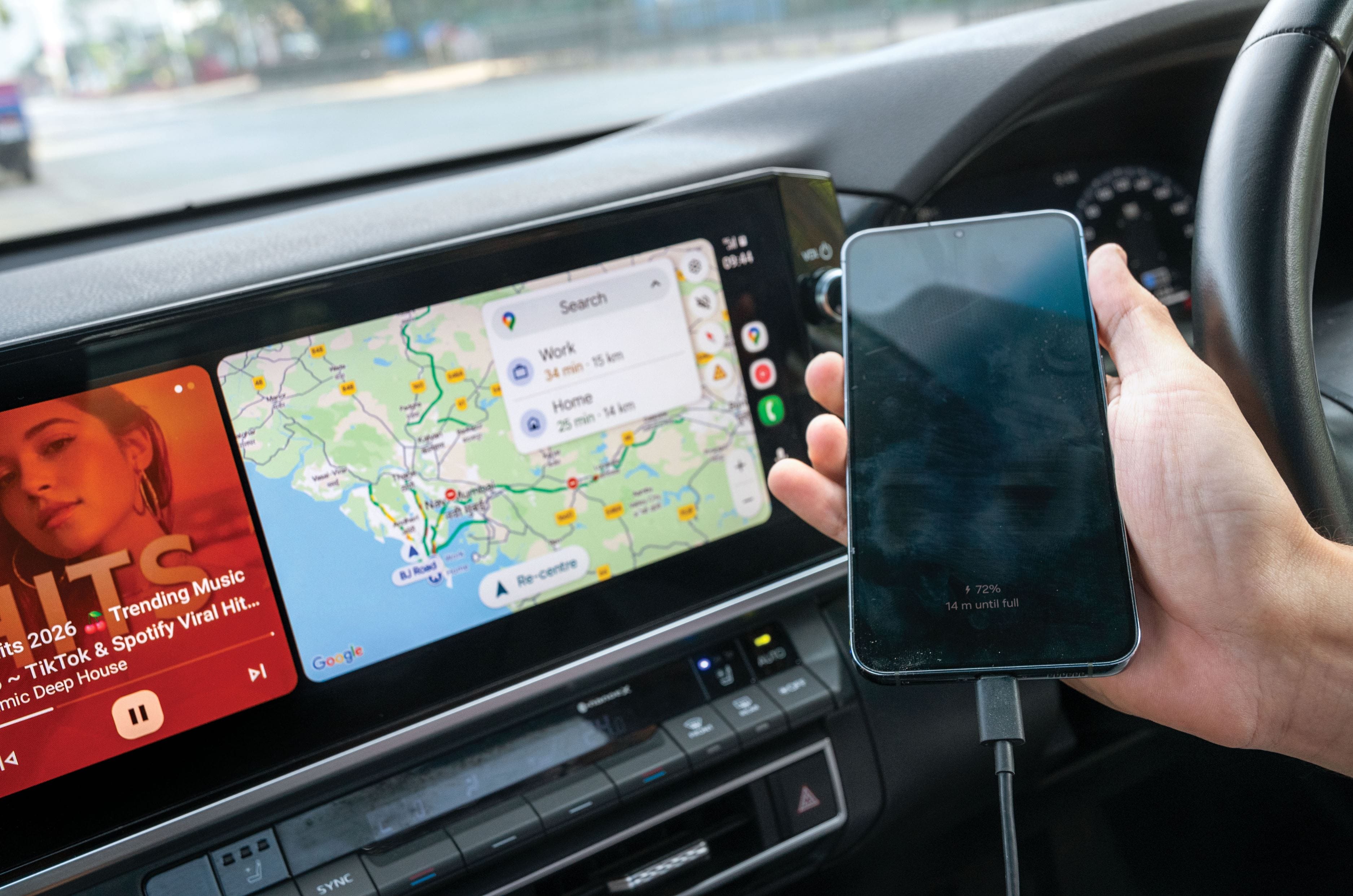
The 12.3-inch instrument cluster offers multiple customisable views with excellent clarity. The infotainment system, also a 12.3-inch unit, delivers a clean and straightforward interface. Curiously, while Apple CarPlay supports wireless connectivity, Android Auto is wired only. It would also have been nice to see things like rear seat ventilation.
Toyota Camry Performance and Refinement –
Utterly seamless and zippy; and it’s very refined too.
Under the bonnet lies Toyota’s fifth-generation hybrid system. It combines a 2.5-litre petrol engine, an integrated starter motor, the main traction motor and a new 1.0kWh lithium-ion battery, which Toyota claims is lighter and more advanced than the outgoing nickel-metal hydride unit.
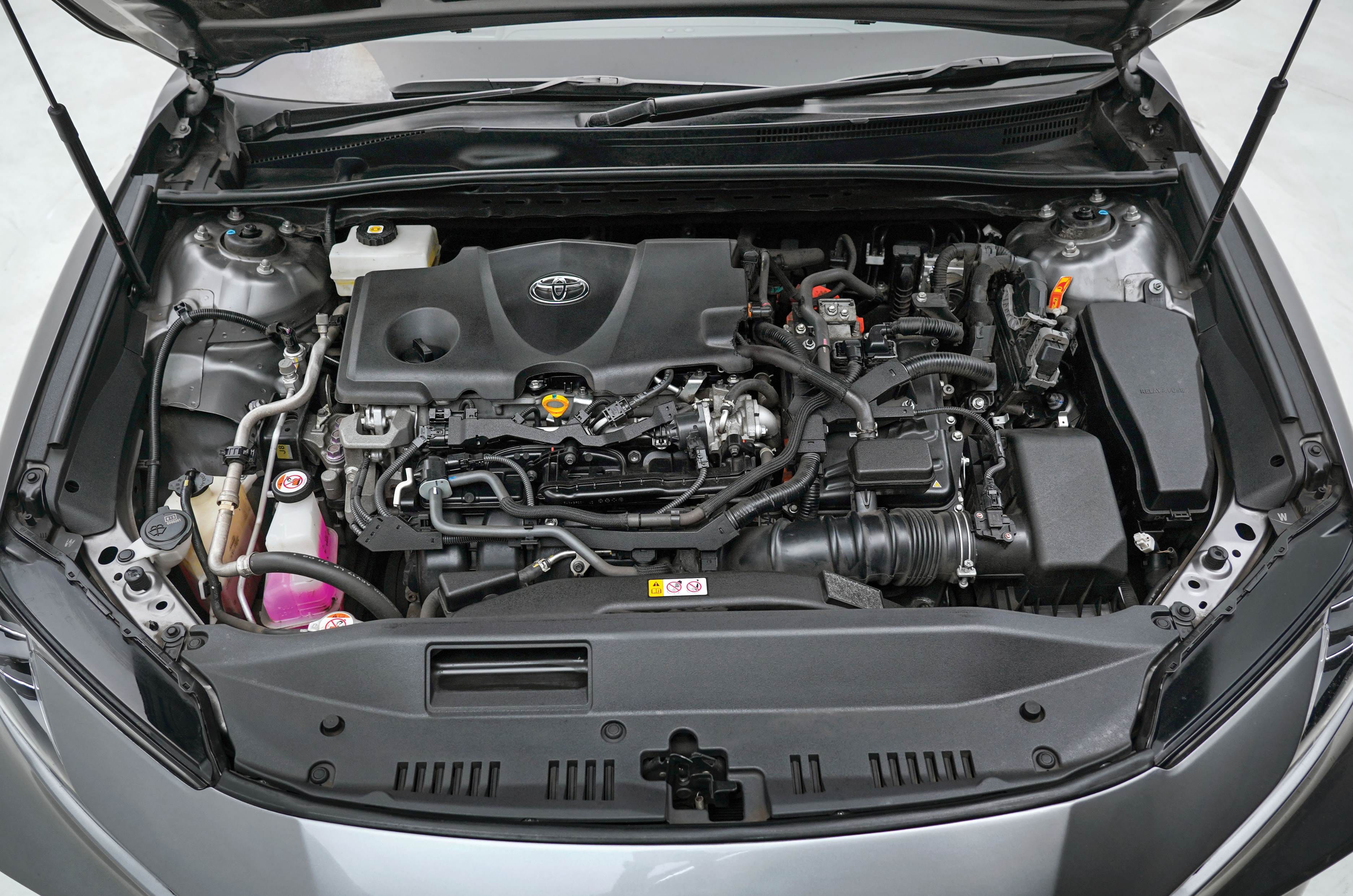
The 2.5-litre ‘Dynamic Force’ engine operates on the Atkinson cycle for improved efficiency and boasts an impressive thermal efficiency of around 41 percent. It now produces 187hp (9hp more than before), while torque remains at 221Nm. The permanent magnet synchronous motor generates 136hp and 208Nm, improvements of 16hp and 6Nm, respectively. Combined system output stands at 230hp, up by 12hp.
The Camry always starts in EV mode and, in gentle driving conditions, operates predominantly on electric power. The petrol engine seamlessly intervenes when brisk acceleration is demanded or when battery charge runs low. The transition between EV and petrol modes is quite imperceptible.
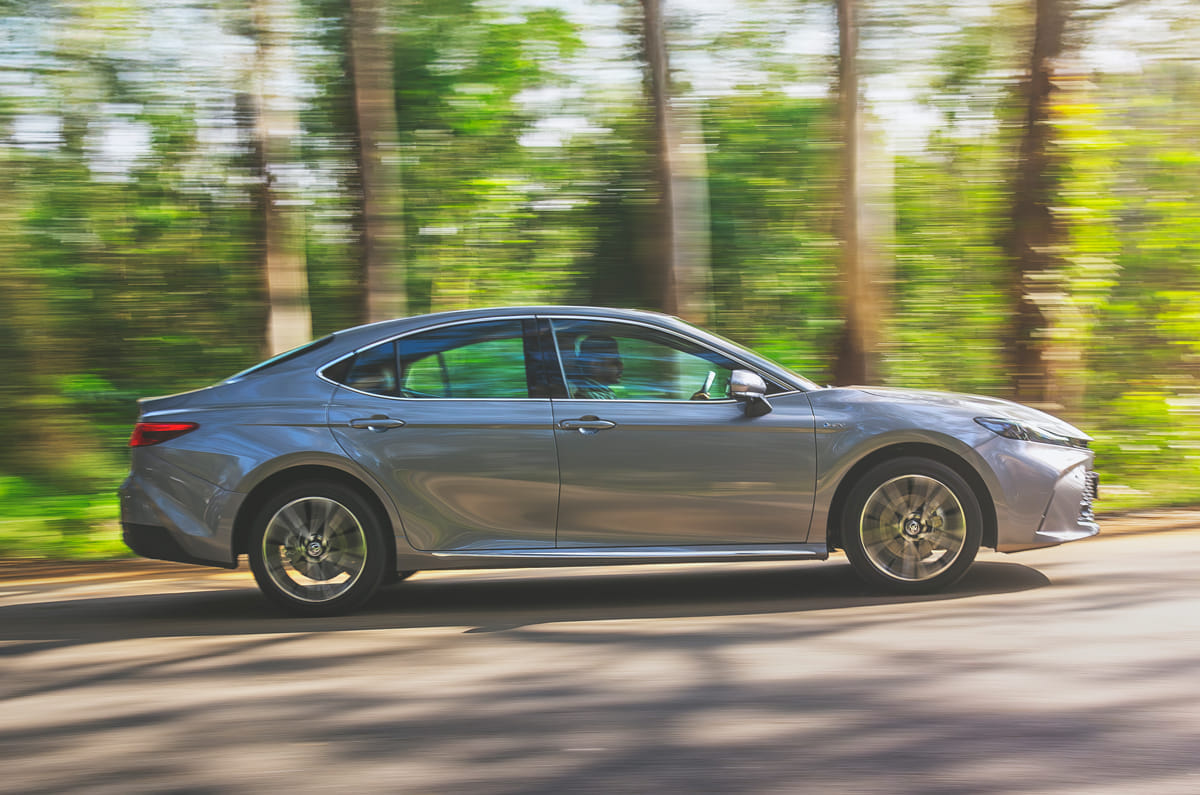
Low-speed refinement is good. Enhanced sound insulation and double-glazed windows create a notably hushed cabin. Even when the petrol engine engages, it emits a subdued hum. Under hard acceleration, however, the engine note becomes more pronounced and slightly buzzy at higher revs.
Like before, though, power is transmitted to the front wheels via what Toyota calls an e-CVT or electronically controlled continuously variable transmission. Unlike a conventional CVT, it doesn’t use pulleys with a belt or chain-driven setup; instead, it is a clever planetary gearbox setup that works in conjunction with the integrated starter generator and traction motor and gives the car a CVT like feel, where the engine revs do not necessarily match the car’s pace.
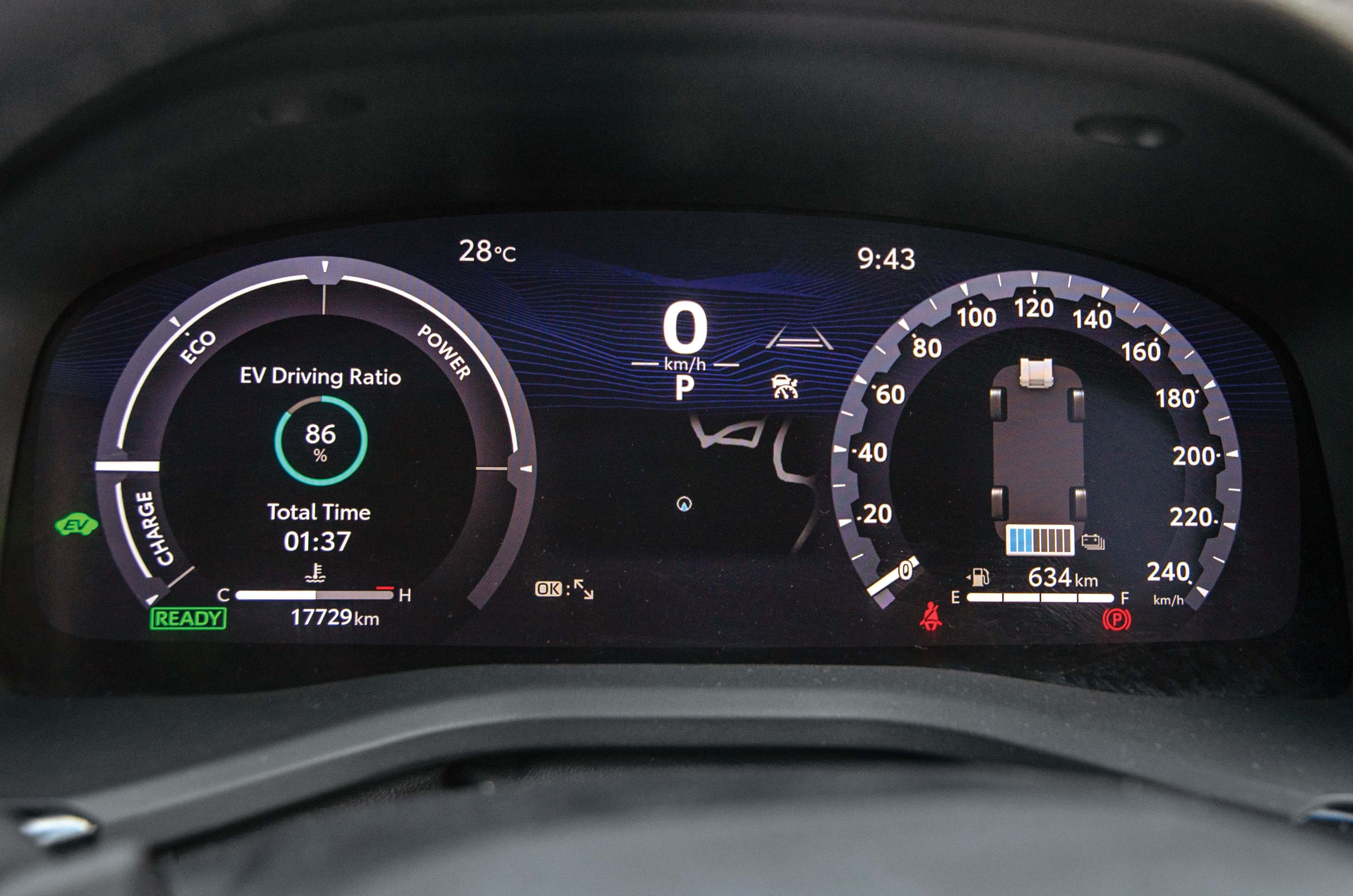
Performance is brisk rather than dramatic. The Camry dispatches 0-100kph in 7.96 seconds – 1.6 seconds quicker than before. Rolling acceleration figures, particularly from 20-80kph and 40-100kph, are strong and mirror those of a similarly priced Audi A4 that’s powered by 2.0-litre turbo-petrol engines.
Drive modes – Eco, Normal and Sport – alter throttle and transmission responses, though full-throttle performance remains consistent across modes. The e-CVT simulates 10 stepped ratios and offers paddle shifters, allowing manual selection of six predefined steps. A dedicated Sport transmission mode raises engine speeds to enhance responsiveness.
Toyota Camry Mileage and Efficiency –
Supremely efficient hybrid results in unmatched mileage.
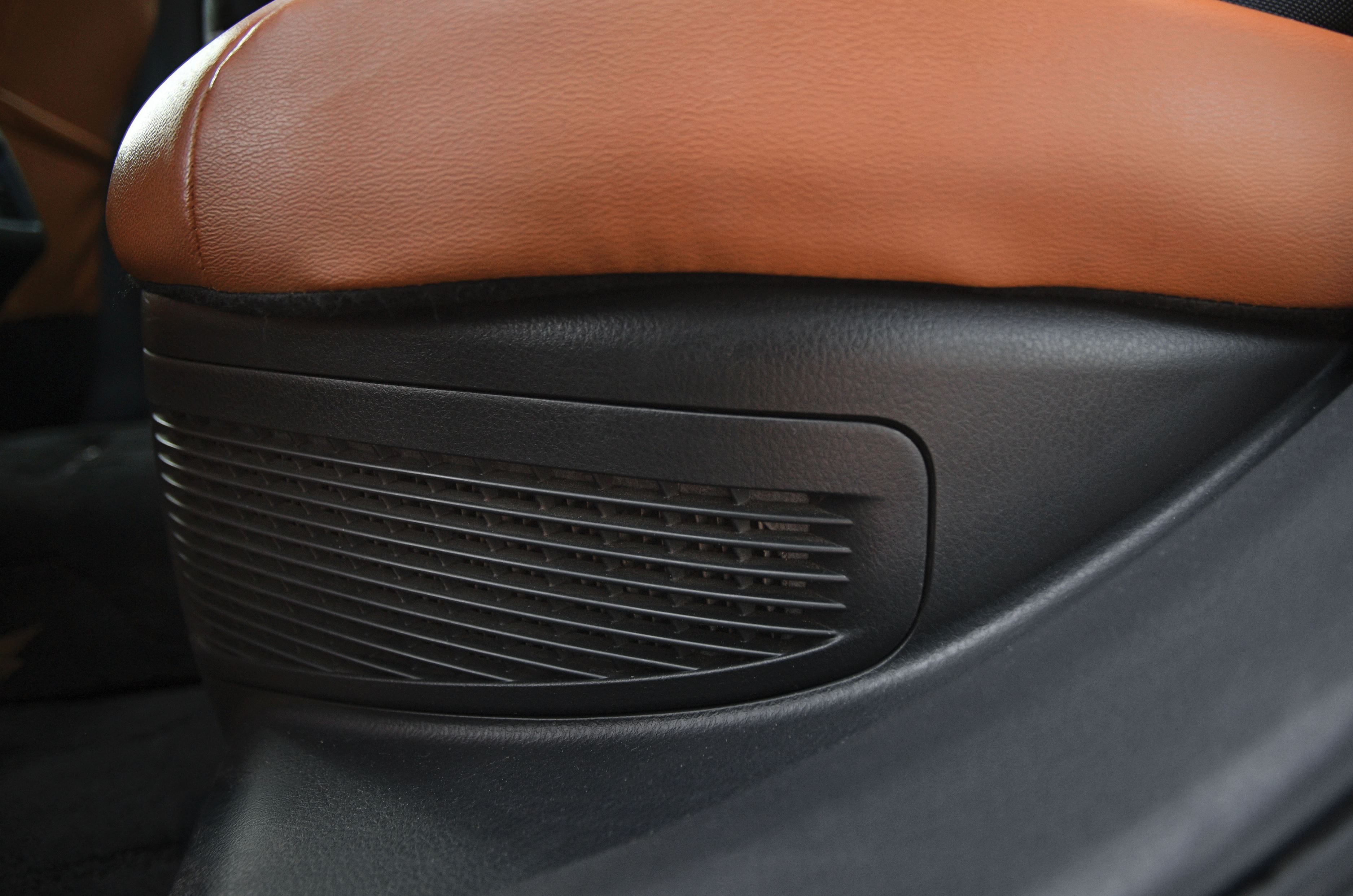
Efficiency remains the Camry Hybrid’s defining strength. Toyota claims a figure of up to 25.49kpl. In our real-world testing, conducted in Eco mode, the sedan returned 16.62kpl in city conditions despite ambient temperatures touching 38 degrees Celsius. On the highway, aided by favourable aerodynamics and optimal cruising conditions, it delivered an impressive 23.07kpl.
A new EV driving time ratio display reveals how often the car operates on electric power. During our test cycle, it spent over 80 percent of the time in EV mode – a key contributor to its strong efficiency figures.
Toyota Camry Ride Comfort and Handling –
Bump absorption is excellent; handling is livelier than before
Ride comfort remains a cornerstone of the Camry experience. Despite riding on 235/45 R18 tyres, bump absorption is exemplary. Unlike some European rivals that exhibit underlying firmness, the Camry’s suspension delivers plush compression and rebound, even over sharp-edged potholes. Toyota quotes a ground clearance of 145mm, and in real-world use, it negotiates most speed breakers without scraping.
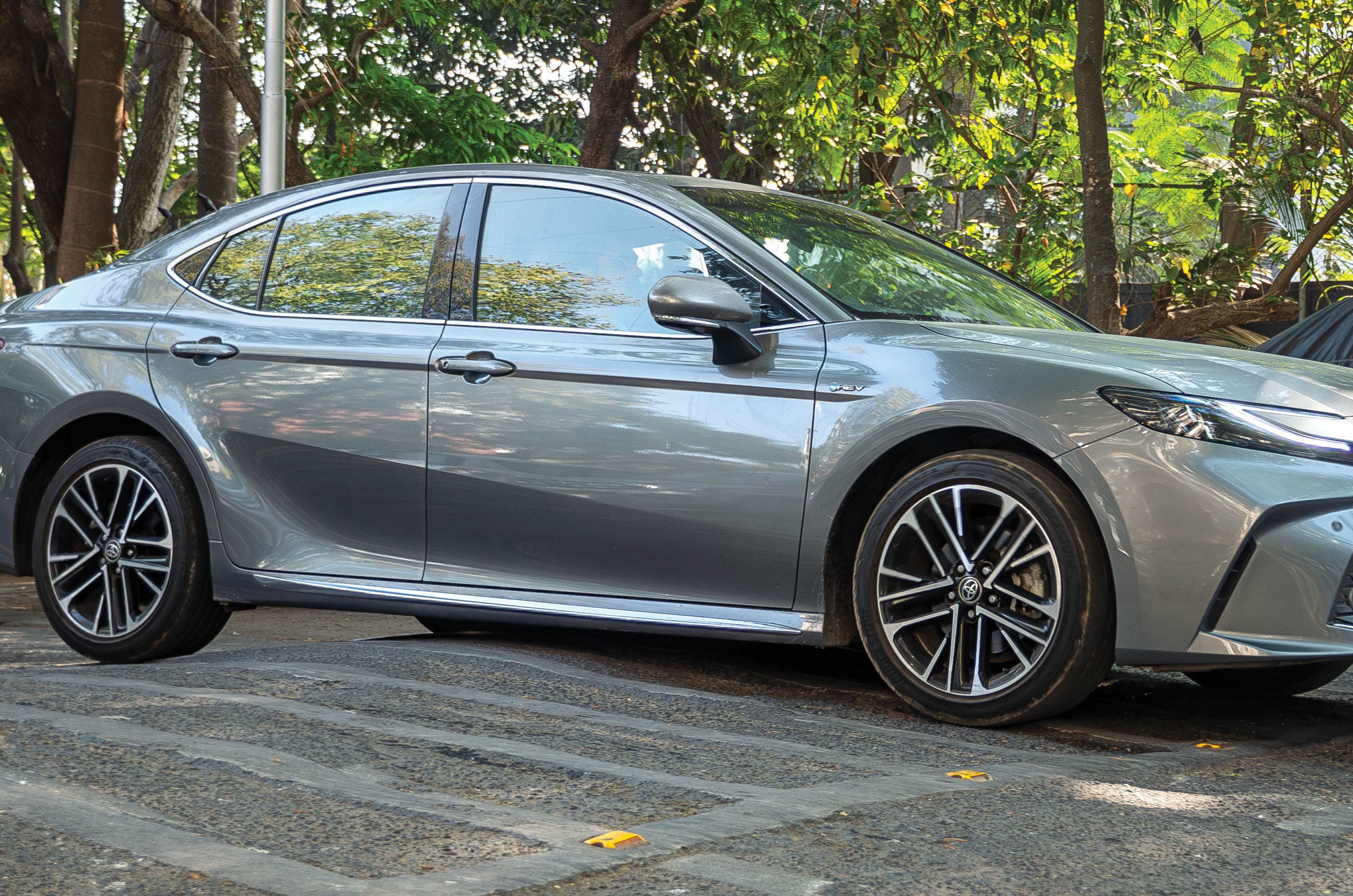
While older Camrys prioritised comfort at the expense of driver engagement, the newer iterations strike a more balanced note. The steering feels predictable, body control is reassuring, and the car maintains composure when driven enthusiastically. It may not aim to be overtly sporty, but it performs its brief with quiet competence.
In panic braking tests from 80kph, the 1.6-tonne sedan came to a halt in 27.63 metres, comparable to an Audi A4.
Toyota Camry Price and Verdict –
Expensive but backed by Toyota’s reliability with noticeable improvements in performance and efficiency.
Like before, the Camry Hybrid is brought to India as a semi-knocked down (SKD) unit and assembled at Toyota’s Bidadi plant alongside the Hyryder and Hilux. It is offered in two variants – Elegant and Sprint Edition, differentiated largely by cosmetic elements; both are priced at Rs 47.48 lakh.
Standard warranty coverage stands at three years or 1,00,000km, extendable up to five years or 2,20,000km. The hybrid battery is backed by an eight-year or 1,60,000km warranty, reinforcing Toyota’s confidence in its electrified technology.
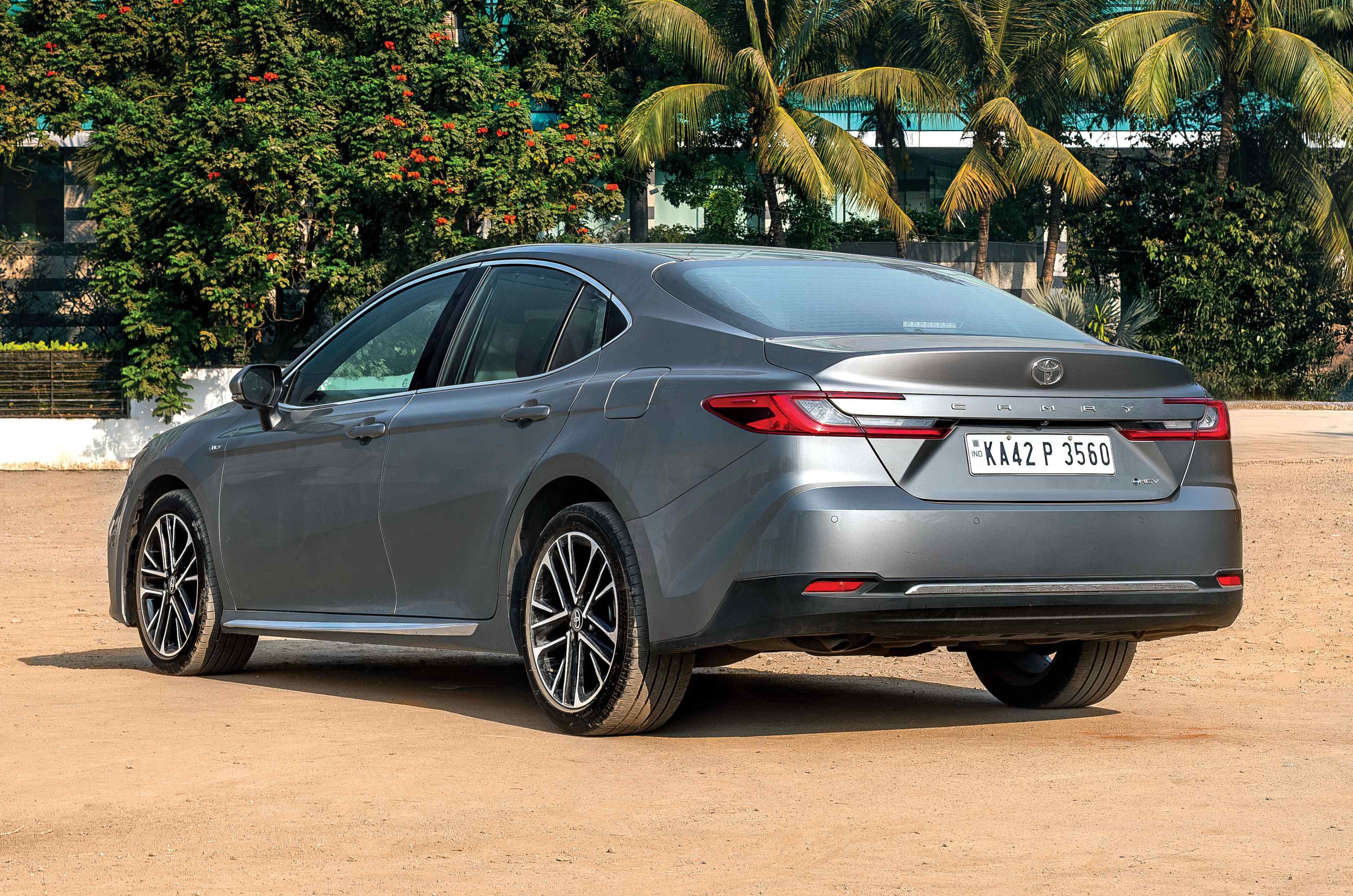
This gen builds onto the Camry’s core strengths. The cabin remains plush, ride comfort is very good, and rear-seat comfort is exemplary. The new hybrid system brings stronger performance and genuinely impressive real-world efficiency. While it still isn’t sporty to drive, it feels more responsive and better tied down than earlier iterations, with reassuring body control.
Priced at Rs 47.48 lakh, it isn’t affordable, but in the absence of a direct rival, it occupies a niche. Yes, it lacks the badge cachet of the German marques, but this car is backed by Toyota’s reputation for reliability, low running costs and dependability. For a certain clientele, that alone is compelling enough.
Ultimately, the Camry Hybrid won’t stir the soul like its German counterparts, but it will relax it. As a supremely comfortable, efficient and dependable luxury sedan, equally suited to self-driven and chauffeur-driven roles, it makes for a very convincing case.