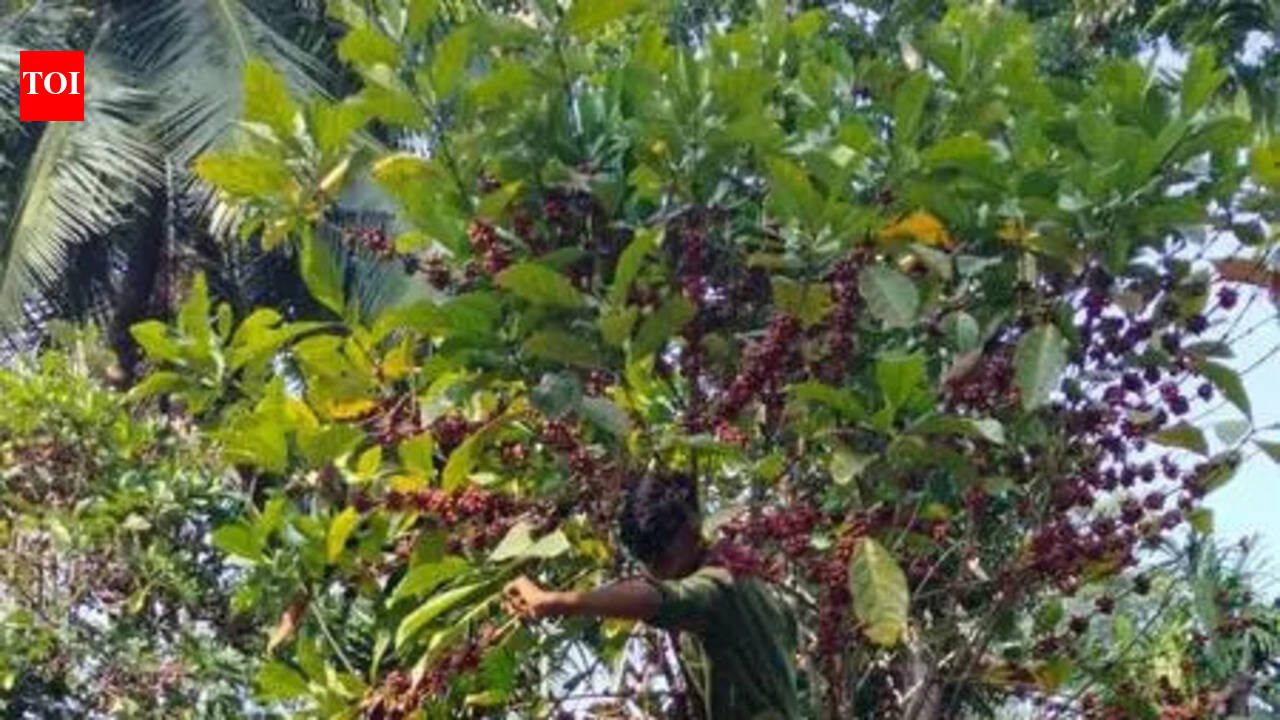

In the traditional belts of Kodagu, Chikkamagaluru and Hassan, planters speak of a calendar that no longer follows memory. Jacob Mammen, managing director of Badra Estates, says climate change is already having a significant impact on the cultivation of traditional coffee varieties such as Arabica and Robusta coffee. The biggest challenge, he explains, comes from increasingly unpredictable weather patterns, particularly the timing and intensity of rainfall.Coffee plants depend on a very specific rain pattern for flowering. A spell of rain triggers flowering, and a “backup shower” about two weeks later helps the flowers set properly. In recent years, however, growers have been facing erratic conditions — either too much rain, too little rain, or rain arriving at the wrong time. This disrupts the flowering cycle and directly affects yields. Extreme weather events are also becoming more frequent. Jacob notes that hailstones last year destroyed coffee flowers on the estate, wiping out the crop in affected areas. Unseasonal rains are also creating harvesting and quality issues. “Early showers, sometimes as early as January, can cause new flowers to open while ripe cherries are still on the plant. When that happens, pickers must stop harvesting to avoid damaging the fresh flowers. At the same time, rain can cause the ripe cherries to deteriorate or dry out, affecting the quality of the beans.”In a warming worldAgainst this backdrop, Jacob says interest is growing in climate-resilient varieties such as Liberica coffee. Traditionally, Liberica was treated as a fence-line crop and not cultivated as a main plantation variety. At Badra, it is still largely grown as “tree coffee” along the boundaries rather than replacing Arabica or Robusta in the fields. However, the estate is beginning to rethink this approach.Coffea liberica is considered more climate-resilient than other major coffee species such as Coffea arabica because of several natural characteristics. Liberica trees can tolerate higher temperatures and grow well in hot, humid tropical environments where Arabica often struggles. The plants develop deep and extensive root systems that allow them to access water from deeper soil layers, helping them survive drought conditions. They also show greater resistance to diseases such as coffee leaf rust, which has historically devastated many coffee plantations. In addition, Liberica trees are larger and sturdier, enabling them to withstand heavy rainfall, storms and variable weather patterns. Their ability to grow in poorer soils and adapt to changing environmental conditions make Liberica a promising climate-resilient coffee species as global warming increasingly threatens traditional coffee cultivation.Market demand is another factor driving the renewed interest in Liberica. According to Jacob, buyers in India as well as overseas are increasingly curious about the variety because of its distinct fruity and sweet flavour profile, which sets it apart from Arabica and Robusta. However, Liberica still faces output-related challenges. At present, its yield is significantly lower than that of Arabica or Robusta. This is partly because it is still largely grown as a tree crop along fences rather than as a fully managed plantation variety. Seeking ExcelsaAnother tree coffee variety, Excelsa, is also generally considered climate-resilient. Jury is still out on whether it classifies as a variety of Coffea liberica, as it shares many of the hardy traits of Liberica. Excelsa can tolerate high temperatures, irregular rainfall, and humid tropical conditions better than Coffea arabica, which is more sensitive to climate change. Adhi Savla, senior manager for Coffee Community at Blue Tokai, says they source Excelsa from South Indian Coffee Company but it is currently sold out. “The quantity is very low as they are experimental lots,” he says. “Excelsa offers a heavier body with distinctive cola-like notes, often reminiscent of cola, black currant and molasses, making it a unique experience for coffee drinkers.”South Indian Coffee Company (SICC) has been exporting Excelsa since 2017. “We have been working with Kew Gardens in the UK since 2021 and they’ve proved that Excelsa and Liberica are two different species,” says Akshay Dashrath, co-founder of SICC and a fifth generation coffee grower. “In India, when it’s hot, it’s usually dry. Sometimes our issue isn’t just heat; it’s also too much moisture. For example, in 2024, we had 65 inches of rainfall on our farm. That is normal historically, but what was abnormal was that 33 inches of that came in a single month of July. These conditions are hard for Arabica and Robusta to tolerate. Excelsa does well in these variable conditions because it is a deep-rooted tree.”Their Mooleh Manay Estate in Coorg produces about three tonnes of clean Excelsa a year. SICC has started to breed Excelsa. “Arabica has had 500 years of selective breeding; Robusta has had 150. Excelsa and Liberica have had zero. What we have in India is essentially a wild population introduced in batches in 1872, the 1920s, and the 1940s,” Akshay adds.Some choose to be practicalFor Arvind Rao, former chairman of the Karnataka Planters’ Association, adaptation is currently less about breakthrough genetics and more about practical mitigation. “Most of us have not really tried climate-resilient varieties because there are not any real varieties available as of now, even from the Coffee Board,” he says. “So we are managing whatever plants that are already there in our fields.” The response, for now, is infrastructural and ecological. “We are conserving water, building storage tanks, putting up irrigation so that during blossom we can irrigate and mitigate drought to some extent,” Rao explains. Shade regulation has also changed. “We are maintaining slightly higher shade to keep temperatures lower. Of course, it reduces the crop somewhat — but it helps manage heat stress.” Soil health has become central to the conversation. Composting and organic matter incorporation are being used to improve water retention.Resilience alone is not enoughFrom a quality and market perspective, another industry observer and a processing expert, who works with post harvest coffee processing and fermentation, Binny Varghese— who has travelled extensively across different coffee regions in the country — sees resilience as layered rather than absolute.”From what I’ve observed across Karnataka and Tamil Nadu, S795 still holds strong,” says Binny. (S795 is an Arabica selection derived from Kent and S288 lines that contain some Liberica ancestry). It is known for high yield, coffee leaf rust resistance, and a flavour profile with notes of mocha or chocolate. “It’s not fashionable, but it’s genetically stable and relatively adaptable to mid-elevations. With disciplined picking and controlled fermentation, it can produce very clean cups with structured acidity and good sweetness.”Selection 9, Binny adds, remains significant. Selection 9 is developed in India by crossing Tafarikela (an Ethiopian Arabica) with Hibrido-de-Timor (a rust-resistant hybrid). “Genetics define potential yield and disease resistance,” he explains. “Processing determines how much of that potential translates into cup quality.”Tracking climate risks with dataConversations around climate risk, he says, have become markedly more direct. “Earlier, climate conversations were cautious. Now they are data-driven and experience-based. Younger producers are using modelling. ” Farmers now openly track irregular blossom showers, temperature spikes during fruit development and unexpected rain during drying — all of which affect bean density and fermentation predictability. “What’s interesting is that adaptation is no longer seen as just ‘plant a new variety’,” notes Binny. “It’s integrated thinking — canopy management, spacing, moisture management, selective picking, even adjusting processing styles to handle inconsistent ripeness.” Go to Source