
QRSAM: First Layer In IADWS
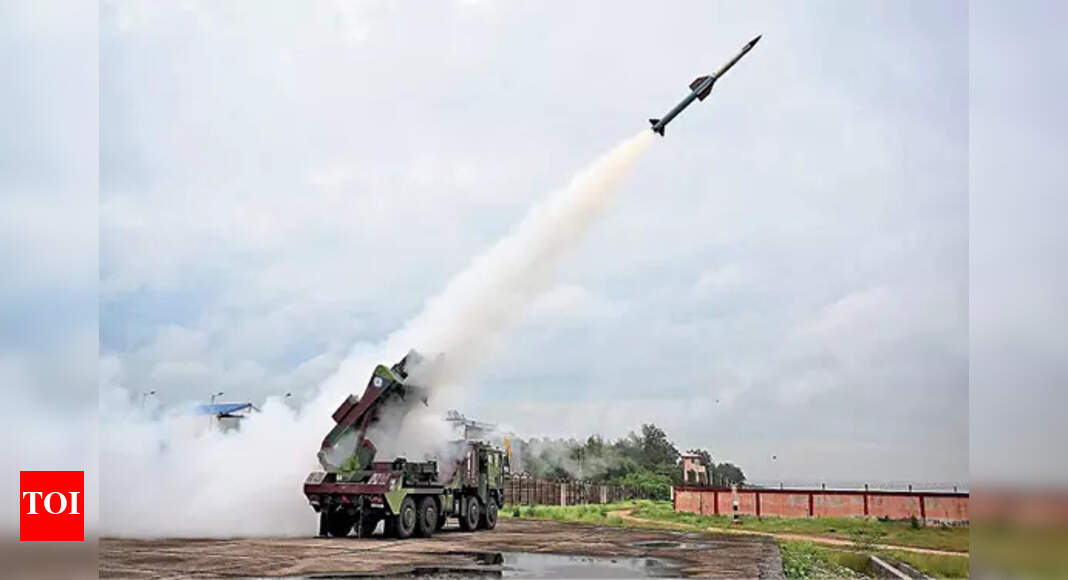
The Defence Research and Development Organisation (DRDO) on Aug 23 successfully carried out the maiden flight-tests of the Integrated Air Defence Weapon System (IADWS). Held off the coast of Odisha, the test validated the country’s first fully indigenous multi-layered air defence shield.During the demonstration, IADWS engaged and destroyed three aerial targets simultaneously – two high-speed fixed-wing UAVs and a multi-copter drone. The targets were neutralised at varying altitudes and ranges, proving the system’s versatility against different airborne threats.
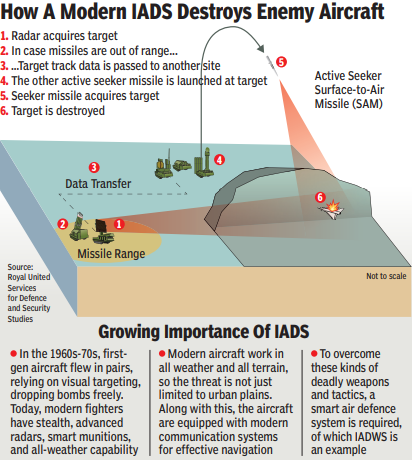
How a modern IADS works
The system integrates three indigenously developed technologies – Quick Reaction Surface-to-Air Missiles (QRSAM), Very-Short Range Air Defence System (VSHORADS) missiles, and a high-power laser-based Directed Energy Weapon (DEW). Together, they create a layered shield capable of countering everything from low-flying drones to high-speed aircraft and missiles.Control of all components is exercised through a Centralised Command and Control Centre, developed by the Defence Research & Development Laboratory (DRDL). This ensures radars, communication networks, missile batteries, and directed-energy weapons function in unison, maximising reaction time and accuracy. At the heart of IADWS is the QRSAM, providing frontline protection to Army units on the move. Mounted on 8×8 high-mobility vehicles, it allows “fire-on-the-move” capability. Its dual-radar system – the Active Array Battery Surveillance Radar and Active Array Battery Multifunction Radar – provides 360-degree detection, tracking, and targeting of multiple threats. With a strike envelope of 25-30km and altitudes up to 10km, QRSAM can intercept aircraft, helicopters, drones, and missiles with precision.By filling the gap between man-portable short-range systems and long-range missile defences like the S-400, QRSAM forms the mobile first layer of the IADWS shield.Complementing QRSAM are the VSHORADS and DEW. VSHORADS, developed by DRDO’s Research Centre Imarat, is a man-portable missile designed for low-altitude threats. Lightweight and field-deployable, it adds agility and flexibility to the IADWS framework.The most futuristic element is DEW. In April, DRDO showcased its 30-kilowatt laser against drones, helicopters, and missiles at ranges up to 3.5km. With 360-degree electro-optical sensors and jamming features, DEW marks India’s entry into ‘Star Wars’-style defence.DRDO chief Samir V Kamat said: “This is just the beginning… We are also working on high-energy microwaves and electromagnetic pulses that will give us Star Wars capability.”Together, QRSAM, VSHORADS, and DEW provide India with a robust, multi-dimensional defence system.Tailored For Regional ThreatsGlobally, nations such as Russia, China, and Iran have developed sophisticated Integrated Air Defence Systems (IADS) to counter US airpower. These systems force US operations farther out to avoid detection. They link radars, mobile command posts, and space-based sensors to create a distributed, networked shield. Russia’s S-400 is among the toughest, with radars reaching 400km and missiles of similar range. Though rarely fired to maximum distance, this capability enables flexible engagement within the given range. The challenge lies in neutralising not a single sensor or missile, but an interconnected web. India’s IADWS mirrors this philosophy, tailored for regional threats.The IADWS test comes a few days after the successful trial of the Agni-V ballistic missile on Aug 20. It also draws lessons from Operation Sindoor in May, when India’s multi-layered defences thwarted Turkish-origin drones and Chinese-supplied missiles used by Pakistan. The operation reinforced the need for homegrown systems tested in live combat scenarios.This renewed focus on indigenisation underlines a wider shift in India’s defence ecosystem. From Operation Sindoor to the IADWS test, the pattern is clear: India is preparing to fight future wars with indigenous technologies.In his Red Fort speech on Aug 15, PM Modi urged Indian innovators and the domestic defence industry to develop jet engines indigenously – a technological gap that continues to haunt India’s aerospace sector. Despite breakthroughs in missiles and radars, India still depends on foreign suppliers for engines, holding back projects like the Tejas fighter and AMCA stealth aircraft.While a HAL-GE joint venture is reportedly being discussed and the long-delayed Kaveri engine remains incomplete despite over Rs 2,000 crore invested, India’s vulnerability in propulsion contrasts with its advances in air defence.This prolonged dependence on foreign jet engines, particularly from the US, France, and Russia, highlights a major vulnerability. While India has made breakthroughs in missiles, radars, and air-defence systems, its inability to master jet engine technology continues to hold back flagship projects like the Tejas fighter and the AMCA stealth aircraft. By situating the QRSAM success within this broader narrative, India’s defence roadmap reflects both its recent achievements and the challenges that remain. Go to Source