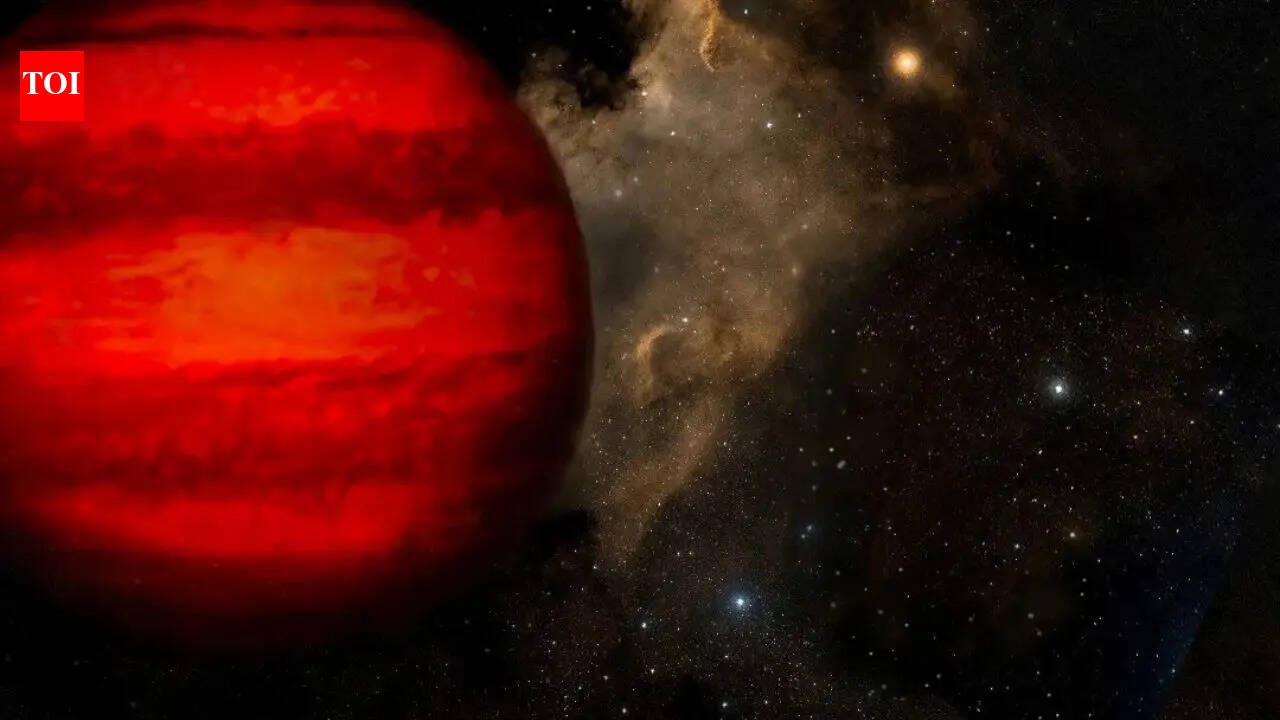


PC: NASA
Astronomers have discovered a record-breaking binary system, ZTF J1239+8347, which is a record-breaking case of two ‘failed stars’ (brown dwarfs) in a 57-minute orbital death spiral that may result in the formation of a new star. The results were published in a study on arXiv that was led by Samuel Whitebook of Caltech. The brown dwarfs are so close together that the more massive one (the primary) is ‘feeding’ off the other (the secondary) by transferring mass from the secondary to the primary. The primary has a hot spot due to the accumulation of material falling onto it, which scientists believe will eventually form enough mass to ignite nuclear fusion and provide a second chance for these ‘failed stars’ to form a low-mass M-dwarf star.
Israel Iran War
A new cosmic speed record of 57 minutes
ZTF J1239+8347 is a binary system of two brown dwarfs that has set a new record for the smallest orbit in known detached brown dwarf binary systems, smaller than previously thought possible. The two brown dwarfs orbit one another at such high speeds, completing one ‘year’ every 57.4 minutes, the fastest orbital period yet recorded in a detached brown dwarf binary system. To help illustrate how compact this system is, the total separation of the two objects is so small that the entire system preparing to merge would fit comfortably within the distance between Earth and the Moon. Researchers at Caltech discovered the high-speed motion of the two brown dwarfs by observing the pulsating brightness of this system once every hour, which is created by the presence of a hot, luminous cloud of gas surrounding the larger brown dwarf caused by the impact of the fast-moving gas from the smaller brown dwarf hitting the larger brown dwarf.
How a ‘vampire’ dwarf feeds for fusion
To evolve from a brown dwarf into an actual star, it has to cross over a certain mass that it didn’t reach during its formation within a molecular cloud. The primary brown dwarf in this binary system is acting like a ‘vampire’ by using its incredible pull to take the outer hydrogen layers off its companion via Roche lobe overflow (or loss of material from the Roche lobe). For an object to produce heat from the sustainable power of nuclear fusion, it must reach around 75-80 times the mass of Jupiter. Therefore, the current mass of these brown dwarfs is slightly less than this threshold; however, the continuous accumulation of hydrogen during this interaction will steadily increase the primary’s mass, eventually pushing it toward the critical ‘ignition’ point.A study published in The Astrophysical Journal Letters predicts that this merger will be relatively quiet compared to the violent supernovae produced by colliding white dwarfs, and it is expected that the result of this merger will be the production of a low-mass Red Dwarf star and providing these ‘failed stars’ with a second chance at becoming stars instead of just brown dwarfs as previously formed.
The future of ZTF J1239+8347
The sustained stability of the current mass transfer process is dependent on two factors – orbital physics and nuclear ignition. An evolutionary perspective on this issue can be found in ‘The Astrophysical Journal Letters’, which states that if the primary brown dwarf crosses the 80- Jupiter mass threshold, it will officially ignite into a new star- a Main Sequence M-dwarf- permanently shedding its ‘failed star’ label. This will allow the brown dwarf to effectively reset its evolutionary clock and continue shining for trillions of years (assuming that it is able to sustain nuclear fusion processes for that length of time). Depending upon gravitational wave emissions (the ripples in spacetime created by two massive, compact objects), the current state of mass transfer could cause both of these massive objects to lose orbital energy, and therefore to spiral inward toward each other- the ‘death spiral’ of mass transfer.
A second chance to shine: How mergers create new stars from ‘failures’
Before this finding, brown dwarfs were viewed as cosmic dead ends; they would cool slowly and disappear into nothingness. The Caltech team’s findings suggest ‘stellar failure’ is not irreversible because, through interacting in binary systems, a star can be created later on in its life cycle. Additionally, their success indicates that the Zwicky Transient Facility (ZTF) can locate ultra-short-period binaries, suggesting that countless thousands of these ‘vampire’ systems could exist within the Milky Way. This research drastically changes the projected timeline of the universe by showing that even the dimmest body can eventually be re-ignited. Go to Source