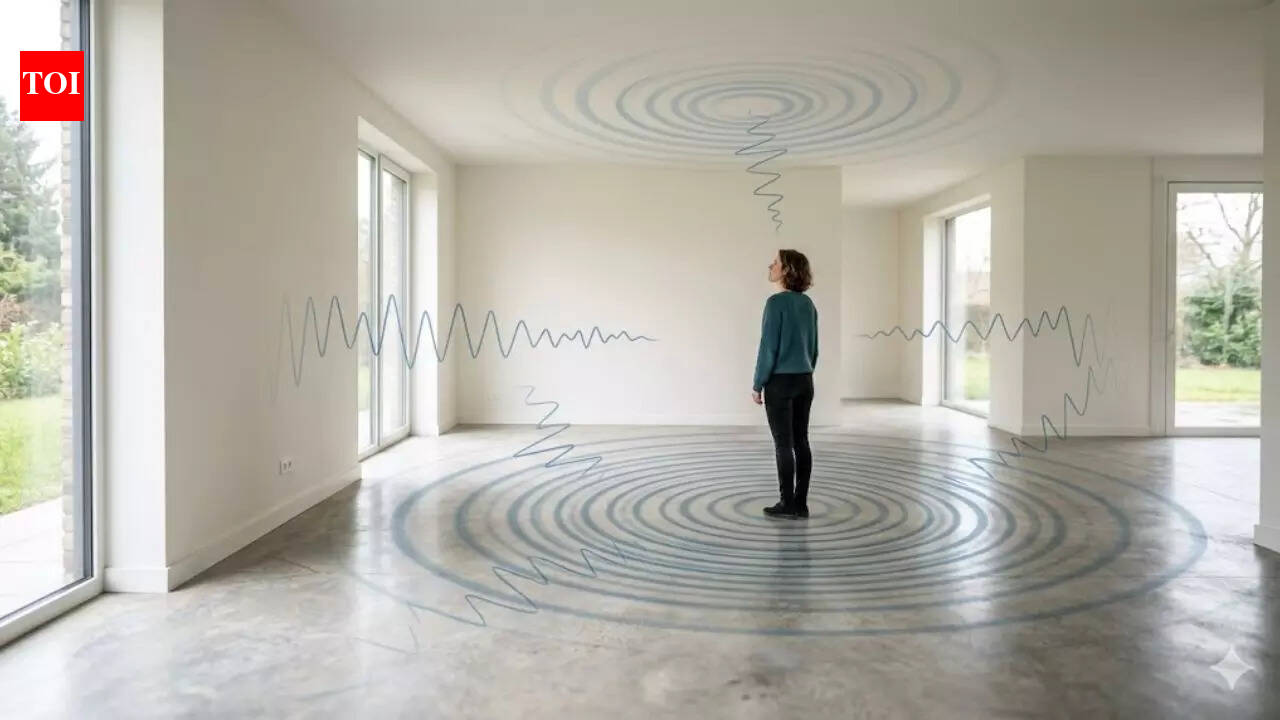

PC: AI Generated
Reverberant sounds made in an empty environment are the result of sound waves bouncing off hard, flat surfaces, as governed by basic principles of the science of physical acoustics. When completed, the energy of the sound wave travels through space until it meets some boundary surface. In a furnished environment (e.g., living room with furniture), the soft materials (e.g. carpets, drapes) function as ‘porous’ absorbers of sound; they absorb the energy of even the smallest sound waves so that they do not reflect toward the point of origin. Conversely, there are no such porous absorption materials in an unfurnished (empty) environment to absorb the same sound waves; therefore, a true, distinct echo is typically only perceived when the reflecting surface is at least 17.2 meters away. In smaller empty rooms, these reflections overlap so quickly (less than 0.1 seconds) that they are technically classified as reverberation. As indicated in their explanation of the science of sound, NASA states that sound is similar to light; when either hits a hard and level surface (e.g.,
Israel Iran War
a concrete slab), the energy from the sound (or the light) will reflect toward where it originated from, resulting in a rapid accumulation of reflective sound waves producing a reverberating nature to sound. If the reflective surface is at a greater distance than the original production of sound, then the reflection of that sound will produce a distinct, delayed echo.
How empty rooms trap sound energy
In reference to light, sound can also be reflected when it encounters a boundary, as stated by NASA. When there’s no soft porous material present in a room (for example: carpets/furniture) then there is no place for the wave (of sound) to lose its energy due to the lack of any absorbent properties, which therefore allows most of the energy to continue to be reflected at almost all angles from the hard surfaces found within the room (for example: concrete/glass/tile). These hard surfaces will behave as an ‘acoustic mirror,’ meaning they will reflect up to 95-99 per cent of the sound energy into the room.
Why hard walls make your voice bounce
To determine how ‘empty’ a room is (without furniture), you must measure the sound energy a wall reflects versus absorbs. According to the WBDG (Whole Building Design Guide), each material has a specific absorption coefficient (the amount of sound energy a material absorbs when it comes in contact with it). Generally speaking, a hard material, non-porous, like an unpainted brick or concrete, will reflect more than 95 per cent of the sound energy that strikes it. The result is that sound waves continue hitting the surfaces and bouncing around until they eventually lose their energy. In order for sound waves not to ‘ping pong’ around in a space, you must install acoustic treatments (this could include special panels or simply the furniture found in most homes) to control how you want the sound studio to behave.
Why empty rooms sound louder: The physics of sound travel
Sound will travel longer distances through an unoccupied room than through a room that is furnished. The reason is that there is nothing in an empty room that will absorb sound energy (referred to as ‘attenuation’), such as upholstered furniture or carpets, which would otherwise soften the sound. According to the National Institute of Occupational Safety and Health NIOSH, the sound level of an enclosed room that is reflective will actually increase due to a phenomenon known as ‘constructive interference’ between reflected and direct (original) sound waves. Thus, when one stands in an empty apartment, the sound is much louder and has much more of an ‘echo’ effect than does one with furniture in it.
The ‘ringing’ effect: Why parallel walls create metallic echoes
The absence of furniture leaves long, uninterrupted reflective paths, allowing sound waves to bounce continuously between parallel walls.According to NIOSH, the net effect of this relationship above is to create an empty room that, in addition to producing an echo, has identified a specific ‘ringing’ characteristic or ‘booming’ noise level to the acoustic performance of the room, but will be diminished or non-existent when furniture is added, to disrupt the flat (long) reflective path. Because sound travels significantly slower than light, the human ear can perceive the distinct time delay of a reflection hitting a distant wall, resulting in an echo. Go to Source