
“/>
As it evaluates growth opportunities for the future, Skoda Auto Volkswagen India is looking at building partnerships with local suppliers to be able to participate in product development.
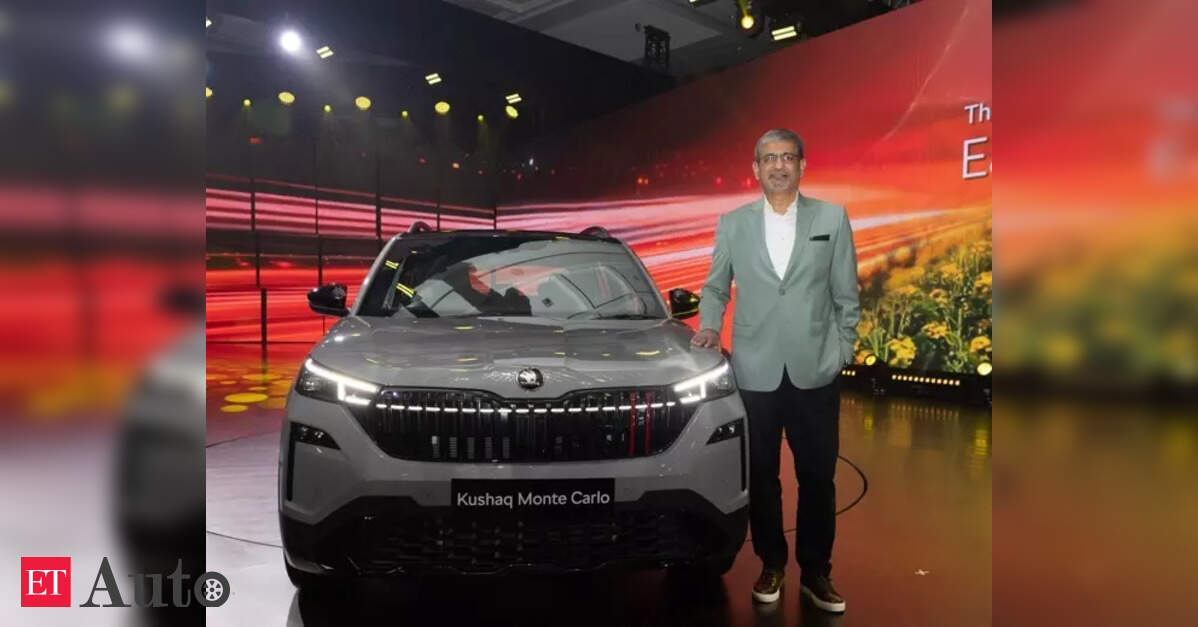
“With the automotive world becoming more and more software-driven, there are opportunities in this space to do something with partners a lot more than what it was in the past,” Piyush Arora, Managing Director and CEO, told ET Auto in a recent interview.
From that point of view, there are opportunities which can be “further leveraged” and will be in sync with the company’s strategy to develop more and more products using Indian engineering skill sets. At present, a large number of engineering suppliers are already being integrated into the development process.
It is in this context that Volkswagen Group Digital Solutions (India) in Pune has been pushing the envelope with its manpower strength growing from almost 1,000 in the initial years to nearly 4,000 today. Predominantly based in Pune, there are employees working out of facilities in Gurugram and Bengaluru too.
I do see a lot of opportunity for the Volkswagen group to source more out of India than what we are doing todayPiyush Arora
Working on global programmes
Efforts are also underway to enhance the engineering base at the Technology Centre in Pune which has already worked on product development in the India 2.0 initiative. Skoda VW will now now look at opportunities where these engineers can participate in global programmes too. “I think our efforts to bring in more products into the market is taking shape well. You can always be faster but I think from the stability and sustainability point of view, we are moving in the right direction with our overall strategy, which is being evolved as more local-for-local,” said Arora.
As he continued, “I would like to definitely state that from India 2.0 till now, when we did Kylaq and going forward with future products, we have more tool manufacturing supplier integration happening in the country.”
Skoda VW is sourcing “a lot of components” from India for other group brands through Tier 1/ 2 suppliers which head out to nearly 40 locations worldwide. “I do see a lot of opportunity for the Volkswagen group to source more out of India than what we are doing today. And we are working in that direction, not only for these two brands, but for others also,” said Arora.
Additionally, 25-30 per cent of cars produced at the Chakan facility near Pune are exported. “I would still like to cater to the Indian market and increase our share here. So at least from that point of view, 25-30 per cent exports for me is a reasonable number, which we should look at maintaining,” he added.
Good progress over the years
According to Arora, India has evolved quite a bit in the last 7-8 years, a period where Skoda VW has also made good progress. Its products are “still very well recognised” by the customer in terms of build quality, durability, driving dynamics and safety which have been its USPs for many years now.
At the same time, the market has evolved and the customer today wants a lot more features in the car. “This is what we are giving top priority today. Of course, you can have a bigger wish list which will be evaluated and addressed at the right point in time,” he said.
I firmly believe in the saying that while AI will not replace people, those people who will not use AI will get replacedPiyush Arora
Asked about the growing role of artificial intelligence within the company’s ecosystem in India, he said baby steps were being taken at this point in time even while the overall thought process within the group worldwide was to adopt AI in every process. The key, therefore, was to use its bandwidth and knowledge to the optimal extent possible.
“I firmly believe in the saying that while AI will not replace people, those people who will not use AI will get replaced. So, from that point of view, it is a tool which is going to be in your hands to improve efficiencies,” said Arora.
By the end of the day, technology “is extremely potent” and will have much higher levels of utility and penetration in the industry than what was is being seen today. “When we talk about efficiency improvement, we are looking at cost- optimisations and to remain competitive, you have no choice but to do it and reap the benefits,” he added.
Rewinding to India 2.0
When the Volkswagen Group announced its India 2.0 programme in 2018, it was a strong statement of intent to hang in there and fight it out in the world’s most competitive car market. It was also a do-or-die situation where group company Skoda Auto was entrusted with the task of lead-managing the exercise.
This initiative would see competitively priced Skoda and VW brands of cars and SUVs produced on the all-new MQB AO platform especially designed for India and other emerging markets.
The leadership team made sure that there was never any case of one-upmanship where one brand tried to outdo the other. After all, both Skoda and VW were perceived as “our babies” where it was important to ensure that neither was left wanting for attention. “We are one big family and if we see a struggle in some section, we will come out in support,” a senior executive had told this writer in an earlier interview.
For instance, Kushaq was the first to debut from the new platform but the lessons learnt were shared with the VW team that was gearing up to launch the Taigun. There was really no prodding required to be open and transparent because everyone knew that the two brands had to do well. “Sure, we have our internal rivalries — and we should because it keeps us on our toes — but we act together,” added the executive.
I think the world will start calming down only next year onwards and believe this will be a very turbulent year where we must observe events carefullyMartin Jahn
Useful brainstorming sessions
Both Skoda and VW had joint meetings on network issues because there were smaller cities/towns where the brands shared workshops. While there were separate brand experiences planned for customers, the backend was all shared because “we need representation in that particular town” and a solo business case could not possibly be conceived with Skoda or VW alone.
Hence, the emergence of the “Y solution” where, as the letter indicated, it was about having two showrooms and a joint workshop. This also helped the dealer because he would end up with lower investments on overheads, manpower and also manage the ups and downs of one business versus another.
Fast forward to the present and Skoda VW will have reasons to be pleased especially with the heady market response to Kylaq. The bigger worry, however, is the ongoing war in the Middle East which has the potential to cause massive disruptions in overseas shipments as well as fire up fuel prices.
This is going to be a particularly difficult period for automakers worldwide. “At the moment, it is not a good idea to take very quick steps and rush into something I think the world will start calming down only next year onwards and believe this will be a very turbulent year where we must observe events carefully,” Martin Jahn, Board Member, Sales & Marketing, Skoda Auto, had told ET Auto earlier this year.