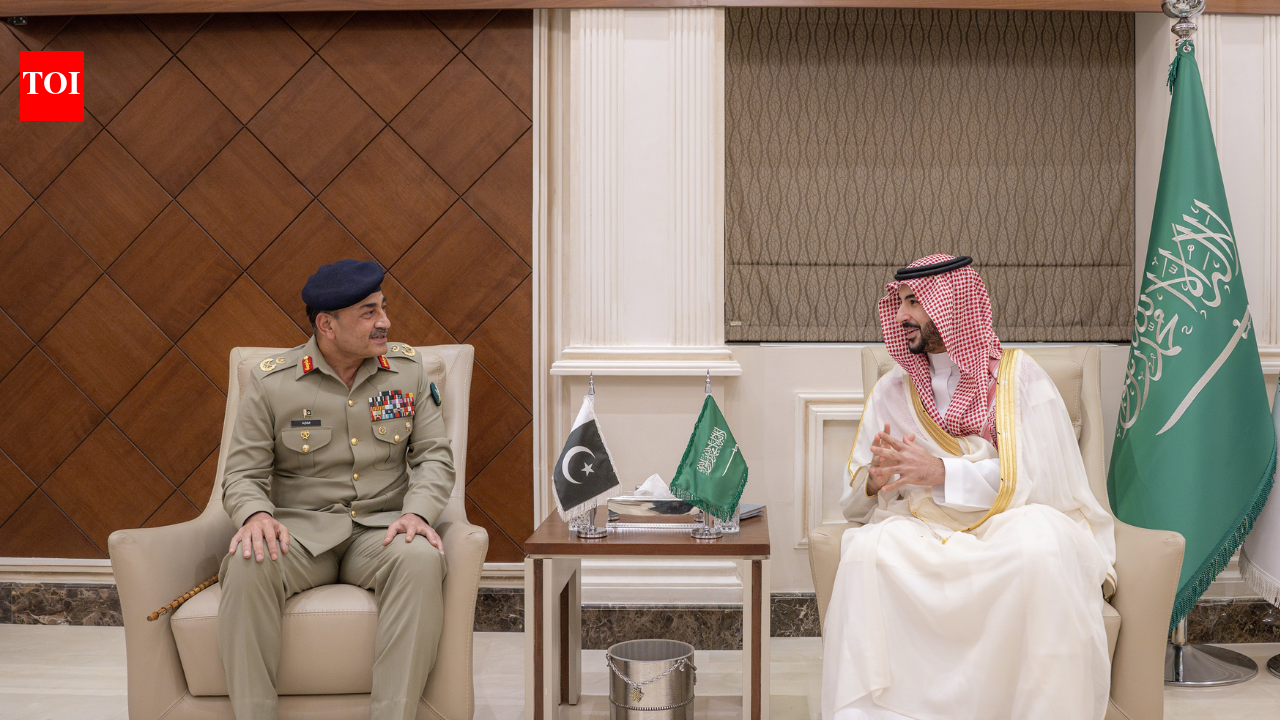

Pakistan army chief Asim Munir meets Saudi Arabia defence minister (Picture from X)
Pakistan army chief and the country’s de facto leader Asim Munir has met Saudi Arabia’s defence minister Khalid bin Salman amid the constantly evolving situation in the Middle East. The meeting comes days after Saudi Arabia’s Aramco oil refinery was hit and after US-Israel joint strikes killed Iran’s Ali Khamenei, triggering Tehran to launch strong retaliatory military actions across the Middle East region and raising fears of a wider regional conflict.The Saudi defence minister shared details of the meeting on X while highlighting Iranian strikes on the Kingdom. Sharing a picture with Munir, he wrote, “Met with Pakistan’s Chief of Army Staff and Chief of Defense Forces, Field Marshal Asim Munir. We discussed Iranian attacks on the Kingdom and the measures needed to halt them within the framework of our Joint Strategic Defense Agreement. We stressed that such actions undermine regional security and stability and expressed hope that the Iranian side will exercise wisdom and avoid miscalculation.
Israel Iran War
” The meeting can be viewed as strategically important. Months earlier, according to a Bloomberg report, Turkey had sought a defence alliance with nuclear-armed Pakistan and Saudi Arabia in a triangular form of an “Islamic Nato”, an effort aimed at reshaping security alignments in the now-disturbed Middle East and beyond.
Days ago, when Saudi Arabia’s Aramco refinery was struck by Iranian attacks, Pakistan issued strong reactions, expressing solidarity with Riyadh as well as with other Gulf countries. As tensions continue to rise, with Iran maintaining its missile and drone attacks, questions are being raised about whether Islamabad’s response will go beyond verbal condemnation, given its 2025 Strategic Mutual Defence Agreement with Riyadh.The pact, initially signed by Pakistan and Saudi Arabia in September, reportedly states that “any aggression” against one member would be treated as an attack on all, a provision similar to Article 5 of Nato, under which member states commit to collective defence.Talks on Turkey’s possible entry into the arrangement are said to be at an advanced stage, with a deal appearing likely, people familiar with the matter told Bloomberg on condition of anonymity. According to the report, the proposed expansion reflects the growing overlap in the strategic interests of Turkey, Saudi Arabia and Pakistan across South Asia, the Middle East and parts of Africa.
Will Pakistan step up?
The pact’s collective defence clause treats aggression against one as an attack on both, building on decades of military ties. However, its core provisions focus on conventional cooperation such as joint exercises, intelligence sharing and drones, without nuclear commitments.Pakistan Prime Minister Shehbaz Sharif, in a call with Crown Prince Mohammed bin Salman, pledged “full solidarity” and support for peace efforts rather than military deployment.Experts say sending troops could draw Pakistan into a wider conflict, further straining its fragile economy and security situation.“The Saudi-Pakistan defence pact is more of a political and strategic partnership rather than a classical defence pact akin to Nato. Pakistan has publicly condemned the Iranian attack on the Saudis and expressed solidarity and nothing beyond that. Pakistan in no way will get into any kind of military involvement as it has enough on its hand both externally with Afghanistan and internally with TTP and BLA. This once again exposes the double standards which Pakistani leadership has been exhibiting from time to time,” said Major General Rajan Kochar (Retd).Experts add that Islamabad is more likely to limit its support to diplomacy, logistics or overflight rights rather than sending troops. Go to Source