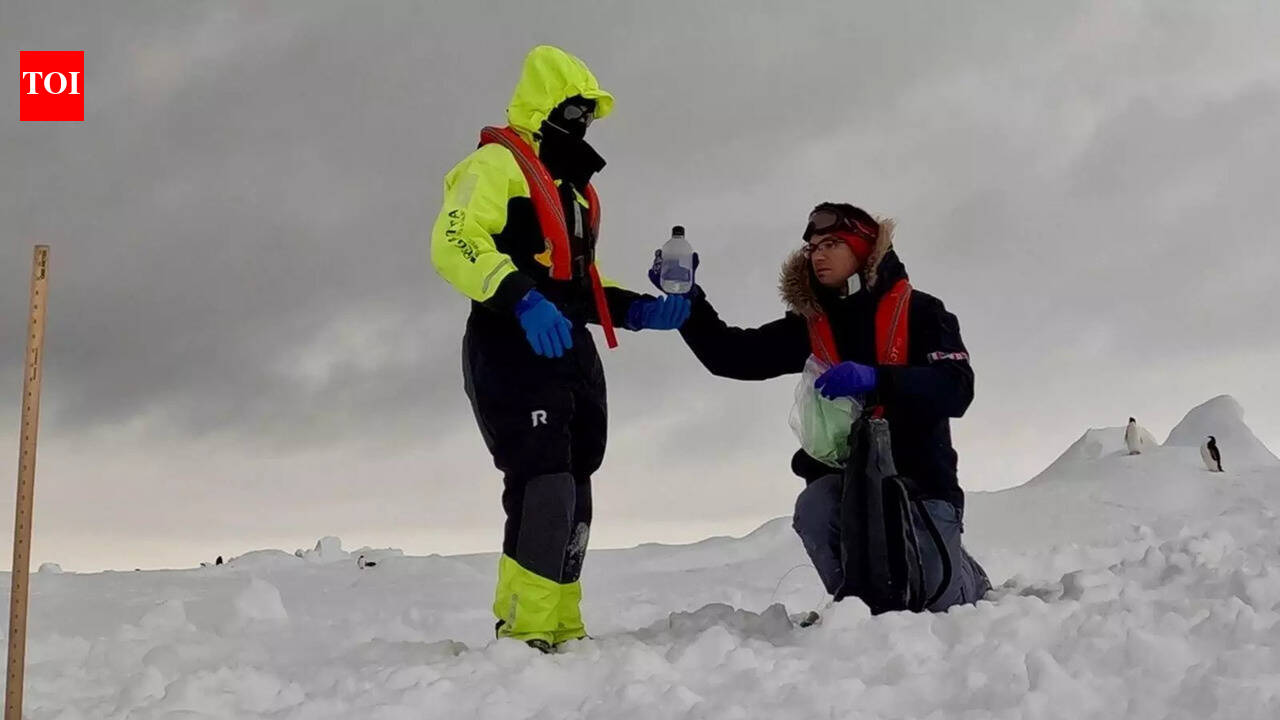

NASA studies Antarctic seawater to support search for life beyond Earth (Image Source – NASA)
At the edge of the Antarctic Peninsula, far from research stations and tourist routes, a small team collected seawater in conditions that are not easily reached. The work forms part of a wider effort led by scientists linked to NASA and the University of Maryland. Their focus is not on Antarctica alone. It is the possibility that oceans exist beneath thick ice on distant worlds. By studying dark, isolated water on Earth, researchers hope to understand what may happen when subsurface oceans on other planets or moons erupt into space. The samples gathered in late 2025 are now back in Maryland, where they will be tested to see how organic compounds and salts behave under space-like conditions.
NASA thinks Antarctic waters mirror hidden oceans beyond Earth
Scientists believe several icy bodies in the solar system contain liquid water beneath frozen crusts. Among them are Europa, Enceladus and Pluto. These ocean worlds may contain carbon, nitrogen and chemical energy, ingredients associated with life.Unlike Earth’s oceans, these environments receive no sunlight. In Antarctica, certain water masses remain sealed under permanent ice cover, offering a loose comparison. The Weddell Sea and the deep Circumpolar Current provide cold, dark conditions that echo what might exist far beyond Earth. Researchers Mariam Naseem and Marc Neveu gathered samples from sea ice and from depths of more than 1,000 metres. The process required drilling into ice and lowering equipment through narrow openings that constantly shifted as surrounding ice pressed inward.
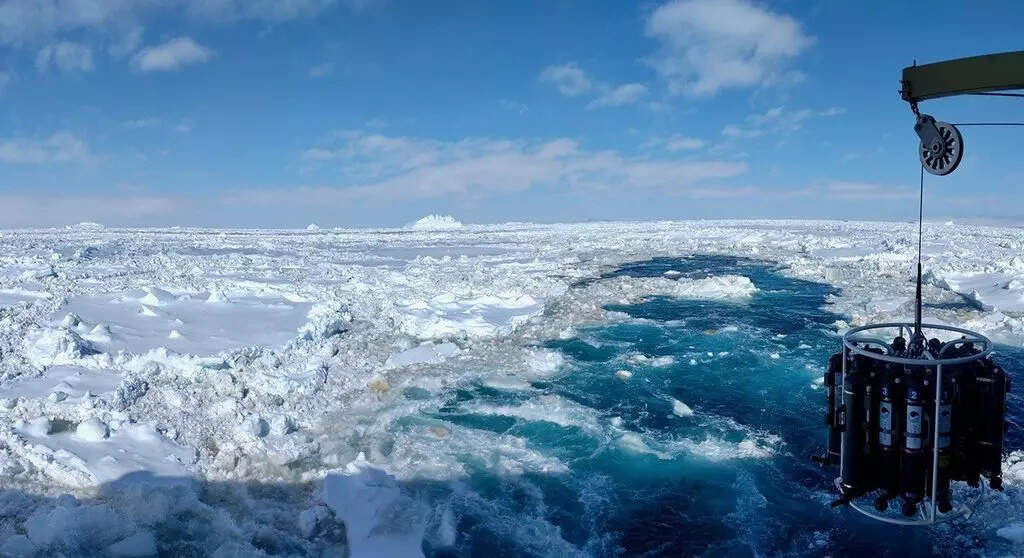
NASA thinks Antarctic waters mirror hidden oceans beyond Earth (Image Source – NASA)
The eruption of water, ammonia, or methane on cold, outer solar system bodies shapes how material escapes into space
On some icy moons, subsurface water does not remain sealed. It erupts through cracks in the ice in a process known as cryovolcanism. This has been observed on Enceladus, where plumes of water vapour and ice particles are ejected into space.Such plumes offer spacecraft the chance to sample ocean material without drilling through kilometres of ice. Yet the journey from ocean to vacuum may alter delicate molecules. Rapid freezing and exposure to space can change or destroy organic compounds such as amino acids. To explore this, the team uses a laboratory device called the Simulator of Ocean World Cryovolcanism. It injects liquid samples into a vacuum chamber that mimics the pressure and temperature of space. The aim is to measure what survives that transition.
Laboratory analysis will track chemical changes
Back in Maryland, the Antarctic samples will be divided. One portion will be tested directly. The other will pass through the simulator. Scientists will then compare the chemistry of both sets using chromatography to identify changes in salts, fatty acids and amino acids.Transporting the frozen samples required careful handling after several flight disruptions between Argentina and Washington. The material arrived intact. The study does not claim to prove life exists elsewhere. It asks a quieter question about what signs might endure if it does. In that sense, the ice at the bottom of the world becomes part of a much wider search. Go to Source