
 "India’s submarine saga: A big boost for Navy as Project-75(I) takes a leap from Scorpene")

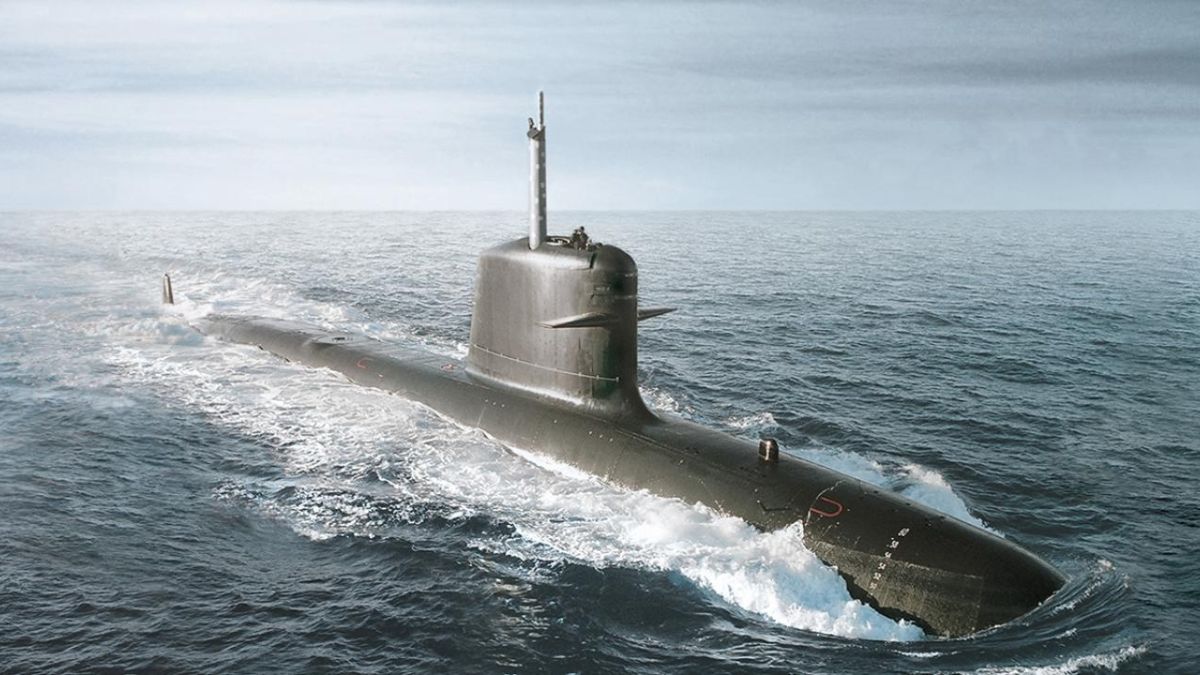
India’s current conventional submarine fleet rests on the Kalvari-class, which is the locally built variant of France’s Scorpene design. These submarines were constructed at Mazagon Dock Shipbuilders Ltd (MDL) under Project-75 in collaboration with Naval Group, and six boats are now in service or nearing induction. This programme not only gave India a modern diesel-electric submarine (SSK), but also helped MDL regain complex submarine-building skills after a long break.
The follow-on programme, Project-75(I), is a deliberate departure from the Scorpene lineage. On August 23, the Cabinet Committee on Security (CCS) cleared formal negotiations for six new submarines to be built with Germany’s ThyssenKrupp Marine Systems (TKMS).
Unlike the Scorpenes, these will be larger, feature advanced stealth shaping and incorporate fuel-cell Air Independent Propulsion (AIP) from the outset. With an estimated project cost of about Rs 70,000 crore, the government is signalling both a technological leap and a bid to secure deeper technology transfer to India.
Propulsion: AIP at the core
The propulsion story highlights the clearest difference between the two classes. The Kalvaris were built without AIP because India’s indigenous DRDO-developed phosphoric acid fuel-cell system was not ready.
The navy always planned to retrofit this during mid-life upgrades by inserting an AIP module, but the DRDO programme has been delayed, forcing the first refits to proceed without the technology, a Times of India report said. As a result, today’s Kalvaris remain dependent on batteries recharged by diesel generators, which limits how long they can stay underwater without snorkeling.
The German submarines proposed under Project-75(I) take the opposite approach where AIP is central, not optional. TKMS has decades of experience with fuel-cell AIP in its Type 212 and Type 214 classes, which can operate silently underwater for two to three weeks at a time. India’s boats will use a variant of this proven technology, which means they will not have to wait for retrofits or unproven indigenous systems before gaining long-endurance stealth.
Range, endurance and mission set
Kalvari-class submarines are capable of strong littoral missions, including anti-ship strikes with Exocet missiles, anti-submarine warfare with heavyweight torpedoes and surveillance in coastal waters.
However, without AIP, their battery endurance allows only about 48 hours of true submerged operations before needing to snorkel and recharge. With DRDO’s AIP—if and when it is integrated—this endurance could extend to roughly 14–21 days, but this is still years away, Business Standard reported.
The German-built submarines under Project-75(I) will immediately support longer patrols across the Indian Ocean. Their design, drawing from the Type 214 lineage, is optimised for quiet long-distance missions and for staying hidden under modern surveillance threats, including drones and maritime patrol aircraft.
The ability to loiter silently at choke points such as the Malacca Strait approaches or the Arabian Sea will give India a far more credible deterrent presence than the Scorpenes currently allow.
Sensors, signatures and combat systems
The Kalvaris are well-equipped for their generation, with good sonar, electronic warfare masts and combat-management systems. Their acoustic profile has improved with each successive hull, showing that MDL has gained confidence in building quiet boats. Nevertheless, their design decisions reflect early 2000s technology and their stealth can only be incrementally improved with refits.
Project-75(I) submarines, by contrast, are being conceived around newer stealth principles. TKMS’s work on machinery isolation and hydrodynamic shaping for its Type 212/214 submarines is well regarded globally.
India’s P-75(I) boats are expected to benefit from those advances, paired with modular combat systems that can integrate advanced Indian and foreign weapons. This combination will give the Navy a higher chance of detecting adversaries first and prosecuting attacks in contested waters.
Industrial effects
Project-75 demonstrated that India can build submarines under license and the Kalvari series proved MDL’s ability to deliver complex boats on schedule once the line matured. This experience is crucial as it supports fleet sustainment, mid-life upgrades and the future integration of DRDO’s indigenous AIP once ready.
Project-75(I) takes the ambition further. The government has mandated deeper technology transfer and local content, starting at around 45 per cent indigenous content for the first boat and reaching about 60 percent by the sixth.
This pushes India toward co-designing, not just assembling. If executed as planned, P-75(I) will help MDL evolve from a build-to-print yard into a design-capable submarine house, laying the groundwork for the indigenous Project-76 submarines and complementing the parallel nuclear attack submarine programME with L&T.
Force-structure impact and timelines
The Kalvaris are valuable in the near term, replacing aging Soviet-era Kilos and German-built Type-209 Shishumars. Yet delays in DRDO’s AIP programme, coupled with retirements, mean that India faces a looming submarine shortfall just as Pakistan inducts Chinese-supplied Yuan-class AIP boats and the Chinese Navy increases its Indian Ocean patrols, Economic Times reported. In this context, keeping the Kalvaris upgraded, including sonar and battery modernisations, is critical to hold the line until new boats arrive.
Project-75(I) represents the medium-term answer. Negotiations are expected to finish in six months, after which contracts will be signed. Even with ambitious schedules, the first submarine will take years to deliver, but once production begins, a steady cadence will restore fleet numbers with vastly more capable boats.
The combination of higher endurance and stealth will enable India to project deterrence far from its shores, giving the navy a sharper tool for sea denial and area control.
How each class boosts India’s maritime posture
Kalvari-class submarines provide a modern, reliable and already available undersea punch. They are suited to defending India’s coasts, shadowing adversary surface groups and deterring blockade or coercion.
Their presence compels adversaries to allocate significant anti-submarine resources and creates uncertainty in their planning. As AIP retrofits eventually materialise, these boats will gain longer endurance, enhancing their value in both littoral defence and limited open-ocean denial.
The submarines under Project-75(I) will expand the navy’s horizons further. By combining built-in AIP endurance, newer stealth architecture and a stronger industrial base, they will allow India to conduct weeks-long covert patrols, monitor vital shipping lanes and interdict adversary naval forces at greater ranges.
Their induction, alongside nuclear-powered attack submarines being developed in parallel, will give India a layered undersea force structure: Kalvaris for near-term and coastal/littoral roles and P-75(I) boats for sustained operations across the Indian Ocean. This blend secures sea-lane access, deters rival naval interventions and enhances India’s credibility as a regional maritime power.
End of Article


&description=India%E2%80%99s+submarine+saga%3A+A+big+boost+for+Navy+as+Project-75%28I%29+takes+a+leap+from+Scorpene)