
What is the difference between asteroids, comets, and meteors
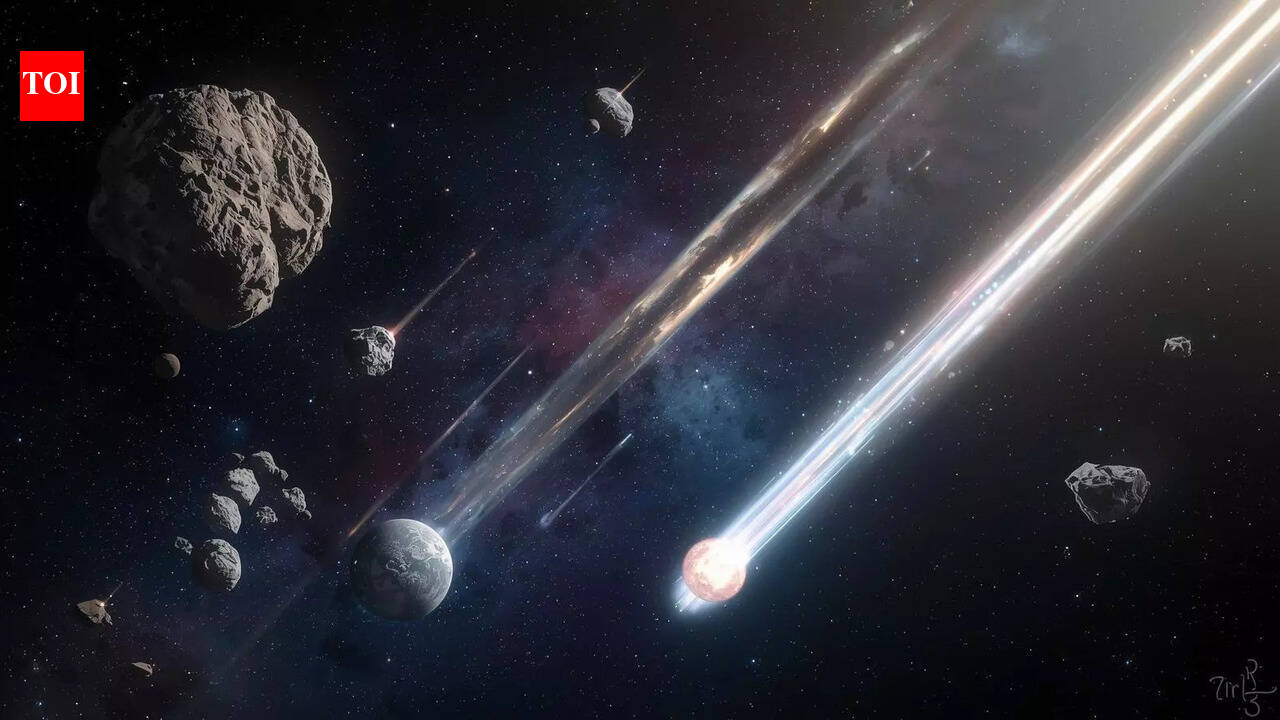
Space around the Sun contains far more than planets. Scattered through it are smaller bodies made of rock, metal, ice and dust. These objects move on their own paths, sometimes quietly beyond Jupiter, sometimes crossing close to Earth. The terms ‘asteroid’, ‘comet’ and ‘meteor’ are often used loosely in conversation, yet they describe different stages or types of material in the Solar System. Scientists track them not only for curiosity but also for safety and long-term research. Observatories and space agencies, including NASA, monitor thousands of these bodies each year. Some are leftovers from planet formation 4.5 billion years ago. Others are fragments from collisions. Together, they form a record of how the solar system developed.
Asteroids vs Comets vs Meteors: Know how they differ in origin, composition and behaviour
Asteroids, comets and meteors are often grouped, but they are not the same. They differ in what they are made of, where they travel, and how they appear when observed from Earth. Some remain as rocky or icy bodies moving quietly through space, while others briefly flash across the sky as bright streaks of light. Understanding these distinctions offers insight into how the solar system formed and how it continues to evolve over time.
| Category | What it is | What it is made of | Where it is found | What happens near Earth |
| Asteroid | Small rocky or metallic object orbiting the Sun | Rock and metal | Mostly in the asteroid belt between Mars and Jupiter, though some move near Earth | Remains a solid body in space; may be tracked if it crosses Earth’s orbit |
| Comet | Icy body orbiting the Sun | Ice, dust and rock | Formed in the outer Solar System beyond Jupiter | Ice turns to gas near the Sun, forming a glowing coma and long tail |
| Meteor | Streak of light in the sky | Produced by a burning meteoroid | Occurs in Earth’s atmosphere | Appears as a shooting star when debris burns up |
Asteroids are basically the leftover bits from when planets were first being made
Asteroids are generally small objects made of rock and/or metal orbiting the Sun. A majority are found in the asteroid belt located between Mars and Jupiter, while some have various orbital paths that bring them close to the Earth. Typically, they have an average size of more than one metre, and many have a quite irregular shape.Since asteroids have hardly changed over the period of billions of years, they are regarded as a reservoir of the most pristine materials from the time when the Solar System was formed. Spacecraft, such as OSIRIS-REx, have collected samples from these bodies and brought them back to the Earth to be examined in laboratories.
Comets are mostly made of ice and they produce a glowing coma and a tail
Comets are like the solar system’s snowballs that come from the icy outer parts beyond Jupiter. They are a mixture of ice, dust, and little rocks. As a comet gets nearer to the Sun, the heat from the Sun causes the ice to sublimate (change from solid form to gas). This results in the release of dust, and a cloud of gas and dust called a coma forms around the nucleus. The tails of comets can be of an enormous length, millions of kilometres, and they always point away from the Sun. Comets are faint and distant for most of their orbital period. It is only when they come close to the inner Solar System that they become active and sufficiently bright to be seen.
Meteoroids, meteors and meteorites describe different stages of space debris
A meteoroid is a smaller fragment of rock or metal in space, usually less than one metre in size. Many originate from asteroid collisions or from debris shed by comets.When a meteoroid enters Earth’s atmosphere at high speed, friction heats it and produces a bright streak of light. That streak is called a meteor, often known as a shooting star. Most burn up completely. If a part survives and reaches the ground, the remaining piece is called a meteorite.
Near-Earth objects are tracked for planetary defence
Some asteroids and comets pass within 50 million kilometres of Earth’s orbit. These are known as near-Earth objects. Large ones are rare, and most have already been identified. Smaller bodies are more numerous and harder to detect. Monitoring continues through telescopes and survey programmes. The work is steady and technical. Much of it passes unnoticed, carried out in observatories under ordinary night skies. Go to Source