
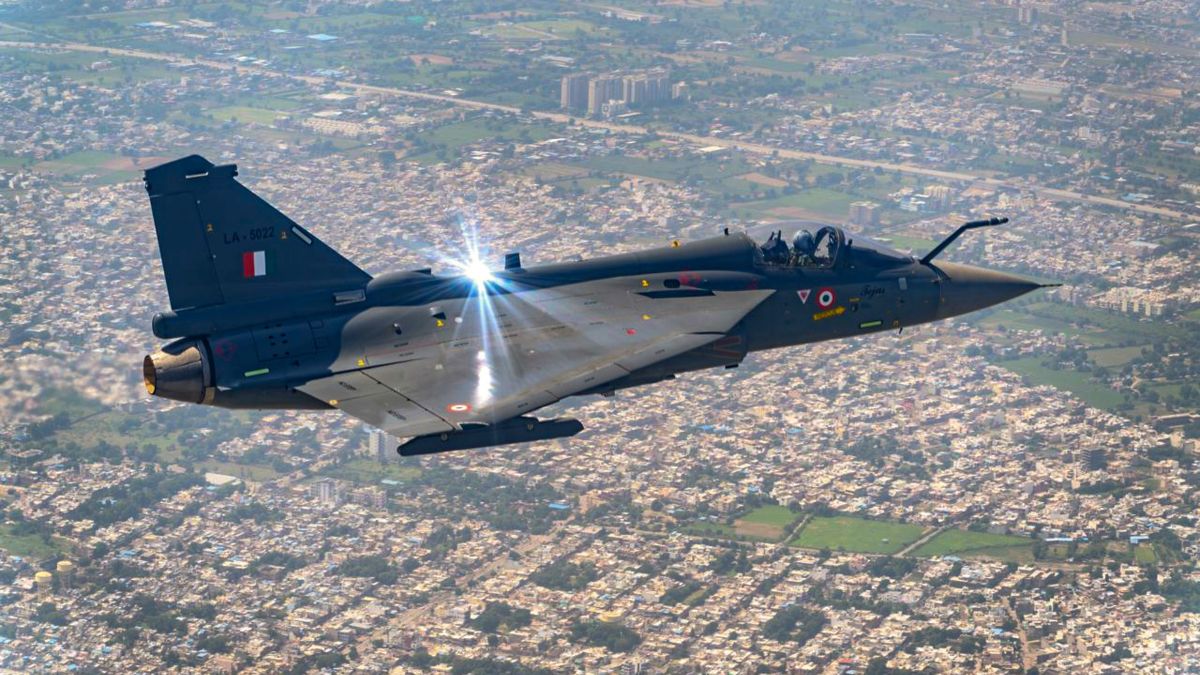
 "HAL-GE talks to start soon for making fighter jet engines in India for Tejas Mk2: Report")

Talks between Hindustan Aeronautics Limited (HAL) and US defence major General Electric (GE) Aerospace to co-produce fighter jet engines in India for the Tejas Mk2 are set to begin soon, says report.
Two years after Hindustan Aeronautics Limited (HAL) and US defence giant General Electric (GE) Aerospace signed an agreement, the two sides are now set to begin commercial negotiations to manufacture fighter jet engines in India for the Tejas Mk2, The Indian Express reported.
The report also said that the Defence Research and Development Organisation (DRDO) has finalised French company Safran to partner with Bengaluru-based Gas Turbine Research Establishment for manufacturing an advanced jet engine in India. This engine will power the country’s indigenous fifth-generation Advanced Medium Combat Aircraft (AMCA).
Officials cited in the report said the aim is to complete discussions on the HAL-GE deal within three months and finalise the agreement to co-produce F414 engines, which are designed for the Light Combat Aircraft Mk2 jets of the Indian Air Force.
GE Aerospace had signed a Memorandum of Understanding (MoU) with HAL in June 2023 for the production of fighter jet engines. The pact was first announced during Prime Minister Narendra Modi’s state visit to the US.
The final deal was expected soon after clearances from the US Congress and the conclusion of commercial terms. While Congress approved the engine deal in August 2023, negotiations have continued over the past two years.
Officials said GE Aerospace has agreed to transfer 80 per cent of the engine technology to India after years of negotiations since 2012, but certain critical components remain excluded from the transfer.
The main parts of a jet engine are the compressor, combustion chamber and turbine.
Back in 2012, GE Aerospace had offered to transfer only 58 per cent of the technology. Under the current 80 per cent transfer, the company is offering 12 key technologies. These include special coatings against corrosion, erosion and heat, as well as machining and coating for single-crystal turbine blades, nozzle guide vanes and other hot-end parts, along with blisk machining.
Despite some limitations, officials said commercial talks remain on track and the deal is likely to be finalised within the next three months, before the end of the year.
End of Article


&description=HAL-GE+talks+to+start+soon+for+making+fighter+jet+engines+in+India+for+Tejas+Mk2%3A+Report)