


AI image
Whenever the subject of men’s loneliness or men’s mental health comes up, the conversation almost always follows the same path. It turns into a reckoning. A reminder. Sometimes even a punishment.Men built this system.Men benefit from patriarchy.Men commit violence against women.So why should we feel sorry for them now?None of this is untrue. Patriarchy is real. Gendered violence is real. Women have borne the heaviest cost of systems created and upheld largely by men. Acknowledging male loneliness does not erase that reality.But somewhere along the way, the conversation becomes so rigid that it stops seeing men as individuals and starts treating them as a single, guilty category. And that’s where something important gets lost.Because not all men are perpetrators. Not all men are powerful. And not all men feel seen by the system they are assumed to benefit from.But what about the man who genuinely respects women, who does not subscribe to regressive ideologies, who feels no ownership over the beliefs of his ancestors, and who is trying, quietly and consistently, to do what society expects of him?These men exist in large numbers, yet they are almost entirely absent from public conversations about male loneliness. This article is about them.
Misunderstood nature of male loneliness
Loneliness, despite common misconceptions, is not merely the absence of romantic intimacy. It is a subjective emotional experience characterised by a perceived gap between desired and actual social connection. Recent discussions around a so-called “male loneliness epidemic” often reduce the issue to dating failures or sexual frustration, particularly online.However, empirical research consistently shows that male loneliness extends far beyond romantic relationships. Men can be married, employed, socially functional, and still profoundly lonely.Studies suggest that men often experience loneliness differently from women. While women tend to maintain emotionally intimate friendships and family ties throughout adulthood, men are more likely to rely on structured social contexts—such as workplaces, educational institutions, or group activities—to sustain relationships. When these structures weaken or disappear, men are less likely to replace them with emotionally open connections. As a result, loneliness can persist unnoticed, even by the men experiencing it.Crucially, research also indicates that many men do not self-identify as “lonely,” even when they exhibit psychological markers associated with chronic loneliness. This disconnect is especially pronounced in India, where cultural norms discourage emotional introspection in men and valorize endurance over expression.Counselling psychologist Dr Ishita Mukerji observed this pattern repeatedly in clinical settings: “I have seen a lot of times in therapy that, you know, many male clients of mine say that I don’t know what I feel. I just know something is wrong. I try to think about it but I don’t get an answer. So they really don’t know, right, what and how they’re feeling. This confusion is not their fault. It is the result of growing up without that emotional permission. They sometimes are numb, emotionally very numb.”
Indian context
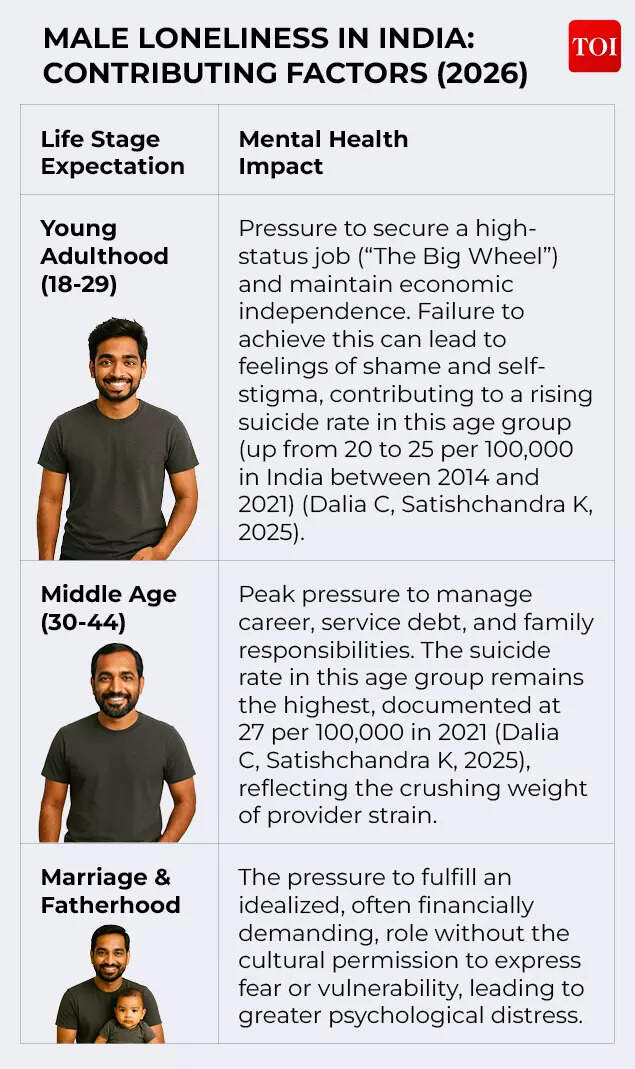
India’s cultural framework places immense emphasis on masculinity as duty. Men are socialised from an early age to internalize responsibility—towards parents, siblings, spouses, children, and society at large. Emotional needs, in contrast, are often framed as indulgent or secondary. This produces what many researchers describe as a “provider burden,” where a man’s worth is tied almost exclusively to his economic utility.Recent data underscores the scale of the problem. A study conducted by the Indian Psychiatric Society found that over 20% of Indian men report experiencing loneliness. Another study by the National Sample Survey Organization revealed that nearly 45% of Indian men feel lonely, with urban men reporting the highest levels. These numbers point to a widespread phenomenon rather than isolated individual distress.
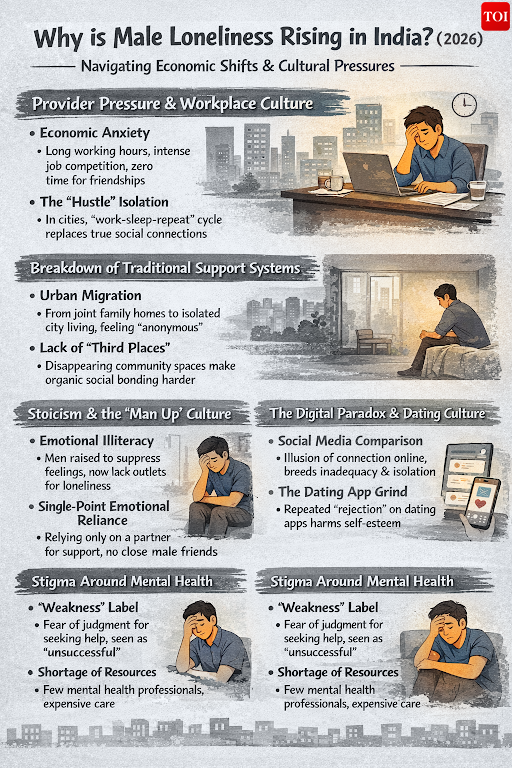
Dr Mukerji explained how deeply financial instability can destabilise a man’s sense of self:“What happens is that when a person when a man loses a job, or he’s earning less, or he’s if he’s struggling financially, it doesn’t feel like a normal life to him, it actually feels like a personal failure. And this creates deep shame, stress, anxiety, and depression as well. Married men feel the pressure most. Because it’s not just they responsibility for themselves, they’re carrying responsibility for their wives, children, parents, extended family. They don’t allow themselves to feel or say, “I’m tired,” or “I’m struggling.” So when stress keeps building, and there is no emotional outlet, some men start feeling hopeless and extremely depressed.”Sanyam Kapoor, a 28-year-old product manager, when asked whether he ever feels his value as a human being is tied to his bank balance or job title, says, “I don’t want it to be, but yeah, it sneaks in. Especially when things aren’t going great financially. It’s hard not to measure yourself that way when that’s what gets noticed first.”Urbanisation has intensified this issue. Modern Indian cities often lack communal spaces that facilitate organic social bonding. Extended families have fragmented into nuclear units, neighborhoods have grown anonymous, and work hours have expanded. In this environment, men frequently find themselves socially functional but emotionally disconnected.
Restrictive emotionality and the cost of masculine norms
One of the most significant psychological constructs relevant to male loneliness is “restrictive emotionality,” a term introduced by Levant in 1995. Restrictive emotionality refers to the learned inhibition of emotional expression, particularly emotions associated with vulnerability such as sadness, fear, or loneliness. According to psychologist Agneta Fischer, emotional expression is not biologically predetermined but shaped through social learning—a process heavily influenced by gender norms.In India, boys are often taught—explicitly or implicitly—that emotional restraint is a marker of strength. Crying, expressing confusion, or admitting loneliness is frequently met with ridicule or concern about masculinity. While men and women experience emotions to similar degrees, men are more likely to redirect vulnerable emotions into socially acceptable outlets such as anger, withdrawal, or stoicism.Kapoor explained why emotional restraint often feels like self-protection rather than denial.“All the time. Not because I think weakness is bad in theory — but because once you say it out loud, you can’t take it back. People look at you differently. Sometimes they worry. Sometimes they dismiss it. Either way, the dynamic changes.”This emotional suppression has tangible consequences. Chronic stress, untreated emotional distress, and prolonged loneliness can contribute to depression, anxiety, substance abuse, and physical health problems.
Suicide, mental illness, and gendered outcomes
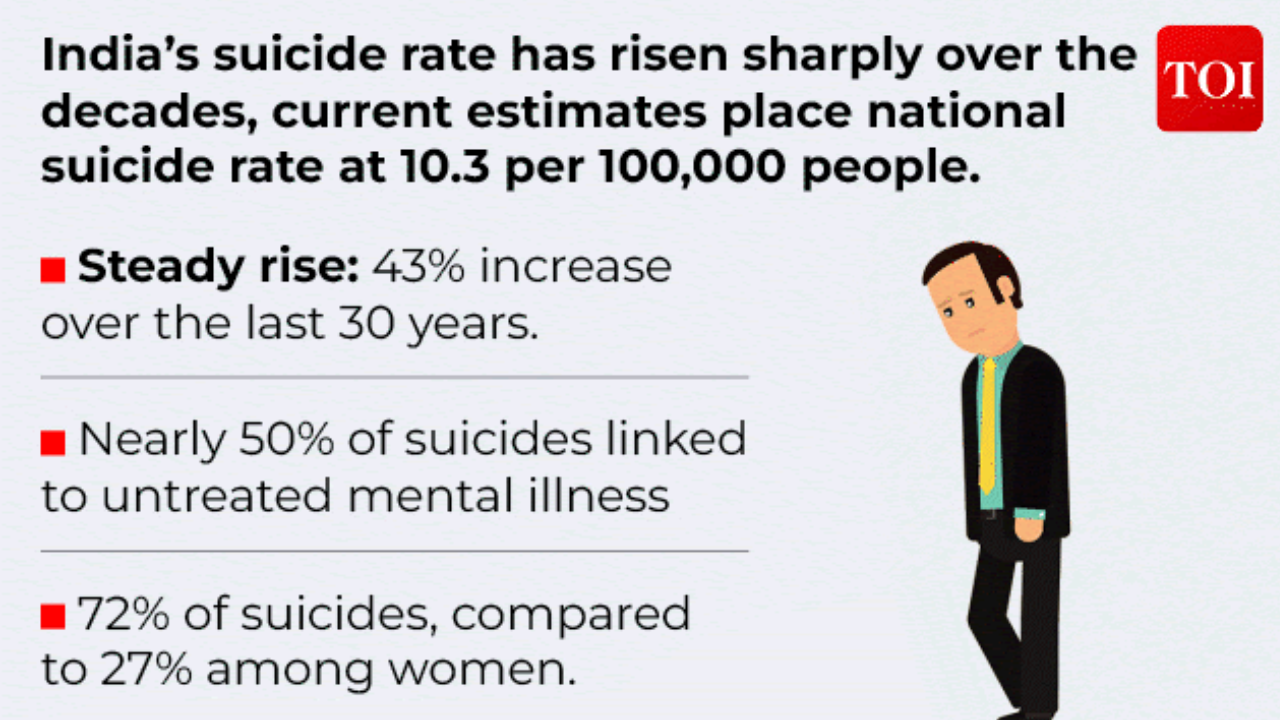
These numbers are not abstract. In recent years, several cases have drawn public attention to the emotional distress faced by men navigating marital conflict and prolonged isolation. In one such case, a 30-year-old executive employed with a major IT firm died by suicide at his family home in Agra. Prior to his death, he recorded a video describing an overwhelming sense of loneliness and urged greater societal awareness of men’s mental health struggles, particularly the emotional isolation men experience during personal and legal disputes.”Please, someone should talk about men. They become very lonely. If laws do not protect men, then there will be no man left to be accused…” said Manav in his note.A 22-year-old architecture student from a private engineering college in Bengaluru died by suicide last week, allegedly due to ragging. Before taking the extreme step, the student, identified as Arun, recorded a video blaming his peers and expressing emotional distress over being spoken about behind his back.A native of Hassan, Arun was a final-year architecture student who had secured a free seat at his college owing to his academic performance. His parents, daily-wage labourers, had struggled financially to support his education. Arun was also known to be a talented portrait artist. He recorded a video message detailing his anguish, mentioning that friends had been speaking ill of him behind his back.This disparity is often misunderstood. Women are statistically more likely to experience depression, yet men are significantly more likely to die by suicide. Research suggests that this paradox is linked to differences in help-seeking behavior, emotional expression, and method lethality. Men are less likely to seek professional support and more likely to reach crisis points without intervention.A 2023 study found that suicide rates among Indian men are particularly high among married men and daily wage workers—groups traditionally assumed to be socially anchored. This challenges the assumption that marriage or employment alone protect against loneliness or mental distress.A 35-year-old man, married with one child and working at a consulting firm, chose to remain anonymous. He described his life as stable, predictable—and emotionally narrow. “I wouldn’t say I’m unhappy,” he said, “but I don’t feel connected either.” Most of his close friendships gradually faded after marriage, and although he shares a home with his spouse, he feels uneasy bringing up his stress or exhaustion. “I don’t want to burden her,” he explained. “I’m supposed to handle things.”
Patriarchy and the myth of collective guilt
Addressing male loneliness does not negate feminist concerns, it complements them by targeting one of patriarchy’s quieter casualties.It is important to acknowledge that patriarchy harms women disproportionately and violently. However, it is also true that patriarchy diminishes men by restricting emotional expression and reducing identity to productivity. The idea that men “deserve” loneliness because they benefit from patriarchy overlooks the fact that most men do not experience power as autonomy or choice, but as obligation.Holding individual men morally accountable for historical and structural injustices obscures the real issue: systems that socialise men into emotional isolation while offering no legitimate pathways for connection.When asked, 23-year-old journalist Pranav Shukla, what stops men from talking openly about mental health, in your experience? He said, “I think men are conditioned not to talk about it. Society often labels them as weak when they do, which makes opening up harder. That said, things are slowly changing and more men are beginning to speak openly about mental health.”
Friendship recession
Friendships are often the first relationships we form outside our families, and they play a crucial role in emotional and social development. In theory, friendships should remain one of the most important emotional anchors throughout adulthood. In practice, however, male friendships often change shape rather than deepen.Sociologist Daniel Cox coined the term “friendship recession” to describe the steady decline in close friendships across industrialised societies. While much of this research has focused on Western contexts, similar patterns are becoming increasingly visible in India as well. Men, in particular, report having fewer close friendships over time and describe greater difficulty forming new ones after early adulthood.It is important to recognise the real value that male friendships offer while also acknowledging their limitations. Many men do not lack friends, nor do they lack affection or loyalty within those friendships. What is often missing is emotional articulation. It is not that men do not want to talk about their personal victories, their disappointments, or their insecurities; rather, many hesitate because they are unsure how such openness will be received. The unspoken rule becomes one of mutual distraction—spending time together, sharing experiences, and silently hoping that presence alone will be enough.This dynamic is reflected in the experience of Ansh Srivastava, a 22-year-old software developer working in Gurgaon. “I always have a fair guess of what’s going on in my closest friends’ lives but never the whole picture. The whole point of male friendships is to spend time together through the lowest and not talk about it and feel better by the presence of their friend. I don’t think I’ve ever had a conversation about my mental health or my friends’ mental health ever, it’s always external events, even though he is literally a part of my family and vice versa.
Do romantic relationships solve loneliness?
There is a persistent assumption that romantic relationships function as a remedy for male loneliness. While intimacy can provide emotional support, research indicates that relying solely on a partner for emotional fulfillment can be precarious. Men who lack broader social networks may experience intense loneliness following relationship conflict, separation, or loss.Moreover, when emotional labor is outsourced entirely to romantic partners, it can strain relationships and reinforce dependency rather than resilience.Dr Mukerji emphasised that mental health care should not be framed as a competition:“From a clinical point of view, if we talk about mental health care, it is not just about comparing who suffers more. It is about, helping people who are struggling and supporting men’s mental health does not just take away from women’s issues. In fact, healthier men leads to healthier families and relationships. It is very important for men to take care of their mental health irrespective of whatever is happening.”Loneliness, therefore, must be addressed as a social condition rather than an individual romantic deficit.
Towards solutions
Addressing male loneliness in India requires interventions at multiple levels:Cultural change: Challenging restrictive norms around masculinity and emotional expression is essential. Vulnerability must be reframed as a human capacity rather than a gendered weakness.Institutional support: Mental health education should be integrated into schools, workplaces, and community organizations. Affordable and accessible mental health services are critical, particularly for working-class men.Community building: Encouraging participation in community groups, sports clubs, volunteering, and peer support initiatives can help rebuild social capital.Policy reform: Mental health must be treated as a public health priority. Data collection, funding, and targeted programs for men at high risk of isolation are necessary.Male loneliness in India is not a fringe concern or an online exaggeration. It is a widespread, under-acknowledged phenomenon with serious consequences for mental and physical health. While patriarchy shapes this crisis, it does not justify indifference to male suffering. The men who quietly shoulder responsibility, who respect others, and who strive to meet societal expectations deserve to be seen—not as perpetrators by default, but as human beings navigating structural silence.If we are to build a society that values mental well-being, we must move beyond blame and toward understanding. Loneliness, after all, is not a moral failing. It is a signal—and one that India can no longer afford to ignore. Go to Source