
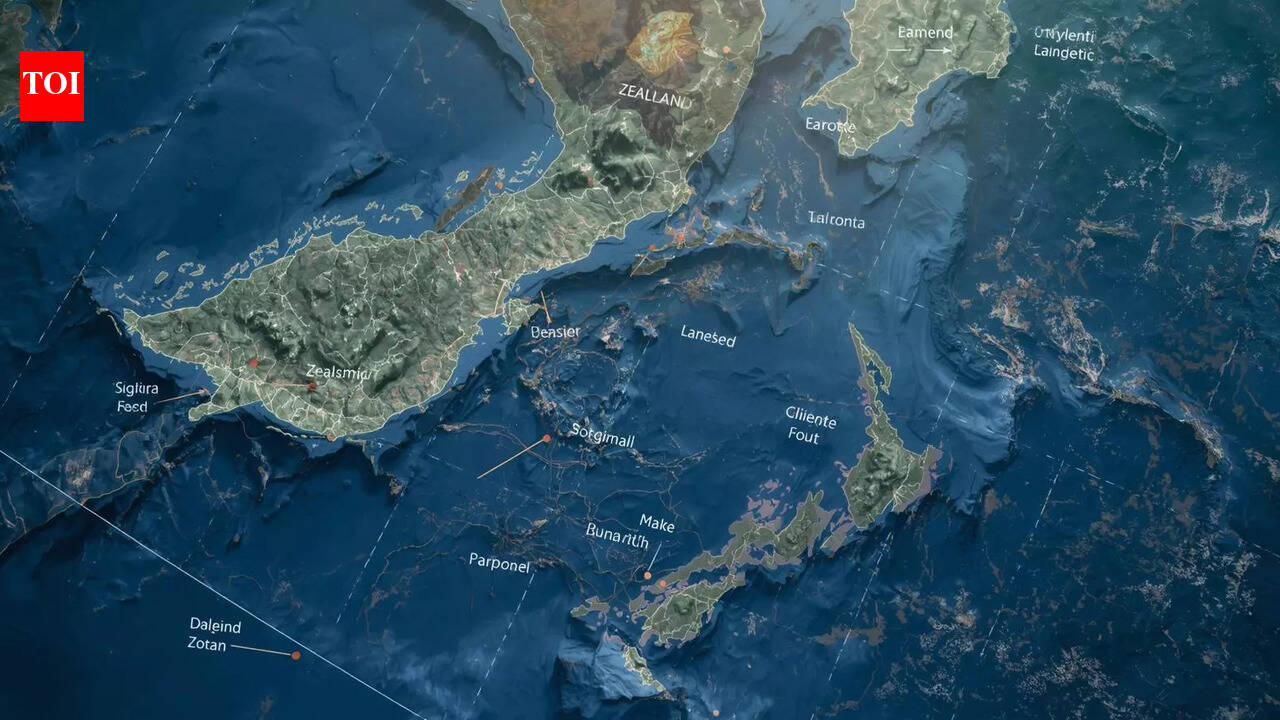

Zealandia: Earth’s hidden continent beneath the Pacific (AI-generated)
The map of Earth looks settled at first glance. Continents feel fixed, named, and counted. Yet over the past few decades, geologists have been quietly reshaping that picture. One large region in the southwest Pacific keeps returning to the discussion. Mostly underwater, stretched around New Zealand and New Caledonia, it does not behave like ordinary ocean floor. Its rocks, thickness, and shape point elsewhere. Known as Zealandia, this vast area of continental crust covers about 4.9 million square kilometres. Nearly all of it lies below sea level, which explains why it escaped notice for so long. But as data has improved, the case has grown clearer. Zealandia is not a loose collection of islands. It fits the definition of a continent, even if it remains largely hidden.
A vast continental landmass lies beneath New Zealand and the Pacific
Continental crust differs from oceanic crust in basic ways. It is thicker, lighter, and made from a wider range of rocks. Zealandia matches these traits. Seismic studies show crust far thicker than the typical seven kilometres of ocean floor. In places, it reaches more than forty kilometres. The rocks sampled from islands and the seabed include granite, schist, greywacke and limestone. These are not the basalts that usually form beneath oceans.Bathymetry adds another clue. Zealandia rises higher than surrounding deep ocean basins. Its edges slope down like the margins of other continents. The outline is continuous, not broken into isolated fragments.
A continent shaped by stretching and sinking
According to the study “Zealandia: Earth’s Hidden Continent”, Zealandia was once part of Gondwana, the southern supercontinent. Around eighty to ninety million years ago, the crust began to stretch and thin. That process weakened it. As Gondwana broke apart, Zealandia drifted away from Australia and Antarctica. Thinning made it buoyant enough to remain continental but low enough to sink.This balance explains why about 94% of Zealandia now sits underwater. It is not ‘drowned land’ in the usual sense. It is continental crust that never fully rose again.
Geological continuity links islands and seafloor
New Zealand and New Caledonia offer rare windows into Zealandia’s interior. Mountain belts, fault systems, and ancient rock units continue offshore in predictable patterns. Sedimentary basins spread across the region record rifting, subsidence, and later marine flooding.These basins hold thick layers of sediment, sometimes several kilometres deep. Their history mirrors that of eastern Australia, once joined to Zealandia before separation. The patterns are regional, not local, reinforcing the idea of a single continental block.
Size and boundaries support continental status
Size matters in geology. Zealandia covers an area similar to greater India before it collided with Asia. It is far larger than features known as microcontinents. Clear boundaries also exist. Oceanic crust lies between Zealandia and Australia, especially across the deep Cato Trough. This separation is physical and tectonic, not just geographic.Using common definitions, Zealandia meets all criteria for a continent. Elevation, geology, crustal structure, and scale align.
Why Zealandia changes how Earth is understood
Recognising Zealandia does not add dry land to the world. It changes context. Continental breakup, rifting, and thinning can now be studied across a single, submerged example. Zealandia shows that continents do not always end at the shoreline.It also reminds researchers that Earth’s surface still holds quiet revisions. Some of them lie just beneath the waves, waiting for enough evidence to speak clearly. Go to Source

