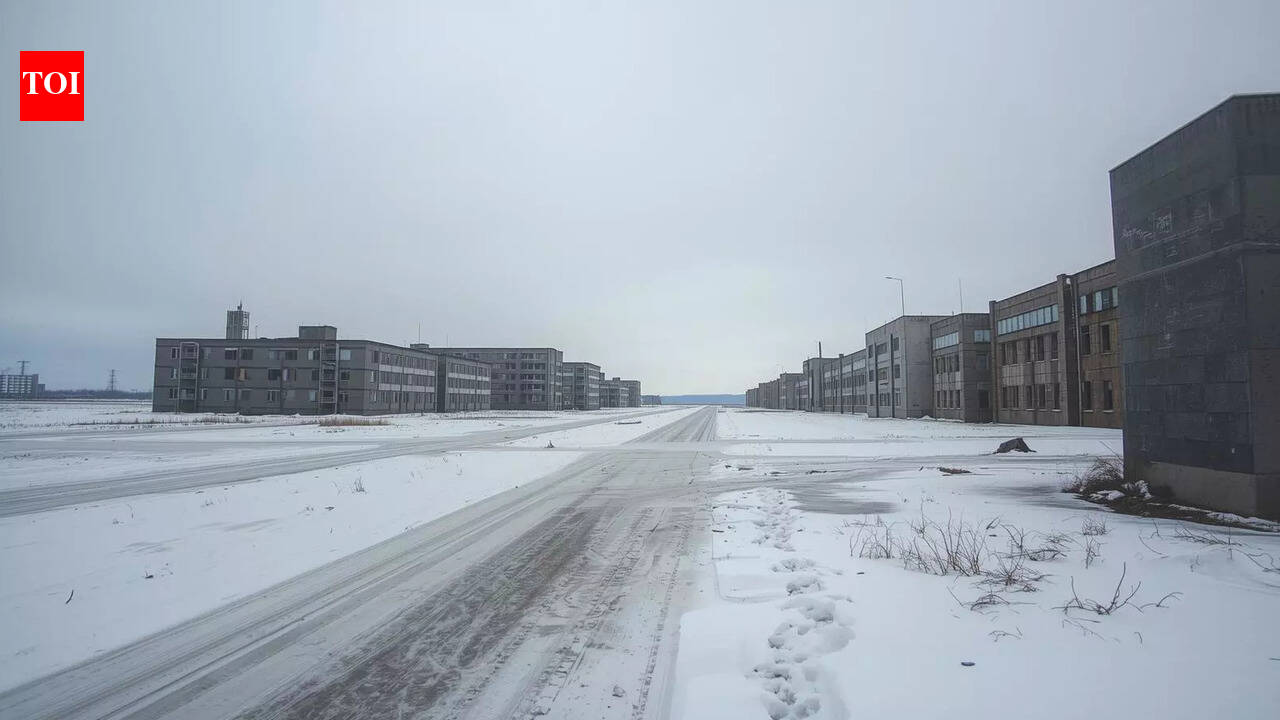

This abandoned Soviet ghost town sits frozen at the edge of the Arctic (AI-generated)
An abandoned town, largely unchanged from decades ago, sits at the far northern edge of Svalbard, beyond reliable phone signal or internet access. Pyramiden lies deep inside the High Arctic, once a working mining settlement and now a destination for a small stream of visitors. It is no longer a place of industry, nor a community in the usual sense. Instead, it exists somewhere between preservation and decay. The buildings remain standing, the streets intact, but daily life ended long ago. What draws people here is not comfort or convenience, but contrast. Pyramiden reflects an earlier political and industrial era, set within one of the most
Inside Pyramiden: A frozen Soviet ghost town on the edge of the Arctic
According to “The rise and fall of Pyramiden: The story of a town in a wider geopolitical and environmental context”, Pyramiden was founded in 1910 by Swedish interests exploring coal deposits in central Svalbard. In its early years, mining remained limited, and the Soviet Union bought the settlement in 1927. Industrial-scale extraction began later, taking hold around 1940. From then on, the town grew steadily, supported by state funding and the strategic importance of maintaining a Soviet presence in the Arctic.By the 1970s and 1980s, Pyramiden reached its peak. It housed hundreds of residents, complete with housing blocks, a school, cultural buildings, and sports facilities. Life was tightly organised around the mine, with resources brought in by sea and distributed centrally. The town functioned as a self-contained unit, insulated from many of the pressures faced elsewhere.
Decline followed the collapse of support
The end came quickly. As the Soviet Union weakened in the 1990s, heavily subsidised operations abroad became harder to justify. Coal reserves around Pyramiden were nearing exhaustion, and the cost of maintaining infrastructure in such an extreme location rose sharply. Political backing faded, and economic calculations shifted.Tragedy struck the community with the plane crash that claimed the lives of miners and their families who were on their way to mine Svalbard in 1996. This incident ultimately marked the end of the settlement. In 1998, the coal mine shut down and the entire community was deserted. People were moved out and homes, furniture, and even personal belongings were left behind. Pyramiden was left unoccupied and unattended, subjected to the harsh Arctic conditions and gradual deterioration for years.
The landscape reclaimed the settlement
After abandonment, natural processes moved quickly. Roads degraded, drainage systems failed, and the surrounding terrain shifted as rivers adjusted their courses. Permafrost thaw and seasonal freezing strained foundations. While many structures remain intact, others have sagged or collapsed.Traces of earlier human activity still mark the area. Mining scars, reservoirs, and transport routes remain visible. Some elements may persist for decades or longer, preserved by cold and dryness. Others continue to fade, blending back into the landscape.
A mountain that defines the place
The town takes its name from the pyramid-shaped mountain that rises above it. The peak stands just over 3,000 feet and dominates the surrounding fjord. Its layered rock gives it a geometric appearance, especially when light catches the slopes.Visitors usually see the mountain under less-than- ideal conditions. Weather shifts quickly, and cloud often obscures the summit. Seasonal light extremes add to the challenge. In winter, the sun does not rise for months. In summer, it never fully sets. When the mountain does emerge, it becomes the visual anchor of the settlement.
Tourism replaces industry without revival
After nearly a decade of abandonment, limited activity returned. Russian authorities began sending small groups north, not to restart mining, but to stabilise parts of the town and open it to visitors. The aim was not repopulation but preservation and controlled access.Today, Pyramiden functions as a niche tourist stop. Summer marks the beginning of trekking routes. In winter, it becomes a destination reached by snowmobile. A small staff maintains key buildings and hosts short stays, but the town remains largely silent.
A place that resists easy explanation
Pyramiden is neither fully abandoned nor truly alive. It sits in an in-between state, shaped by history, climate, and distance. For some, it feels eerie. For others, oddly welcoming. The absence of modern signals reinforces the sense of stepping out of time. What remains is not a monument or a museum in the formal sense. It is simply a town that stopped, surrounded by ice, still standing where it was left. Go to Source