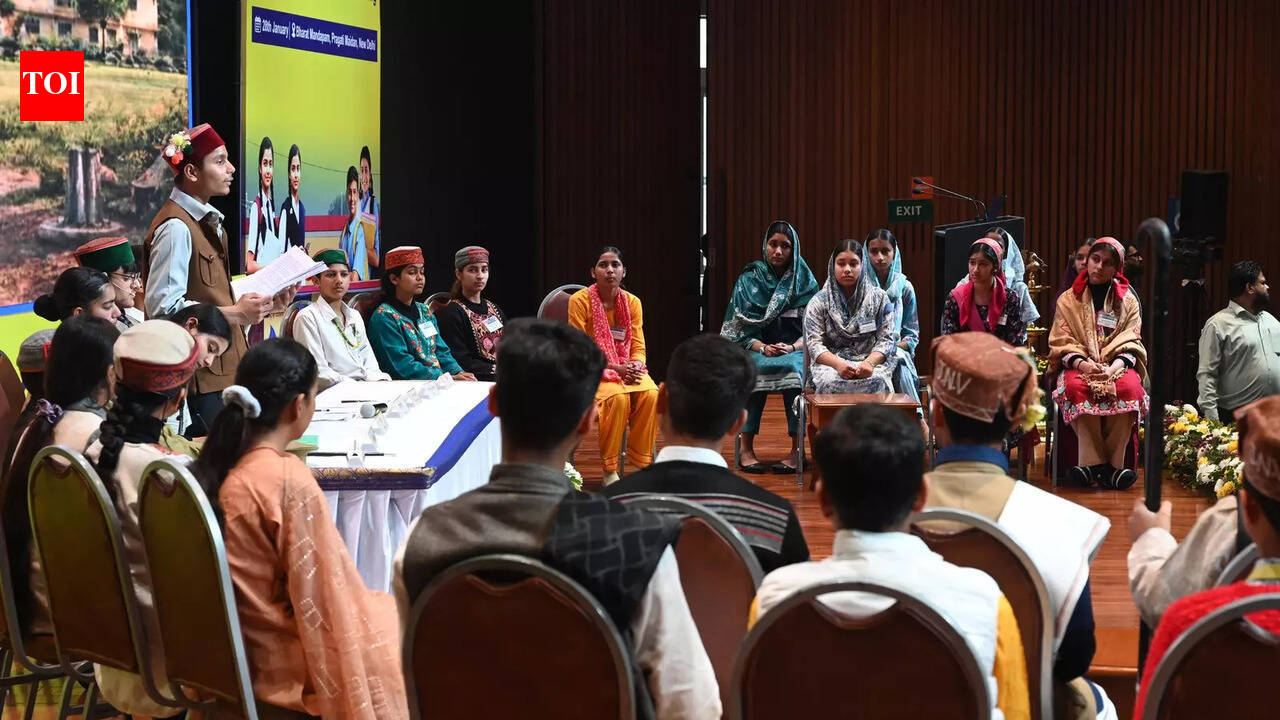

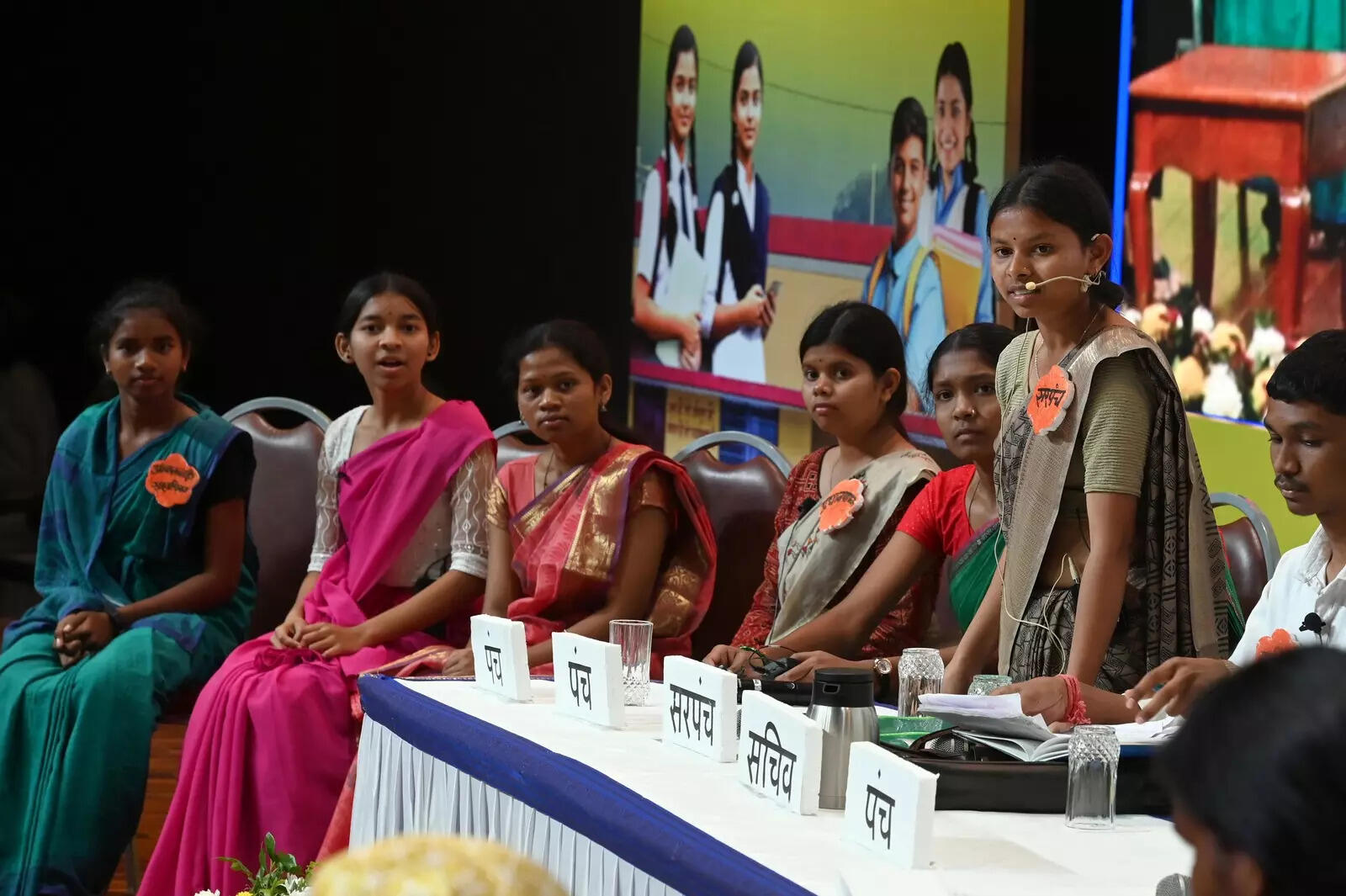
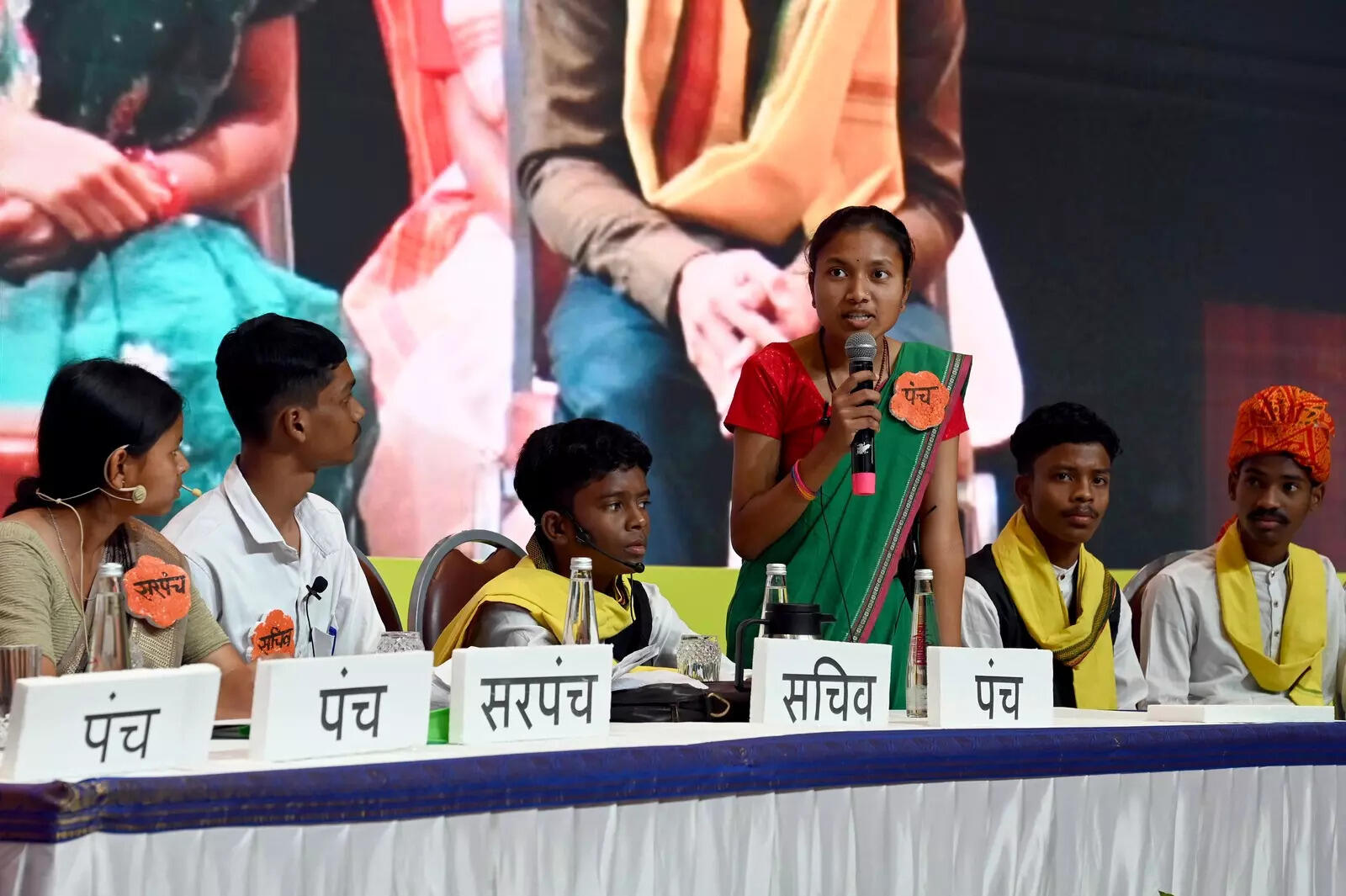
Ministry of Panchayati Raj in collaboration with Ministry of Education and Ministry of Tribal Affairs is organise National Award Ceremony of Model Youth Gram Sabha where students from rural village took part in model Youth Gram Sabha Mock Session, on Wednesday, in Delhi. Photos— Piyal Bhattacharjee (with Ambika pandit’s story)
New Delhi: Garima Dhruwa, a class 11 student at the Eklavya Model Residential School (EMRS) for tribal students in Kosambuda in Chhattisgarh, in her first ever trip outside of her state to Delhi, stole the limelight at a packed auditorium at Bharat Mandapam on Wednesday as she played a confident ‘sarpanch’ showcasing what a model gram sabha should offer to make grassroots democracy truly participatory.Steering the narrative as a ‘Sarpanch’, Garima as part of a team of around 30 students, brought alive a “Model Youth Gram Sabha” (MYGS) as it would unravel in a village – listening, deliberating and offering solutions.“There was no script here. We, along with our teachers shortlisted the issues affecting the villages and presented what we have experienced through everyday life in our own villages,” the humanities student who aspires to be an IAS officer told TOI on the sidelines of a programme organised by the ministry of panchayati raj where the mock gram sabha presentation received applause and much appreciation. Daughter of a teacher, Garima now feels confident of reaching out to the panchayat pradhan in her own village to take up issues that bothered her as a child. One such issue being difficulty in accessing water due to broken taps in public spaces meant for villagers. From classes 9 and 11 and having their own lived experiences of challenges in their villages, each of the girls and boys in Garima’s team played a role ranging from ‘panch’ to to the panchayat secretary and the village residents of all age groups.
.
Far away from home, Garima and her schoolmates presented before policy makers, representatives from Panchayati Raj Institutions, teachers and youth among others in the audience the aspirations of the villages surrounding Kosambuda in Chhatisgarh and how this was the story of most villages across states.The issues ranged from a girl playing the Self Help Group member appealing to the Sabha to support her by buying the products made by women to residents calling for stepping up sanitation in the area by creating waste water channels and planting more trees around the outlets to put the run-off water to good use. The Panchayat also approved the demand for a dedicated vehicle to ferry pregnant women to the hospital that is far from the village and a fine of Rs 500 to punish those found to be using abusive language in public places. The Sarpanch and other members also reprimanded families for not sending their children to school.From the North of India another group of students – they came from Jawahar Navodaya Vidyalaya in Himachal Pradesh’s Una drew from everyday experiences of village life to highlight how the civic, infrastructure, livelihood, social and cultural issues in villages were best solved through mutual discussion as the sense of community continues to be strong factor. A class 11 science student, Shivam Sharma who played the Sarpanch told TOI that the learnings in the process of putting together the Gram Sabha have given him a new perspective about the village he comes from and the ones that surround his school. “We drew a list of issues affecting the villages with their teachers, went out to visit the village, surveyed the space and met with the gram pradhan and then planned our own gram sabha,” shared Sharma who aspires to be a doctor. Here the roadmap that developed through the discussions included demands ranging from creating a library for children to putting solar lights. Better education, health and more avenues for livelihood were concerns raised through the course of the discussion. Interestingly, the Sarpanch and other members also discussed the transition from Mahatma Gandhi National Rural Employment Guarantee Act to the new law Viksit Bharat – Guarantee for Rozgar and Ajeevika Mission (Gramin). Both these schools – the one from Chhattisgarh among EMRS and the other from Una among JNVs that held ‘Model Youth Gram Sabha’ in their schools across states were conferred with the first prize at the national awards programme as a recognition of their work at Bharat Mandapam. Both schools were given an award money of Rs 1 crore each for development activities. Addressing the gathering, union minister of state SP Singh Baghel said that these model youth gram sabhas “mark a paradigm shift in civic education by offering students hands-on exposure to grassroots democracy as they get to engage with Panchayati Raj Institutions, strengthen the spirit of gram swaraj and nurture leadership qualities”.
.
Secretary, ministry of panchayati raj, Vivek Bharadwaj added that the “initiative aligns with Prime Minister Narendra Modi’s vision of nurturing 1 lakh young leaders across the country” and “demonstrates how youth can contribute meaningfully to solving ground level problems”. A comprehensive compendium documenting the transformative journey of MYGS released at the programme highlighted how over 28,000 students from 619 Jawahar Navodaya Vidyalayas and 200 Eklavya Model Residential Schools successfully participated in simulated gram sabha and gram panchayat proceedings nationwide over the past few months.Going forward the govt plans to institutionalise the “model youth gram sabhas” into its scheme – the ‘Rashtriya Gram Sabha Abhiyan’ wherein the states will be asked to weave in this outreach exercise among youth in their plans for the financial year 2026-27.“With over 6.64 lakh villages housing nearly 65-70% of the population, the vitality of rural India lies in the strength of its gram sabhas. As a constitutional body under Article 243, the gram sabha embodies direct democracy, enabling every adult resident of the village to participate in governance, deliberate on development priorities, and ensure accountability of Panchayati Raj Institutions (PRIs),” the ministry said in a statement.It further stated that despite its critical role in rural governance, youth participation in gram sabhas remains low, largely due to limited awareness, insufficient exposure, and a lack of meaningful engagement opportunities. It was in this backdrop to encourage and cultivate civic consciousness among students, the ministry of panchayati raj, in partnership with the department of school education and literacy and the ministry of tribal affairs, conceptualised the “Model Youth Gram Sabha”. Go to Source