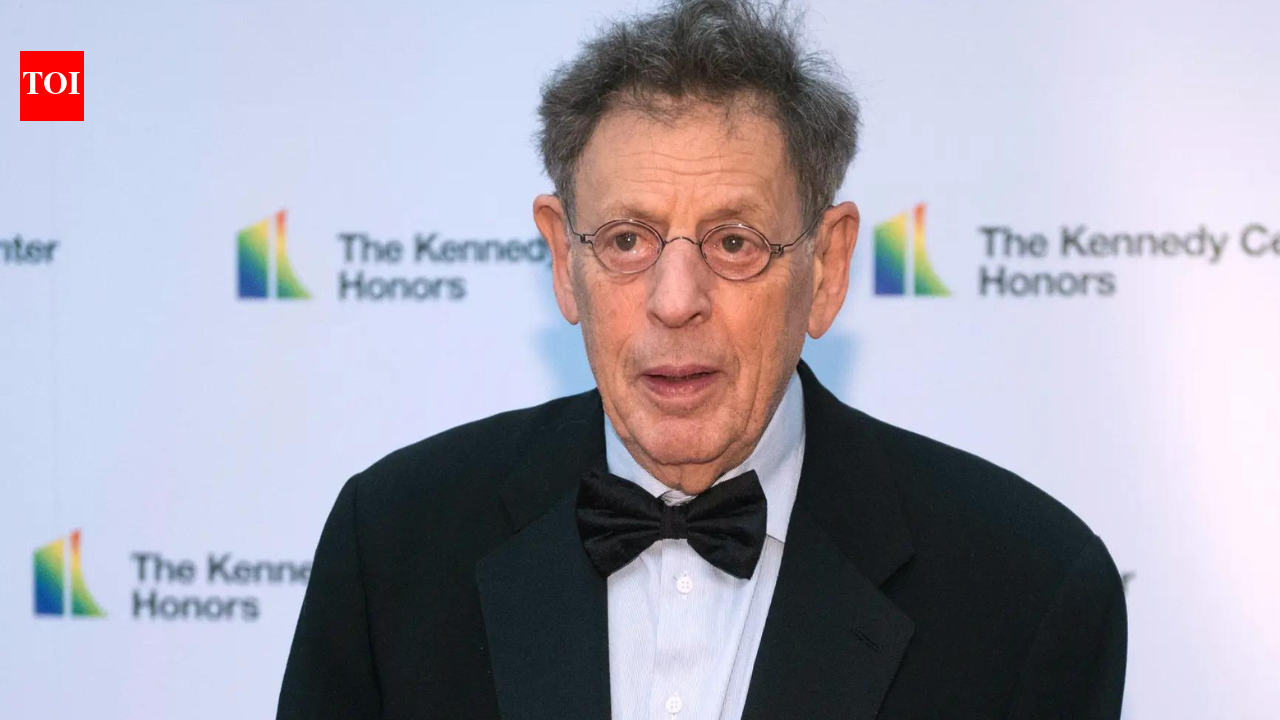

Philip Glass (AP image)
TOI correspondent from Washington: Celebrated American composer and Indophile Philip Glass has withdrawn the world premiere of his Symphony No 15, “Lincoln,” from the MAGA-infused Kennedy Center in Washington DC — the decision redolent of nonviolent Gandhian protest embodied in his landmark opera Satyagraha.Glass announced this week that the Kennedy Center’s current direction under President Trump – who attached his name to the Kennedy Center – conflicts fundamentally with the values his symphony seeks to uphold. “Symphony No 15 is a portrait of Abraham Lincoln, and the values of the Kennedy Center today are in direct conflict with the message of the Symphony,” he wrote on social media, explaining that he feels “an obligation” to withdraw the work under its present leadership.Glass’s withdrawal is part of a broader boycott by more than a dozen artists and cultural organizations responding to the Kennedy Center’s overhaul under the Trump administration. Since Trump assumed control of the center’s board and controversially affixed his name to the institution’s façade to rename it the “Donald J Trump and John F Kennedy Memorial Center for the Performing Arts,” a cascade of cancellations and exits has shaken its iconic reputation. Among those who have pulled back from scheduled performances or engagements are soprano Renee Fleming, jazz virtuoso Bela Fleck, and television creator Issa Rae — all citing discomfort with the center’s new political alignment. Broadway’s Hamilton has also canceled planned shows, and the Washington National Opera announced it will relocate after more than half a century at the venue. Longtime jazz artist and former host of the Kennedy Center’s Christmas Jazz Jam also cancelled his performance after the Trump name was added to the building.Indian artists who have performed frequently at the Kennedy Center over the years include Ustad Zakir Hussain, Pandit Jasraj, Akram Khan, Alarmel Valli, Madhavi Mudgal, and Shanthala Shivalingappa, among others. The Center also presented a major celebration of Indian arts called Maximum India in 2011 that included performances by violinist L Subramaniam, Kailash Kher, and Raghu Dixit. It also hosts an annual series called “District of Raga” on the Millennium Stage, which highlights local and visiting Indian classical musicians throughout the year.Scheduled for June performances, Lincoln — originally co-commissioned by the Kennedy Center and the National Symphony Orchestra — incorporates texts from Lincoln’s speeches and writings, reflecting unity, democracy and moral purpose. By pulling it from the institution now widely seen as politicized, Glass struck a chord with parallels to Satyagraha, his 1980 opera about Mahatma Gandhi’s early development of nonviolent resistance.Glass’s ties to Indian music and philosophy are more than artistic influences — they are a foundation for his worldview. He first encountered Indian classical music in the mid-1960s, transcribing sitar maestro Ravi Shankar’s music into Western notation while in Paris. That experience, he later said, transformed his musical thinking and helped birth his signature minimalist style, rooted in additive rhythmic structures learned from Indian tradition. Decades later, their collaboration on the album Passages became a rare exchange between Western and Indian masters. His opera Satyagraha — sung in Sanskrit and built around texts from the Bhagavad Gita — remains one of the most profound bridges between Indian philosophical thought and Western classical music.It is within this context that Glass’s protest becomes more than a career decision: it is an expression of artistic integrity and an assertion that music — like satyagraha itself — can embody ethical resistance, which is becoming a recurring theme in Minneapolis and other cities raging against ICE operations. These moves also reflect broader unease in the arts community over the intersection of politics and cultural institutions, many overrun by racist and xenophobic MAGA extremists railing about “foreign” influences. Critics argue that Trump’s leadership and rebranding politicize what was long considered a nonpartisan cultural institution, undermining its mission to celebrate artistic expression across ideological and national lines.