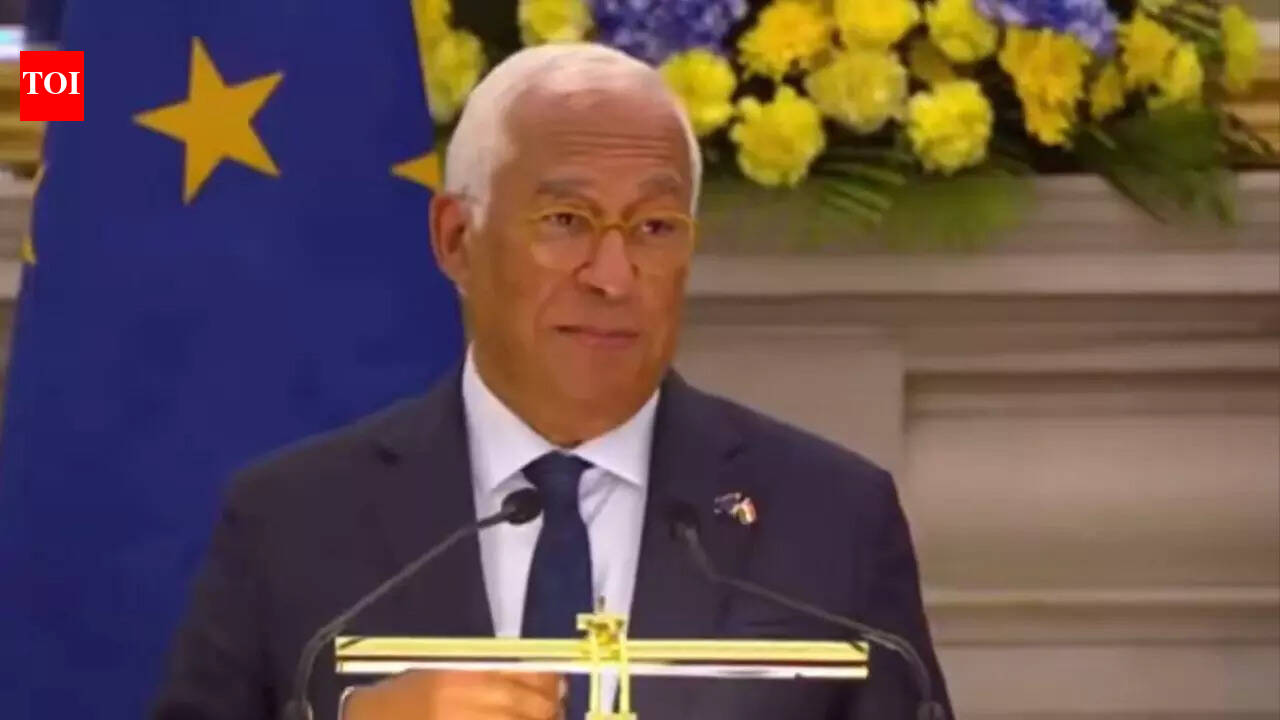

When European Council President Antonio Costa held up his Overseas Citizen of India (OCI) card in New Delhi, it struck a deeply personal note during the signing of the India-EU Free Trade Agreement (FTA). The gesture served as a reminder that global diplomacy is shaped not only by strategy and markets, but also by memory, migration and lineage.The moment came as India and the European Union sealed the long-awaited FTA, hailed by Brussels as the “most ambitious” trade pact in the bloc’s history.Costa spoke of his personal connection to India and said he is an Indian citizen by origin. He also thanked the country for the Republic Day invitation, and underlined that India-EU ties are deeply personal for him.Addressing an audience at Hyderabad House, Costa linked the historic deal to his own story. “I am from Goa,” he said, recalling his ancestral roots in the Indian coastal state.Holding up his OCI card, he added: “I’m the President of the European Council, but I’m also an overseas Indian citizen. Then, as you can imagine, for me it has a special meaning. I’m very proud of my roots in Goa, where my father’s family came from and the connection between Europe and India is something personal to me.”
#BREAKING: EU Council President @eucopresident proudly displays his Overseas Citizen of India (OCI) Card.
“I am President of the European Council but I am also an Overseas Indian Citizen. As you can imagine, it has a very special meaning. I am very proud of my roots in Goa.” pic.twitter.com/uxtTNhheN3
— Aditya Raj Kaul (@AdityaRajKaul) January 27, 2026
Costa’s statement regarding his Indian roots comes as India and the EU seek to elevate their partnership beyond trade. The FTA aims to cut tariffs on more than 90 per cent of traded goods, deepen services and investment links, and position both sides as dependable partners in a multipolar world.
Who is Antonio Costa?
Antonio Luis Santos da Costa is among Europe’s most seasoned political figures. Born in Lisbon on July 17, 1961, he assumed office as President of the European Council on December 1, 2024, following his election by EU leaders in June last year.The position places him at the centre of coordination among the European Union’s 27 member states at a time of geopolitical volatility and economic realignment.A lawyer by training, Costa has held nearly every major rung of Portuguese public life. He served as Prime Minister of Portugal from 2015 to 2024, was mayor of Lisbon for eight years, and previously held portfolios ranging from justice to internal affairs. He has also been a member of the Portuguese Parliament and the European Parliament, building a reputation as a consensus-driven leader.
Antonio Costa’s Goa connection
Costa’s Indian link runs through his father, Orlando António Fernandes da Costa, a noted Portuguese writer and intellectual of Goan origin. The Costa family hails from Margao in South Goa, which remained part of Portuguese India until 1961.Costa’s grandfather was born in Goa and spent his formative years there, part of the Catholic Goan community shaped by centuries of Indo-Portuguese exchange. These experiences found expression in Orlando da Costa’s writings, which often evoked life in Goa, cultural hybridity and the experience of migration.Though António Costa grew up in Portugal, Goa remained part of the family’s inner world — present through stories, Konkani phrases, food traditions such as sorpotel, and inherited memories passed down generations.
A living connection
The bond is not merely historical. The Costa family retains an ancestral home on Abade Faria Road in Margao, where extended relatives continue to live. During a personal visit to Goa in 2017, Costa spent time with family members in his father’s hometown.In Goa and among segments of the Indian diaspora, Costa is often affectionately referred to as “Babush”, a Konkani term of endearment, a quiet reflection of local pride in his rise to one of Europe’s most powerful offices. Go to Source