
Mark SavageMusic correspondent

 Getty Images
The last time Take That agreed to a documentary, they had nothing to lose.
It was 2005, and they’d been inactive for almost a decade. Gary Barlow and Mark Owen had lost their record contracts, Jason Orange had abandoned his acting ambitions, and Howard Donald was quietly enjoying parenthood.
Robbie Williams, still a year away from his disastrously received Rudebox album, was the only member with a significant public profile.
When he failed to show up for the film’s climactic reunion, the rest of the band reacted with a mixture of hurt and total lack of surprise.
But what happened next surprised everyone.
More than six million people tuned in to watch the documentary on ITV, making it the night’s most-watched programme.
Within days, the UK’s biggest concert promoter Simon Moran had put an offer on the table: Get back together, and we can sell out 30 arenas.
Gary, Mark, Jason and Howard mulled it over all of 12 hours before agreeing.
The clincher came at a London pub where they recreated the choreography to Pray, perched upon bar stools, several drinks worse for wear.
Twenty years later, they’re still going. If anything, the second chapter of Take That’s career is even more extraordinary than the first, full of number one singles and multiple Brit Awards. This summer, they’ll play to a million fans on a brand new stadium tour.
To celebrate, the band have launched another documentary – this time for Netflix.
But with more at stake – and without the participation of Williams and Orange (who retired in 2014) it’s never as captivating or revealing as the original.
It’s also more sanitised. Whereas ITV had footage of the band singing “you’re only in love with an image” at their teenage fans, and talking about on-tour sex contests, the new film focuses more on professional rivalry and interpersonal relationships.
 Netflix
The main question is, what is there left to learn?
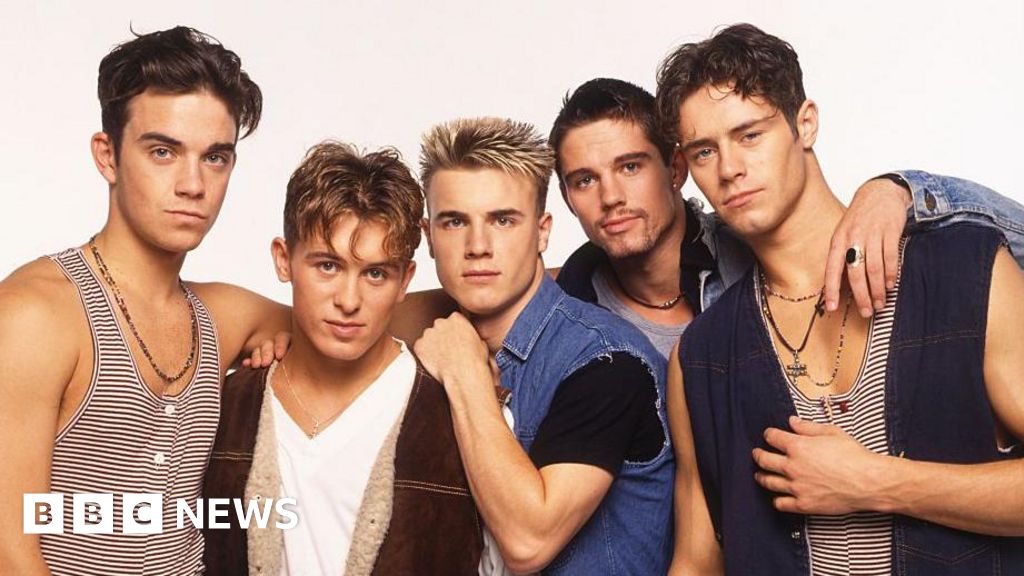
We all know the story: Take That were five plucky northern lads, formed in 1990 around the songwriting talents of bow-tied lounge singer Gary Barlow.
Initially called Cutest Rush, then Kick-It, they were marketed at gay audiences, with a notorious video for early single Do What U Like, featuring the quintet butt-naked and writhing around in jelly.
But it was teenage girls that made their career, screaming songs like Everything Changes, Relight My Fire and Pray to the top of the charts.
But as their fame grew, tensions simmered. Barlow refused to let his bandmates contribute to the music, leaving them feeling “like backing dancers and puppets”, says Howard.
Fed up, Williams started abusing drink and drugs, almost overdosing the night before the 1995 MTV Europe Awards.
When the others issued him with an ultimatum, he walked out. But without his puppyish energy, Take That were on borrowed time. Within a year, the band was over.
One of the few revelations in the new documentary is that Williams’ departure gave his bandmates a new perspective: You don’t have to do everything you’re told.
“We were like, ‘Oh, hang on a minute, that looks quite refreshing’,” recalls Barlow.
But it wasn’t.
As Williams solo career went stratospheric, Barlow’s became a punchline.
“It was just so excruciating [that I] just wanted to crawl into a hole,” he recalls. At one point, he refused to leave the house for a year, ballooning to 17 stone.
Howard Donald also took it hard, at one point contemplating suicide.
“I decided to go to the Thames… I was seriously thinking of jumping in,” he says.
 Netflix
All of these revelations were covered amply in the 2005 documentary and, although the repetition doesn’t diminish the impact, fans will find themselves wondering why they’re sitting through the same anecdotes (sometimes literally – as several clips of Orange and Williams are lifted directly from the original programme).
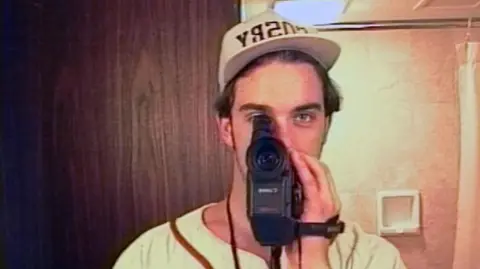
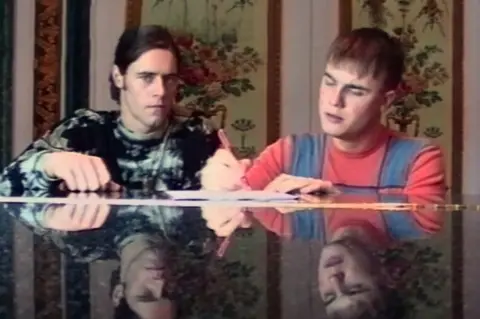
Sweetening the pill, there’s lots of previously unseen archive footage, giving glimpses of the band in the studio and blowing off steam on tour.
But the show really gains momentum when we get to Take That’s unlikely resurrection in the early 2000s.
We discover that Orange insisted the band ditch their former manager, Nigel Martin-Smith – claiming he’d made members feel “worthless” and “insecure” – and set off by himself to dispatch the news.
And Barlow acknowledges that he’d treated his bandmates as lesser partners during their first flush of fame.
“I didn’t really care about anybody else in the 90s,” he says. “I was a very different person back then, very thick skinned, incredibly ambitious.”
When Orange suggests they split all of the band’s future royalties (a trick he’d picked up from U2), Take That finally become a group of equals.
“I felt like I had some kind of worth and it made me feel like an artist again,” says Howard of the band’s feverishly-received reunion.
 Getty Images
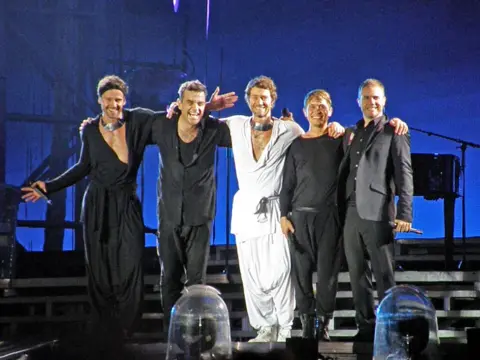
The final hurdle is a rapprochement with Robbie, which finally takes place in 2010. As we learn, not everyone is convinced it’s a good idea. “I thought he’d be this complete egotistic arsehole,” says Howard.
But footage from the sessions for 2010’s Progress album (culled from a second ITV documentary, Look Back, Don’t Stare) shows how easily they fell back into friendship.
As they take the show on tour, there’s a quick but beautiful shot of Williams watching from under the stage, flashing a quick thumbs up at his former nemeses as they perform Rule The World.
“It was lovely for us to have Rob back,” says Owen. “I’m so glad it happened. To be able to heal, reflect, rejoice.”
At the end of that tour, both Williams and Orange sailed off on their own courses and Take That became a trio.
The documentary skips over the next 10 years, a tacit admission that everything since Progress has been a footnote.
And, as Barlow admitted to a journalist in 2018, the band never need to worry about their future again.
“If I could be bold, I don’t give a [expletive] whether the new album’s a hit or not,” he told The Telegraph. “Even if it’s a flop, we’re still going to go on tour next year and play to 600,000 people.”
The documentary closes on a similar note: Take That are national treasures, their reputation is secure, their hatchets are buried. It’s a happy ending, if a strangely frictionless one.
But as the credits roll, a brand new song plays and, hey, it’s pretty good. I even found myself singing along.
And maybe that’s the real conclusion: Even in comfortable middle age, you can’t discount Britain’s biggest boy band.