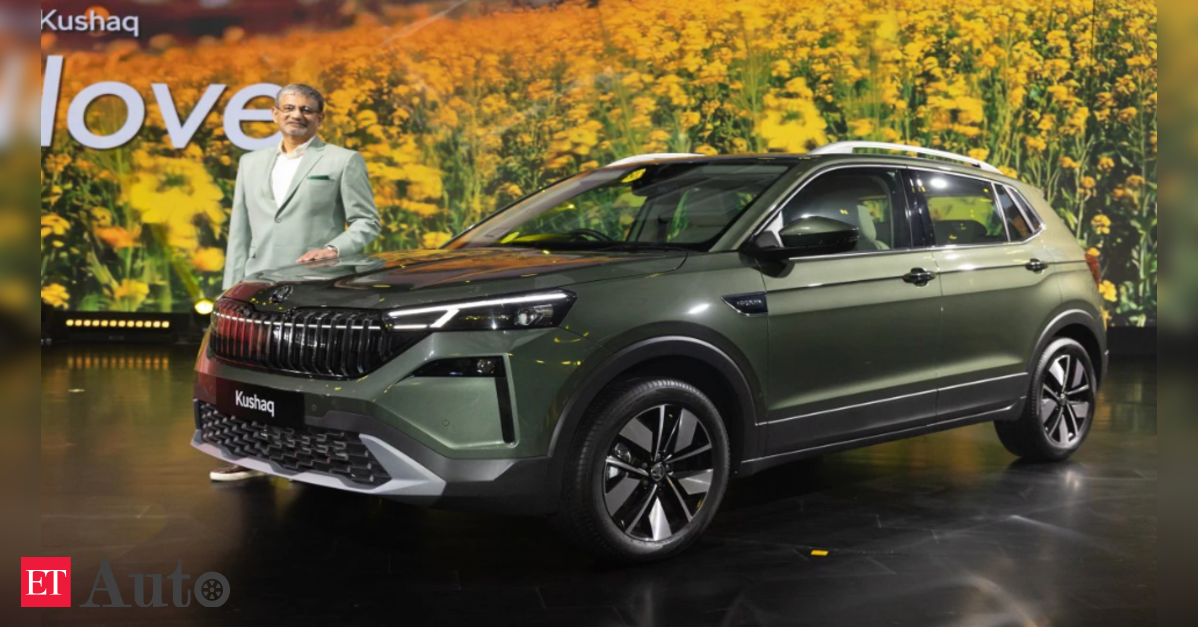

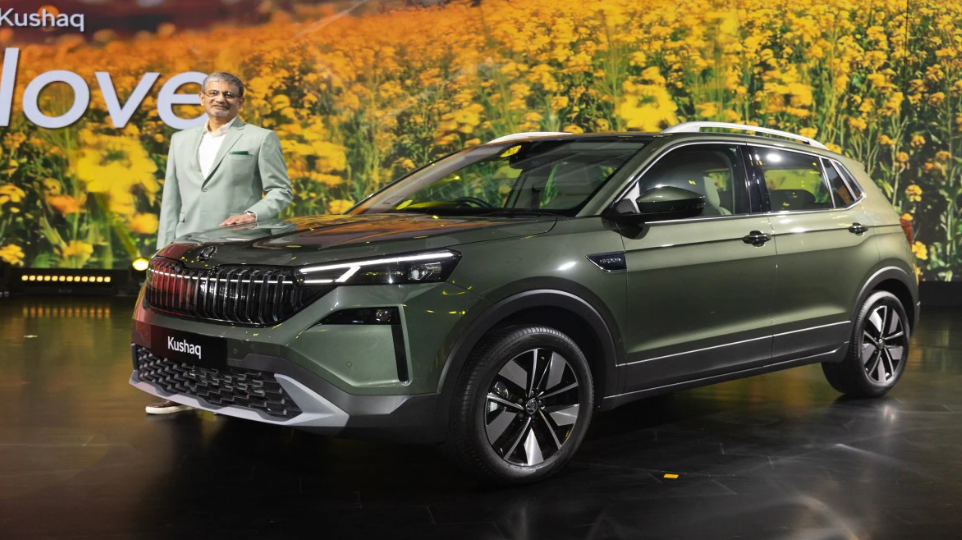
 Piyush Arora, Managing Director and CEO of Skoda Auto Volkswagen India
After nearly two decades of cautious presence in India, the Volkswagen Group appears to be recalibrating its strategy as it seeks to move from a niche player to a volume contender in one of the world’s most competitive car markets.
The success of Skoda’s sub-4 metre SUV, Kylaq is changing the narrative for the company, Piyush Arora, Managing Director and CEO of Skoda Auto Volkswagen India Pvt Ltd told Financial Express.
“The sub-4 metre SUV has driven 36 per cent overall growth for the Group and made India the fourth-largest market globally for Skoda,” Arora said. He added that the company plans to introduce 10 products in 2026, including new launches, mid-life refreshes and feature upgrades, to sustain momentum.
Launched last year, the Kylaq sold 46,872 units in 2025, emerging as a key growth driver for the Group.
Despite operating multiple global brands in India—Volkswagen, Skoda, Audi, Bentley, Lamborghini and Porsche—the Group’s market share has remained in the 1.5–2.5 per cent range, well below its stated ambition of 5 per cent. While the Skoda-led India 2.0 strategy launched in 2018–19 marked a shift towards localisation, tangible scale has remained elusive.
Volume driver
While Kylaq volumes surged, sales of older models such as the Kushaq, Taigun and Slavia declined last year. Arora attributed this to normal product lifecycle dynamics and expressed confidence that updated versions, including the refreshed Kushaq launched recently, will revive demand. With the Kylaq establishing itself as a volume driver, expectations are growing around a Volkswagen-branded sub-4 metre SUV. Although Arora declined to confirm plans for a sibling model, analysts note that achieving a 5 per cent market share would require multiple high-volume products rather than reliance on a single nameplate.
Cautious stance on EVs
On electrification, the Group continues to take a cautious stance. While Skoda has been testing the Enyaq electric SUV in India and Volkswagen showcased the ID.4 earlier, no near-term EV launch has been announced.
Arora said the Group’s EV strategy in India is shaped by market realities. “EV penetration in India is still around 4 per cent, and charging infrastructure remains limited,” he said, adding that the focus is on launching EVs that are “India-ready” rather than merely “India-bound”.
While global models such as the ID.4 are expected to arrive eventually, Arora said the real volume opportunity lies in locally manufactured EVs designed for both domestic and export markets—a development likely before the end of the decade.
Eye on localisation
The Group’s engineering-led philosophy continues to influence its product decisions. Addressing comments by Skoda’s global leadership that India-bound cars may be “overengineered”, Arora said the challenge lies in balancing safety and driving dynamics with localisation and consumer expectations.
“Our development has always been driven by safety and driving dynamics. We are evaluating how to deepen localisation without compromising our core DNA,” he said.
This approach also explains the Group’s absence from the aggressive rollout of advanced driver-assistance systems (ADAS) seen among competitors. Arora said ADAS will only be introduced once it is fully adapted to Indian driving conditions.
Beyond India 2.0
As the Volkswagen Group transitions beyond India 2.0, the strategic focus is shifting from survival to scale. Shared platforms, deeper localisation and selective product launches form the backbone of its next phase.
“The Kylaq has demonstrated that Indian customers are willing to embrace European engineering at an Indian price point,” Arora said. The challenge ahead will be whether the Group can replicate this success across future models and translate momentum into sustained market share gains.