


.
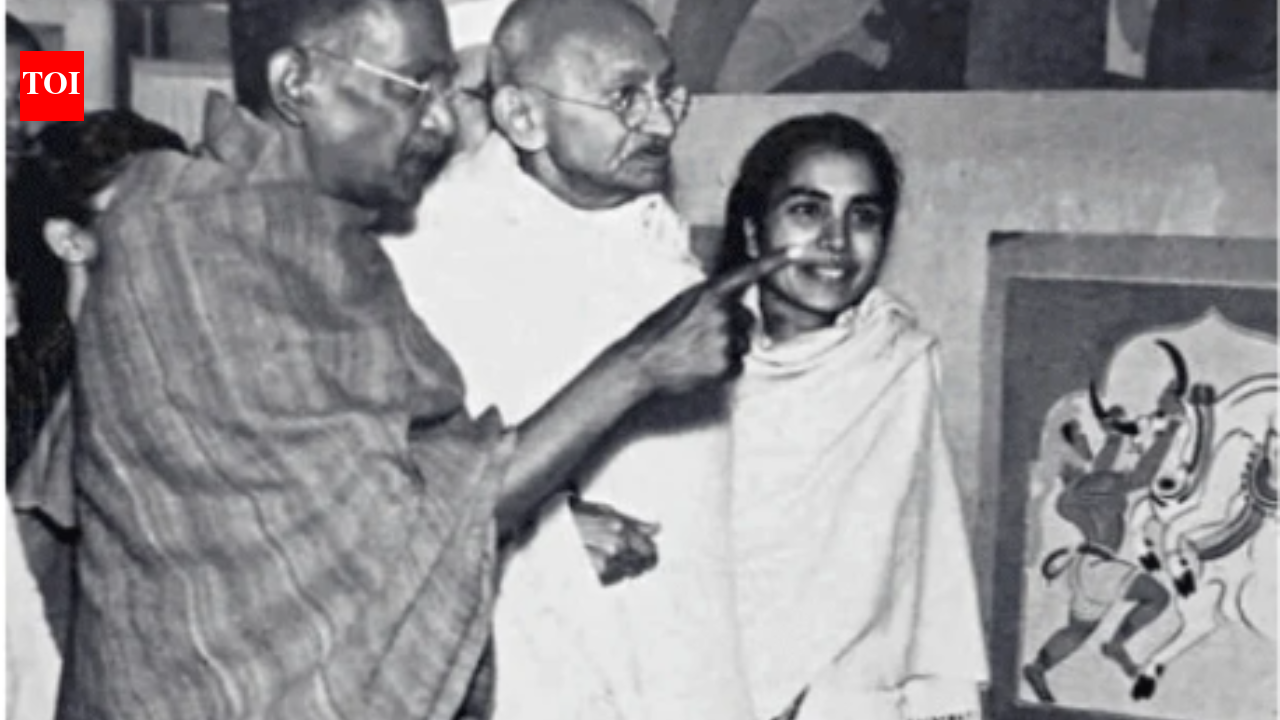
As we turn 76 as a constitutional Republic, we should underline a lesserknown and unique facet of the Gita and the Bible of our governance. Most constitutions begin with black letter law; ours begins with art. If the aim of art is to represent not the outward appearance of things, but their inward significance, the best metaphor for the Indian Republic is a document that speaks to the soul before it speaks to the statute.India’s Constitution is widely celebrated as a legal masterpiece, a visionary consolidation of checks, balances, rights and responsibilities. But buried in the book is a quieter triumph: 22 handdrawn illustrations, each accompanying one of its first 22 Parts, and rendering a book of law into a living tapestry of our civilisational spirit.Nandalal Bose and his Shantiniketan associates were not decorating after the fact. They were intentionally and symbolically rendering the spirit of each constitutional Part. It is spirit, not text, that is reflected in the design. With each page we turn, we step into an art gallery of Indian being.This is where aesthetics meet authority. There are a handful of countries where the Constitution is also a work of art. Ours is one of them.
.
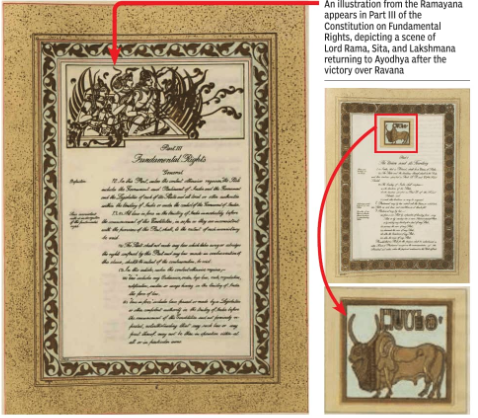
Crafted in flowing calligraphy by Prem Raizada and illumined by Bose’s team, the Constitution is handwritten, hand-painted and heart-born. Every page radiates an aesthetic that marries legal form with cultural substance. The intricate patterns of the Preamble, the artistic flourish of the Ashokan Emblem, the quiet reverence of Himalayan magnificence: each stroke reminds us that beauty is not superficial, but constitutional.The artists, paid Rs 25 per page, made priceless manuscripts, which are today enshrined in helium-filled chambers in the Parliament Library, more revered than rare manuscripts, more sacred than statute books. As an illustrated ‘Gita of Governance’, the Constitution’s illustrated manuscript does not shout but whispers in ink. Its 22 illustrations serve as metaphors for the Parts they accompany, symbols that communicate through visual language the values, dilemmas and aspirations that laws alone cannot express.For instance, the pairing of Part III on Fundamental Rights with the conquest of Lanka by Lord Rama is no accident. It evokes the triumph of dharma over tyranny. The depiction of the Dandi March alongside Part XVII on official language is not a coincidence; it is a subtle nod to linguistic unity as an act of peaceful assertion. These aren’t annotations; they are visual philosophies.Such symbolic pairings do more than inform; they inspire. They transform the Constitution from a legal text into a national epic, in equal parts scripture, statute and story.The illustrated Constitution is a Republic in technicolor, where India is illustrated on every page: an India that is inclusive, plural, layered, and luminous. From the seals of Mohenjodaro to the Himalayas, from Nalanda’s scholarly calm to Noakhali’s pain, these illustrations span centuries, religions, regions and ideologies.This is not an India of slogans, but of symbols. Buddha and Mahavira stand alongside Netaji and Shivaji. It is a great way of conveying how the Indian philosophy consists of two binary elements — Yuddha (war) and Buddha (peace). Ashoka canvases along with Lakshmibai. Ram and Krishna converse with Guru Gobind Singh. These are not political choices; they are civilisational ones. The message is profound: India is not made by any one moment or man, but by the multitude.Each page tells a story — not just of governance, but of a people’s quest for meaning, dignity and justice. The illustrations don’t just depict India’s past; they foreshadow its constitutional future. They also reveal the imagination of our founding fathers — men and women who dreamt of a document that did not merely prescribe but evoked, that did not merely legislate but inspired. In doing so, they gave us a map of memory, a charter of culture and a mirror of our moral fibre.In an age of black-andwhite binaries, these lush illustrations are a reminder that Indian constitutionalism is not a single tone; it is a rainbow of responsibilities and rights, shades of heritage and hope. Such images comprise an unspoken preamble, another level of overture — a visual message of the part of the mind that believes, that preps the soul before the brain engages. This document is not just a blueprint for governance. It is a mirror of our moral inheritance.Where other constitutions speak in articles and amendments, ours breathes through allegory and art. This is not ornamental. It is transformative. The illustrated Constitution serves as a counter-narrative to the sterile image of law. It reveals that justice, too, can be beautiful. Democracy, too, can be drawn. Nationhood, too, can be painted.These illustrations also turn the Indian Constitution into an entity reflecting India’s unique constitutional identity. What other Constitution dares to blend Shiva’s cosmic dance with federal finance, or show Akbar while listing bureaucratic services? Where else do deserts, oceans and ancient sculptures frame legal architecture? The uniqueness of our illustrated Constitution lies in its fusion of text and texture, its legal gravitas softened by visual grace. It is India’s original ‘living document’, long before the courts used that phrase.The manuscript’s USP is its humanity, its ability to speak to citizens as much through sight as through statute. It underscores an oft-ignored truth: a Constitution is not just a legal contract; it is a cultural compact. It must speak to the head and the heart, to the reason and the rasa (aesthetic essence). The illustrated Constitution accomplishes this with quiet dignity.In an era of quick fixes and digital templates, the Indian Constitution’s illustrated version is a slow, deliberate and divine act of nation-building. It reflects the care with which India imagined herself. Not just legally, but visually, morally and spiritually.The 22 illustrations are India’s constitutional haiku — short, symbolic and stirring. They are not footnotes. In their silence, they speak. In their stillness, they move. And in their artistry, they awaken a nation’s conscience. They make the Indian Constitution a testament to timelessness. Abhishek Singhvi is a four-term sitting MP; Akash Kumar Singh is a doctoral scholar at JNU. Views expressed are personal Go to Source