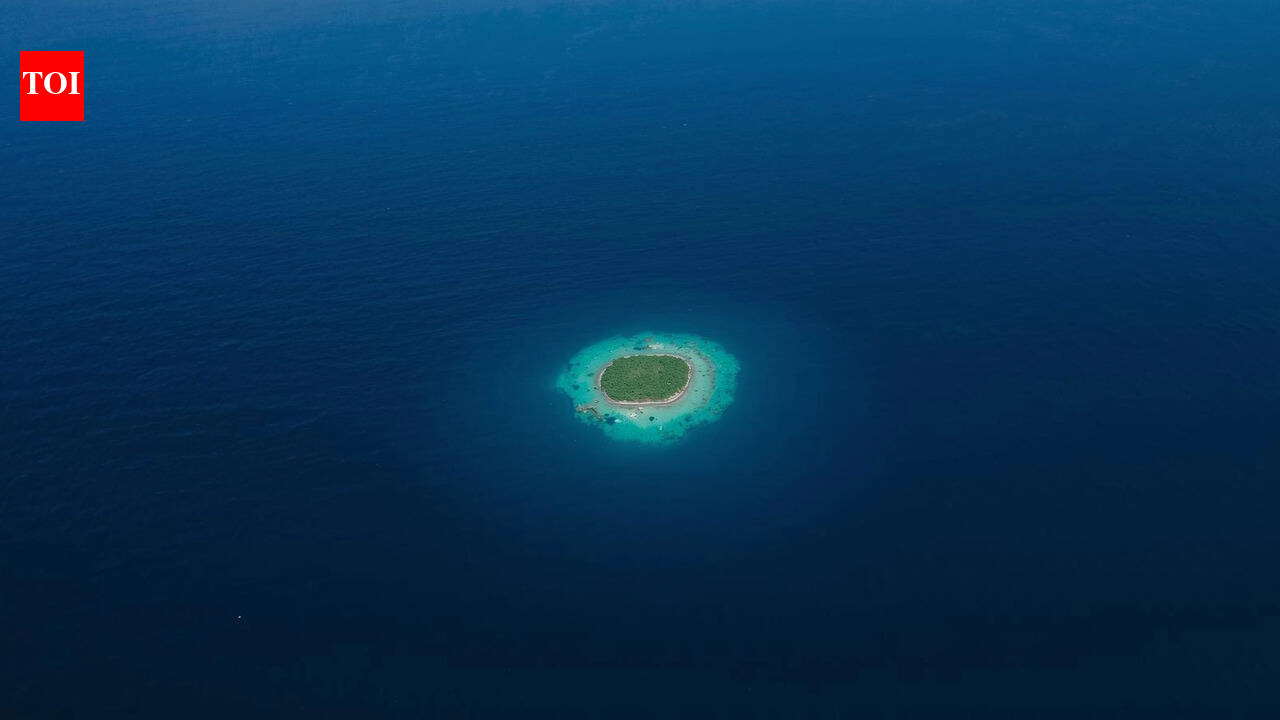

This place is the most isolated place on Earth, and NASA uses it as a spacecraft graveyard ( AI-generated)
Point Nemo sits quietly in the southern Pacific, marked on maps but rarely thought about. It is not a destination in any usual sense. There are no ships passing nearby, no islands breaking the surface, and no settlements within reach. Known formally as the oceanic pole of inaccessibility, it is the point on Earth that lies furthest from any landmass. Its remoteness means the closest humans are often orbiting above it aboard the International Space Station, not on Earth. Identified only in the early 1990s, Point Nemo reflects how modern mapping reshaped our understanding of the planet. It is less a place people go to than a coordinate that reveals just how empty large parts of Earth still are.
Point Nemo: The most isolated point on the planet
Point Nemo lies at 48 degrees south and 123 degrees west, deep in the South Pacific Ocean. The nearest land is more than 2,600 kilometres away in every direction, split between small islands such as Ducie Island, Motu Nui near Easter Island, and Maher Island off Antarctica. Even by ocean standards, this is extreme isolation. Shipping routes avoid the region. Weather systems pass through without much notice. The sea itself is often described as biologically sparse, shaped by slow currents and limited nutrients.
How did modern computing locate the middle of the ocean
The idea of finding the most remote ocean point sounds straightforward, but it was not possible until satellite data and computing became precise enough. In 1992, Croatian-Canadian survey engineer Hrvoje Lukatela developed a geospatial program called Hipparchus. Using digital coastlines and spherical geometry, the software calculated the point furthest from any coastline. The result was Point Nemo, named after the fictional Captain Nemo rather than any human presence.
A region shaped by absence
Unlike coastal waters filled with fishing vessels and shipping traffic, the waters around Point Nemo are largely untouched by daily human activity. There are no ports to anchor to and no reason for commercial ships to pass through. Scientists studying ocean circulation sometimes note the area for what it lacks rather than what it contains. Fewer nutrients rise from the deep. Marine life exists, but in lower concentrations than elsewhere in the Pacific.
A spacecraft graveyard
Far above the ocean, Point Nemo has assumed an unexpected role. Space agencies use the area as a controlled reentry zone for decommissioned spacecraft. Each year, an estimated 100 to 200 tonnes of space debris falls back to Earth, and some of it is deliberately guided toward this remote patch of ocean. They have directed more than 260 spacecraft there over the past 45 years.The debris ranges from rocket stages to defunct satellites. Notable examples include Russia’s Mir space station and the European Space Agency’s Automated Transfer Vehicle Jules Verne. The logic is practical rather than symbolic. Large spacecraft can survive re-entry in fragments, sometimes burning but not fully disintegrating. Letting them fall far from land reduces risk.
Why isolation matters for re-entry
Smaller debris often burns up unnoticed, but larger objects behave differently. They re-enter at high speed and can scatter material across wide areas. Choosing a location with minimal shipping and no population reduces the chance of harm. Point Nemo offers that buffer. Its isolation, once a geographic curiosity, now serves a safety function linked to modern spaceflight.
A place defined by coordinates
There is no marker floating above Point Nemo, no sign to indicate arrival. Its significance exists mostly in data, charts and planning documents. For most people, it remains an idea rather than a location. A reminder that even in an age of constant connection, there are still parts of Earth defined by distance, silence and absence. Go to Source