

Last Updated:
A senior commander of a private airline explained that wing flaps, located on the rear of the wings, play a vital role in flight operations, particularly during takeoff and landing



Experts cautioned that flap malfunctions can pose serious risks, especially during landing. (Source: Instagram/@the.independent)
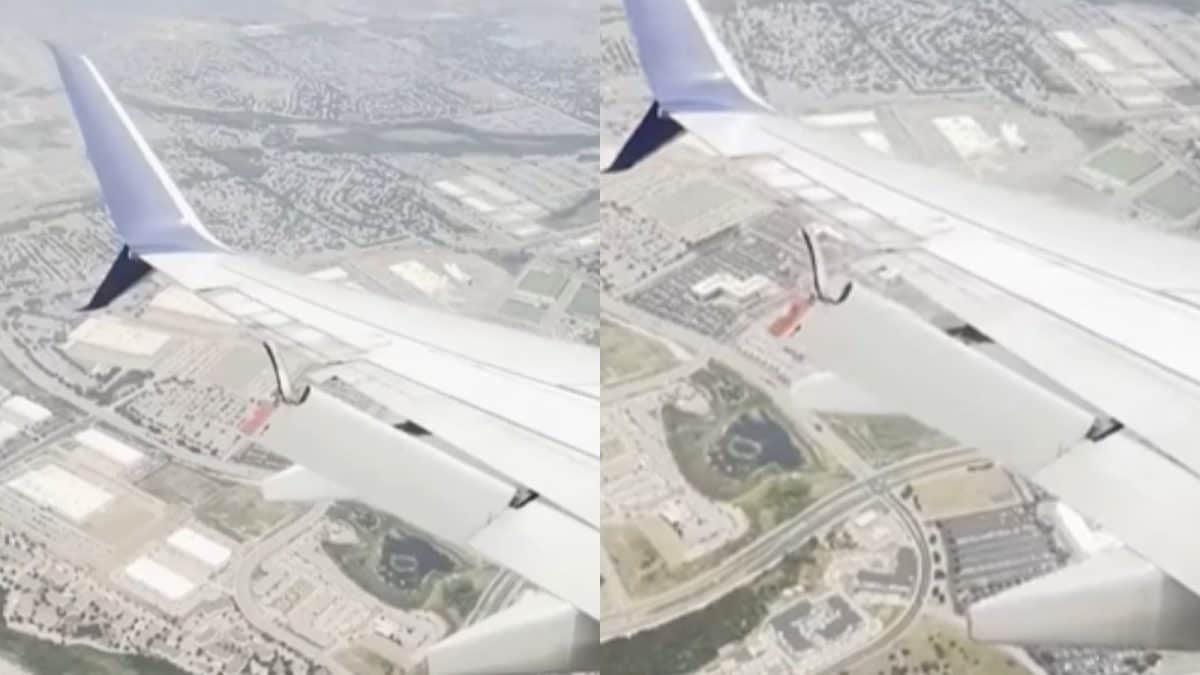
Panic gripped passengers aboard Delta Airlines Flight 1893 when a part of the plane’s wing flap broke loose mid-air, dangling precariously at an altitude of nearly 12,000 feet. The incident occurred on a Boeing 737 aircraft headed to Austin-Bergstrom International Airport from Orlando. A passenger, Shanila Areef, who was seated by the window, first noticed the damaged flap on the left wing as the aircraft prepared for landing.
According to Shanila, the flap was “almost broken” and appeared as if it could detach completely at any moment. She immediately alerted the crew and captured the alarming scene on her camera.
Recommended Stories
As word spread among passengers, panic set in across the cabin. Fortunately, despite the malfunction, the flight landed safely in Austin, where engineers later confirmed that the wing flap had separated from its fixture. Delta Airlines has since removed the aircraft from service and sent it for maintenance.
How Crucial Are Wing Flaps?
A senior commander of a private airline explained that wing flaps, located on the rear of the wings, play a vital role in flight operations, particularly during takeoff and landing. “When tilted downwards, flaps increase lift at lower speeds, helping the aircraft take off quickly, even on shorter runways. During landing, the same flaps increase drag, which slows the aircraft down and ensures a controlled touchdown,” the commander said.
In Boeing 737s, flaps are typically set at angles of 5 to 15 degrees during takeoff. Without them, an aircraft would require a longer runway and higher speed to become airborne, increasing risk at airports with shorter strips.
What If The Flaps Fail?
Experts caution that flap malfunctions can pose serious risks, especially during landing. “If flaps fail before landing, the plane will approach at much higher speeds and require more runway distance to stop. On shorter or wet runways, this can lead to an accident,” the commander said.
In cases where flaps on one wing work while the other side fails, the imbalance can make it extremely difficult for pilots to maintain control. Still, pilots undergo rigorous training to handle flap failures and can manage takeoffs without them, though the process is riskier.
Boeing 737 History
The Boeing 737 series has faced scrutiny in the past. The 737 Max model was grounded worldwide following two fatal crashes in Indonesia (2018) and Ethiopia (2019) that killed 346 people. Investigations revealed a faulty sensor system had caused the aircraft’s nose to pitch downward, leaving pilots unable to recover.
While the current incident did not involve a 737 Max and ended without casualties, it has reignited concerns over passenger safety and the reliability of aging aircraft in service.
Loading comments…
Read More

 "6,000 bodies on railway station: After 3 rounds of truce talks, Ukraine struggles to name soldiers it has lost in war")
