
Investigations estimate the body-brokering industry is now worth around $1 billion (£800 million) and growing.
Disclaimer: This article contains distressing details about the handling and sale of human remains.The business of buying and selling human bodies is not a fringe operation in the United States. It is a vast, largely unregulated industry that sits in the space between medical science, profit, and grief, and, according to multiple investigations, it has left families traumatised and misled about what happened to their loved ones after death.Known as body brokering, the practice involves for-profit companies acquiring donated corpses, dismembering them, and selling whole bodies or individual parts for research, training, testing, and, in some cases, military experimentation. While body donation itself is common and often altruistic, critics say body brokering exploits legal loopholes and emotional vulnerability, turning human remains into commercial inventory without meaningful oversight.According to The Sun, the industry is now valued at around $1 billion (£800 million) and continues to grow.
When donation turns into discovery
For Farrah Fasold, the system failed in the most brutal way imaginable. After her father, Harold Dillard, died from terminal cancer in late 2009, she believed she was honouring his wishes by donating his body to medical science. Instead, she later learned that his remains had been dismembered, his arm found stuffed in a barrel alongside other body parts. Farrah later discovered that she had been sent sand instead of her father’s ashes. Weeks later, authorities found her father’s head among body parts at a medical incinerator.“I developed insomnia, I had a really hard time sleeping,” Fasold said.“Anytime I closed my eyes, I would instantly see visions of the big red medical waste tubs that they had found all the body parts in.”She added: “What they did with my dad’s body is not what he signed up for. There was no justification, no justice.”Her experience is not isolated.Kim Erick was told her son, Chris Todd Erick, had died by suicide in 2012. Years later, she said she recognised what she believed to be his skinned body displayed as The Thinker at a Real Bodies exhibition in Las Vegas.“As Chris’s mother, I recognise everything about him,” she said.
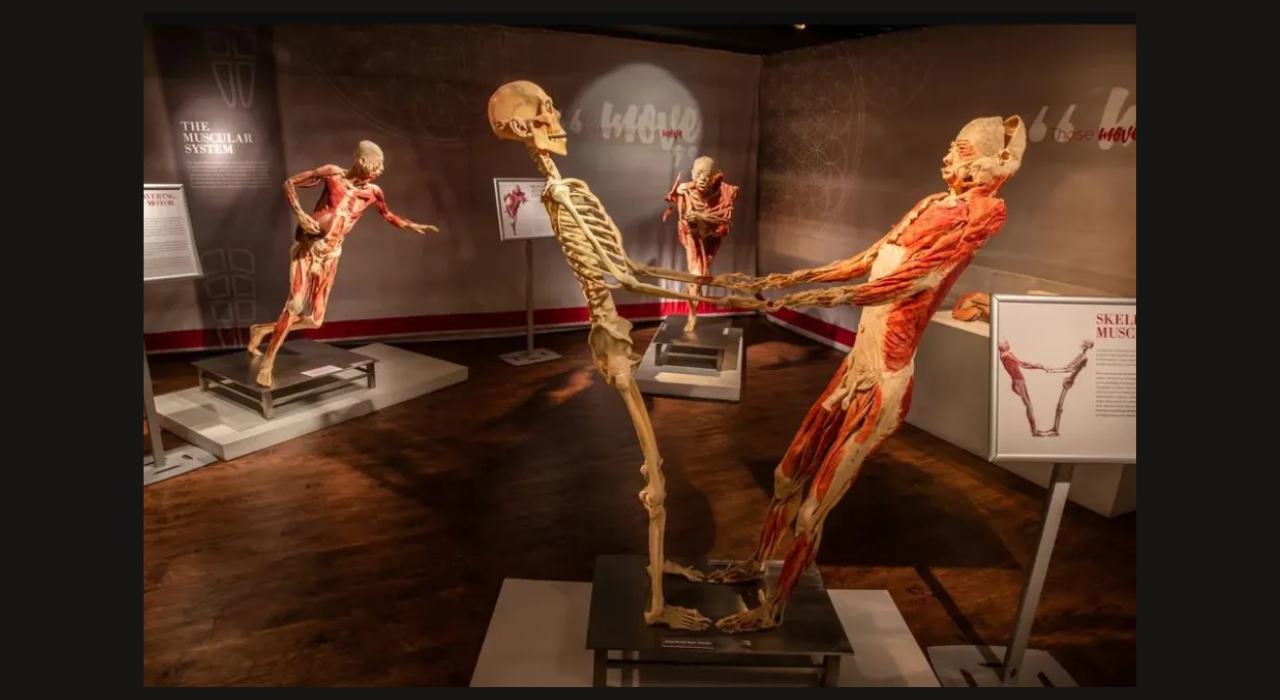
A mother said she believed her son’s skinned body was displayed at a Las Vegas exhibition/ Image: Real Bodies Vegas
Legal in the US, illegal in the UK
In the UK, the for-profit trade of human body parts is banned under the Human Tissue Act. Across much of Europe, similar laws apply. In the US, however, the system operates very differently.Although the Uniform Anatomical Gift Act prohibits the sale of human tissue, it allows companies to charge a “reasonable amount” for processing, storage, and transport, a loophole that has enabled a sprawling commercial market.Researcher and author Jenny Kleeman, who investigated the trade for her book The Price of Life, described the industry as “murky” when speaking to The Sun.“In the UK, you can donate your body to medical research, but nobody’s allowed to donate your body for you,” she said.“The people who administer the whole process, they don’t make a profit out of it.“Whereas in America, you are allowed to make a profit out of providing these dead bodies [without permission].”She added: “Because there’s no regulation saying that you can’t make money this way, it has allowed for an industry to emerge where people can provide bodies when they have no background in scientific research.”
A price on every part
Internal documents cited by The Sun show how bodies are broken down and sold piece by piece by firms calling themselves “non-transplant tissue banks”.
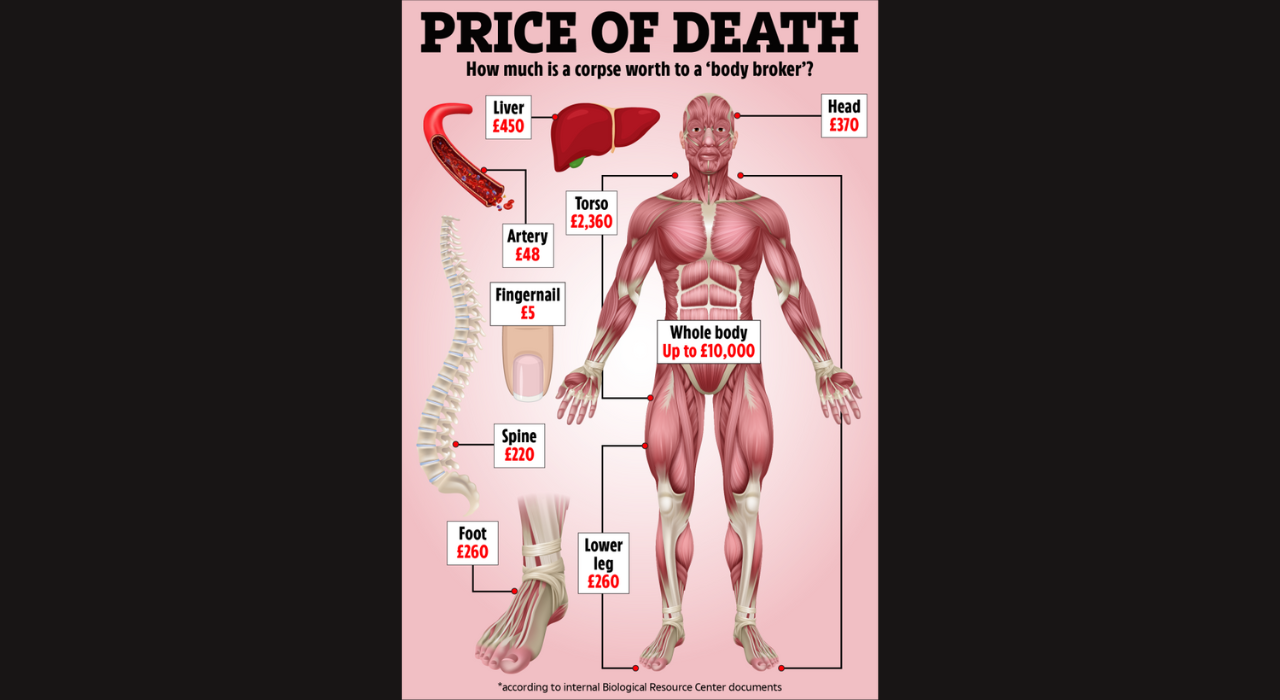
Internal Biological Resource Center documents show individual body parts sold for hundreds to thousands of pounds
According to those records, a whole body can fetch up to £10,000. Individual parts are priced separately:
- Torso: £2,360 ($2,761.20)
- Liver: £450 ($526.50)
- Head: £370 ($432.90)
- Foot: £260 ($304.20)
- Lower leg: £260 ($304.20)
- Spine: £220 ($257.40)
- Artery: £48 ($56.16)
- Fingernail: £5 ($5.85) (around £25 per hand- $29.25)
At one firm, a public school janitor’s liver was sold for £450 ($526.50), while a bank manager’s torso was sold to a research institute for more than £2,600 (more than $3,042.00).These bodies are supplied to universities, medical schools, surgical training programmes, medical-device companies testing implants, and, in some cases, US military research.
A billion-dollar trade hiding in plain sight
In 2017, Brian Grow uncovered at least 25 for-profit body-brokering companies operating across the US. One firm alone earned £9.3 million over three years, he reported.Kleeman also found that one of the largest brokers shipped body parts to more than 50 countries, including the UK.Despite the scale of the business, oversight remains minimal.One of the most notorious companies, Phoenix-based Biological Resource Center (BRC), became the subject of FBI scrutiny after authorities discovered warehouses containing dismembered bodies stored in tubs.A police detective wrote in an affidavit:“All of the bodies appeared to have been dismembered by a coarse cutting instrument, such as a chainsaw.”Inside one Bio Care warehouse, officials found 127 body parts belonging to 45 people.Bio Care owner Paul Montano was charged with fraud, but prosecutors later dropped the case, saying they could not prove deception under existing laws.
Consent, contracts and consequences
Consent lies at the heart of the controversy. Families are typically asked to sign lengthy forms containing dozens of clauses outlining potential uses of the body. Critics argue these documents are difficult to understand, especially during periods of grief.In December 2016, more than 20 donated bodies were secretly used in US Army blast experiments, leaving remains shredded by shrapnel. Families said they had never agreed to military use, but the broker’s defence team pointed to a clause permitting use by the United States Army.The bodies, according to reports, were blown into hundreds of pieces.
Inside the broker mindset
Kleeman, who has interviewed numerous figures across the body-brokering industry during years of research for her book, said one of her most revealing conversations was with Garland Shreves, the CEO of Research for Life.“He says he’s doing it out of respect for the world of science and feels that other body brokers have given the industry a bad name,” she said.But Shreves also admitted he could never promise families they would receive the correct ashes of their loved ones, acknowledging that once bodies are sold, control is lost.
Why the system persists
Despite the scandals, medical institutions continue to rely on donated bodies.Brandi Schmitt, director of the anatomical donation programme at the University of California, revealed to The Sun that the university received 1,600 whole-body donations in 2024, with another 50,000 living donors registered.“In medical schools all over this country, when students study anatomy, they use cadavers,” Kleeman said.“It’s how people learn about the human body, and it’s how surgeons learn to operate.”She added: “I don’t think there is anybody who would want someone opening their body up for surgery who has never practised before.”Doctors, engineers, and researchers depend on human bodies to train and innovate. Families who cannot afford funerals may see donation as a meaningful alternative. But the American body-broker system often leaves donors’ relatives unaware of how remains are used, divided, shipped, or destroyed. Go to Source