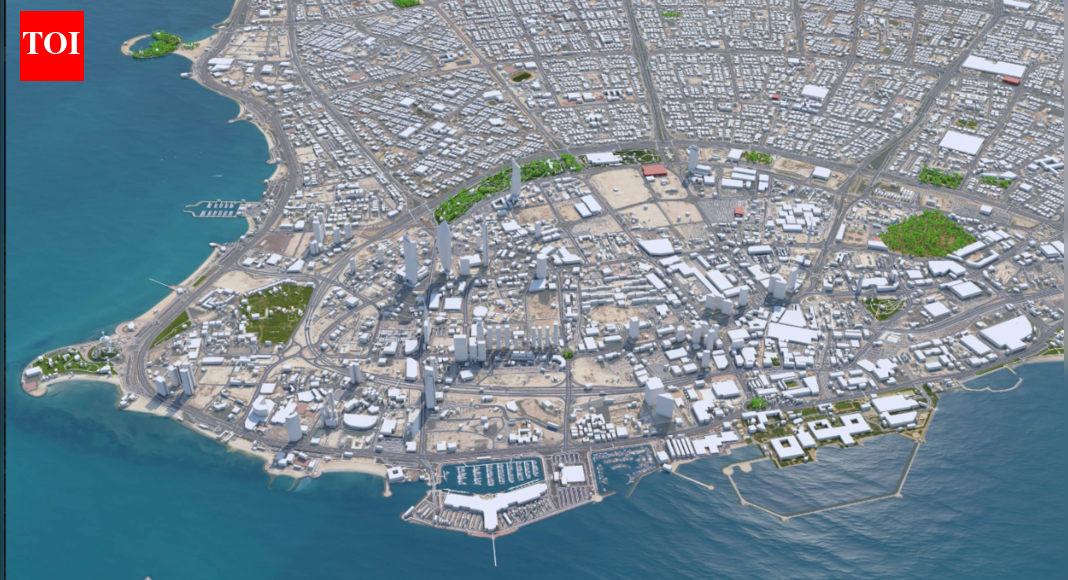

With zero natural rivers or lakes, Kuwait depends almost entirely on seawater desalination to meet its water needs/Image: Renderhub
Kuwait’s shimmering skyline and bustling urban centres rise from one of the most water-scarce landscapes on Earth. Roughly the size of New Jersey and spanning just under 18,000 square kilometres, the country sits at the northern edge of the Persian Gulf, wedged between Iraq and Saudi Arabia, its terrain dominated almost entirely by arid desert. Despite lying within the broader Tigris–Euphrates river basin, a region historically synonymous with fertile land and flowing water, Kuwait itself has no rivers, no lakes, and no perennial streams. It is among the very few nations worldwide with zero internal renewable freshwater resources.This stark absence of natural water stands in sharp contrast to Kuwait’s modern profile. Home to nearly 4.9 million people, the high-income state is best known for its vast oil wealth, its outsized role in global energy markets, and a cultural legacy that once earned it the nickname “the Hollywood of the Gulf.” Sustaining daily life, from drinking water and food production to industry and urban growth, has therefore depended not on geography, but on engineering, policy, and energy-intensive innovation. In a country where nature provides virtually no freshwater at all, the simple act of turning on a tap is anything but ordinary. So, how does a modern nation keep its taps running, crops growing, and population hydrated in such an arid setting?
No rivers, no problem
According to the United Nations Food and Agriculture Organization (FAO), Kuwait has no natural freshwater resources such as rivers or lakes, a condition shaped by its prevailing hyper-arid climate. Annual rainfall averages less than 120 millimetres, and even that limited precipitation rarely lingers. Intense heat and evaporation mean most rainwater is quickly lost to the atmosphere before it can be stored or reused. Kuwait’s flat desert terrain offers little geological advantage: unlike countries with mountains that trap moisture or deep aquifers that recharge over time, the country’s soils retain very little water, and internal renewable groundwater resources are considered negligible.The landscape does contain shallow depressions known as wadis; ancient, dry riverbeds that briefly come alive after heavy rains. During the short rainy season, surface runoff can collect in these wadis, occasionally triggering flash floods that last anywhere from a few hours to several days. Notable examples include Bahrat al Abraq, Bahrat al Mirfi, Shaib Rujm al Jahtan, and Wadi al Batin, sometimes referred to as the “Kuwait River.” Yet these features offer only fleeting relief. Extremely high evaporation rates and severe soil-moisture deficits prevent most of this runoff from infiltrating the ground in meaningful quantities, leaving little water available for long-term use.With neither permanent rivers nor viable freshwater aquifers to rely on, Kuwait has been forced to look seaward. The country now depends almost entirely on one of the most expensive and energy-intensive solutions available: seawater desalination.
How desalination became Kuwait’s lifeline
Since the 1950s, desalination has been the cornerstone of Kuwait’s water strategy. The country’s first desalination plant began operating in 1953, marking an early recognition that survival in a water-scarce environment would depend on technology rather than natural supply. Over the decades, this infrastructure has expanded dramatically along Kuwait’s coastline. Today, more than 90 percent of the nation’s drinking water is produced by desalinating seawater drawn from the Arabian Gulf and treated in large-scale coastal facilities.Desalinated water now underpins nearly every aspect of daily life in Kuwait, supplying households, industry, and public services alike, though the largest share is reserved for potable use. To reduce pressure on this costly system, the country also relies on treated wastewater, which undergoes tertiary or more advanced levels of treatment. This reclaimed water is not used for drinking but plays a critical supporting role, particularly in the irrigation of fodder crops, date palm groves, and urban landscaping, allowing Kuwait to conserve high-quality desalinated water for human consumption.The country now operates multiple desalination plants, including the Shuwaikh, Doha East, and Az-Zour facilities. According to MEED (Middle East Economic Digest), the Az-Zour North complex is one of the largest in the region, producing over 480,000 cubic meters of water per day.
Importing and rationing: Secondary strategies
While desalination remains the primary method, Kuwait supplements its needs through water imports and recycling wastewater for industrial and agricultural use. In recent years, the government has also introduced smart metering and public awareness campaigns to reduce waste and promote conservation.Additionally, the Ministry of Electricity and Water has encouraged the use of greywater systems in commercial buildings and new residential developments.
A global outlier
In a 2023 World Bank report on water security in the Middle East and North Africa, Kuwait was singled out as having zero cubic kilometers of internal renewable water resources per year, making it one of the most water-stressed countries in the world by geography.Even countries like the UAE and Bahrain, which also rely heavily on desalination, have some groundwater reserves or seasonal wadis. Kuwait, on the other hand, depends nearly 100% on human-made systems to provide every drop of fresh water.
Resilience through infrastructure
Despite these extreme limitations, Kuwait maintains one of the highest per-capita water consumption rates in the world, a testament to its advanced water infrastructure. The country continues to invest in sustainable technologies, including solar-powered desalination, advanced reverse osmosis systems, and wastewater reuse for agriculture and industry. These innovations are not just about survival—they reflect Kuwait’s broader ambition to align with global environmental standards and reduce its long-term dependence on fossil fuels for water production.However, experts caution that the country’s water supply remains vulnerable to rising energy costs, geopolitical risks, and climate change impacts. Because desalination is energy-intensive, any disruption in fuel supply or power infrastructure could have a ripple effect on water availability. To tackle this, the Kuwaiti government is actively exploring public-private partnerships (PPPs) to expand capacity and ensure a resilient supply chain that can withstand future shocks.
Verdict
Kuwait’s lack of rivers or lakes might seem like an impossible obstacle, but the country has turned its geographical disadvantage into an engineering triumph. By mastering desalination and modern water management, it has built a system that not only supports everyday life but also allows for industrial growth and urban expansion in an unforgiving climate.Yet, this achievement comes with a price, financial, environmental, and strategic. Water in Kuwait is not simply a natural resource; it is a manufactured necessity, sustained through energy-intensive processes that require constant innovation, investment, and public awareness. This dependence carries broader implications for the country’s economic future. While other Gulf states are increasingly seeking to diversify away from oil and build more resilient, post-hydrocarbon economies, Kuwait faces a structural constraint: the most basic requirement for survival, water, remains overwhelmingly tied to desalination, one of the most energy-demanding technologies in use. As long as freshwater security is inseparable from fossil-fuel-powered infrastructure, reducing reliance on oil becomes a far more complex challenge.As the global climate crisis deepens and freshwater scarcity becomes a shared global concern, Kuwait’s experience may serve as both a cautionary tale and a blueprint—reminding the world that water security is no longer a passive gift of geography, but a challenge that must be engineered, powered, and sustained. Go to Source