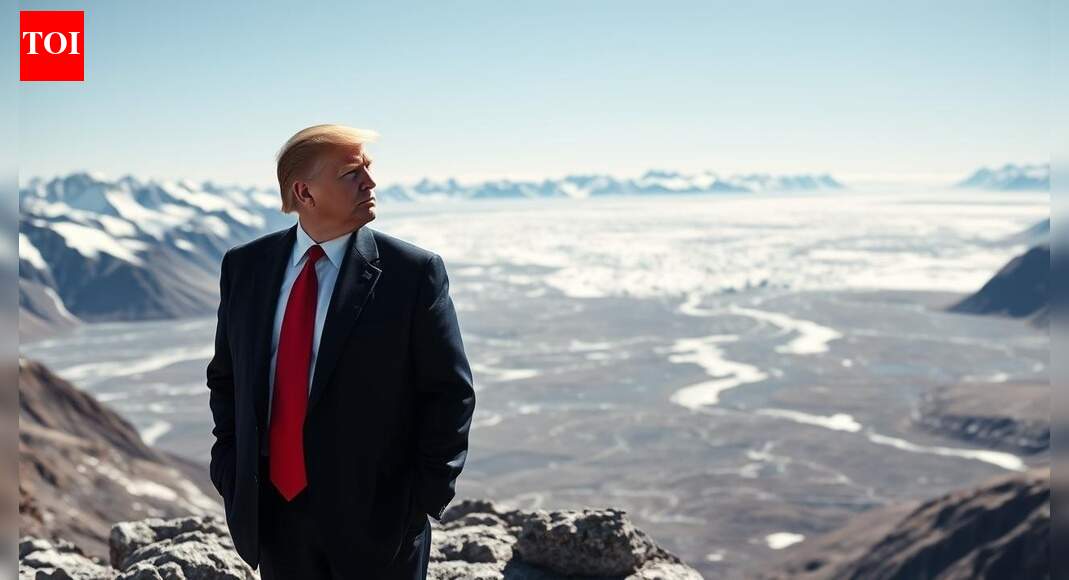

When US President Donald Trump argued that America must “conquer” Greenland to prevent Russia or China from becoming its neighbour, the claim overlooked a key geographical reality: Russia is already a neighbour of the United States. Earlier, while addressing a gathering at the White House, Trump said, “We are going to do something on Greenland, whether they like it or not, because if we don’t do it, Russia or China will take over Greenland, and we’re not going to have Russia or China as a neighbour. I would like to make a deal the easy way, but if not, we are going to do it the hard way.”
Emphasising the strategic importance of the island, he said, “When we own it, we defend it… Look at what happened with the horrible deal Obama made with Iran, which was a short-term deal… Countries need to have ownership… We have to defend Greenland, because if we don’t, China or Russia will.”However, the United States already shares a border—albeit a maritime one—with Russia. The two countries are separated by the narrow Bering Strait, which lies between Alaska in the US and Russia’s Chukotka Peninsula. At their closest point, the distance between the two nations is just 2.4 miles, marked by the Diomede Islands: Big Diomede, which belongs to Russia, and Little Diomede, which is part of the United States. In winter, sea ice can form a temporary ice bridge between the islands, creating what is often referred to as an “Ice Curtain” between the two rivals. Alaska itself was purchased from Russia in 1867, when then–US Secretary of State William Seward negotiated the deal for $7.2 million. The acquisition eventually paved the way for Alaska to become the 49th US state in 1959. Russia’s Chukchi Peninsula, meanwhile, forms part of the Chukchi tundra ecoregion along the East Siberian Sea, a marginal sea of the Arctic Ocean—underscoring how closely the two countries already sit across the Arctic frontier.