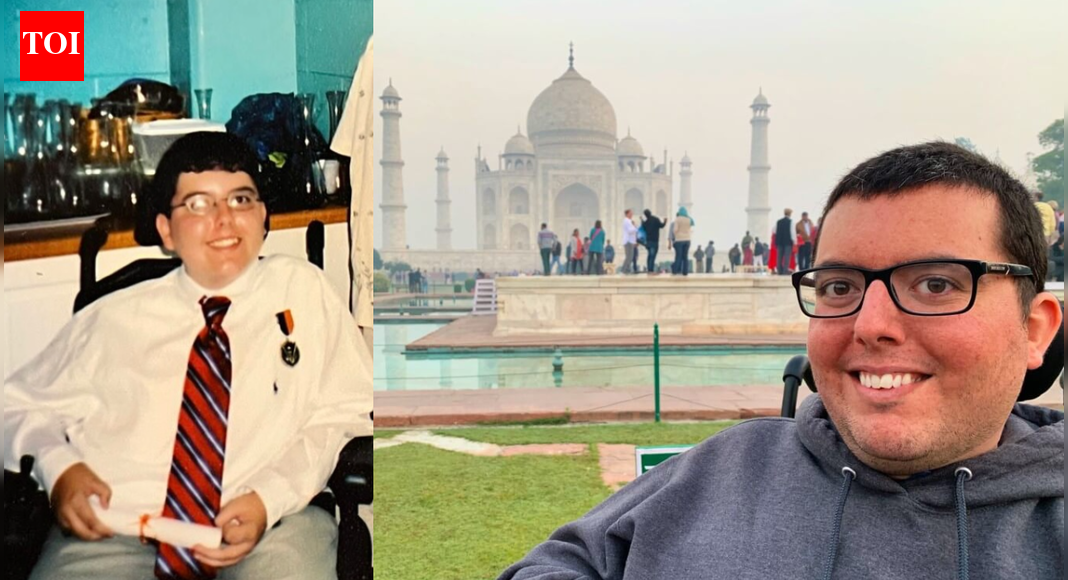

Cory Lee has ridden camels in Morocco, floated in Iceland, explored India, paraglided in Switzerland, visited Antarctica/ Image: Cory Lee
Growing up, Cory Lee was given a piece of advice that would later shape his life: “If you can’t stand up, stand out.” It was something his mother told him repeatedly, and something he says he still lives by. Lee was diagnosed with spinal muscular atrophy at the age of two and began using a powered wheelchair full-time by the time he was four. Travel, however, was never something he felt was off-limits. As a child, he took trips across the United States with his family. As a teenager, he started looking beyond it. By the time he reached adulthood, that instinct hardened into resolve, particularly after a job interview ended abruptly when a potential employer told him he could not be hired because the role involved travel and they believed his disability made that impossible. “I went to a job interview, and they told me that I could not have that job because it involved travelling, and he thought that I couldn’t travel because of my disability,” Lee told LADbible. “So they immediately turned me down.”
The trip that changed everything
Lee’s first overseas journey came at 15, when he joined a short cruise to the Bahamas. The trip lasted just four days, with barely half a day on land, but it left a lasting impression. “My first overseas trip was a cruise to the Bahamas when I was 15 years old,” he told Intrepid Travel. “The cruise was only four days long and we really only had about 12 hours in Nassau, but it completely blew me away. “It was the first time that I saw a different culture, tried new foods, and met people that lived very different lives than I did. I thought, ‘If the Bahamas can be this amazing, I wonder what the rest of the world is like?’ It was during that trip when the travel bug within me was born.”
Building Curb Free With Cory Lee
In 2013, as Lee was preparing for his first international trip to Australia, he noticed how little practical information existed online for wheelchair users who wanted to travel independently. The job rejection was still fresh. So was the urge to prove it wrong.That year, he launched his blog, Curb Free With Cory Lee, documenting destinations that were accessible and, just as importantly, those that were not. The site became both a personal record and a practical guide for others navigating the same barriers; he has since built a large social media following and was recently named by Condé Nast Traveller as one of the “most influential figures in the field of accessible travel.” “Since then, I’ve fallen in love with the world and hopefully shown other wheelchair users what’s possible,” Lee has said, describing travels that have taken him swimming in Iceland’s Blue Lagoon and floating in a hot air balloon over Israel’s Negev Desert. By 35, Lee had visited 55 countries, spanning all seven continents.
Travel, meticulously planned
None of it, he is careful to point out, happens spontaneously. Each trip requires extensive preparation, often between six months and a year of research, particularly when it comes to transport, accommodation and access. The experiences themselves have been wide-ranging: riding a camel through the Sahara in Morocco, paragliding in Switzerland, travelling across India, Egypt, Italy and Thailand, and reaching Antarctica, a destination many able-bodied travellers never manage. For Lee, the most difficult part of travel remains flying. “I would love to be able to stay in my wheelchair on the plane,” he said. “Creating a wheelchair spot on planes would be my ultimate dream and I would fly even more than I already do.” “Whenever I’m flying, I’m constantly worried about whether my wheelchair is going to be damaged or not, because it’s stowed in the cargo hold with all of the luggage,” he added. “It is very frequently damaged during flight and then I can’t get around independently, so it’s a catastrophe.”
Living with SMA
Lee was diagnosed as a toddler after his mother noticed he would take a few steps and then fall. “At the age of two, my mom started noticing I would try to take a few steps and then I would just fall down,” he recalled. “They did a muscle biopsy and discovered that I had SMA.” By four, he could no longer walk at all. Over time, muscle weakness progressed further. Today, he cannot straighten his legs or lift his elbows off the armrests of his wheelchair. When he was diagnosed in the 1990s, treatment options were limited. “Back in the 90s, we had no treatment,” he said. “So I just went to physical therapy to stretch the muscles, go swimming, see a therapist, but that was pretty much it.” Recent advances in medicine, including gene therapies now available to children diagnosed today, have changed that outlook, something Lee views with cautious optimism. “It’s definitely exciting to see that now when children are diagnosed, there are finally treatment options,” he said. “So I feel super hopeful for the next generation of kids with SMA that they’re going to be able to maintain the muscles they do have over a longer period of time.” For Lee, travel remains both escape and statement, not in spite of his disability, but in full view of it, as he continues to roll through places the world once told him he could never reach. Go to Source