.
NEW DELHI: One of the country’s largest central govt hospitals is functioning with a significant shortage of teaching faculty, potentially straining patient care and medical education. An RTI reply from Vardhman Mahavir Medical College and Safdarjung Hospital administration on Dec 27, 2025, shows that 70 out of the 398 sanctioned teaching posts are vacant. While department-wise data show while 365 faculty members are currently in position – 346 are occupied by regular faculty members and 19 by contractual faculty – 37 are posted in excess in some departments, leaving the 70 posts vacant elsewhere due to uneven faculty distribution.
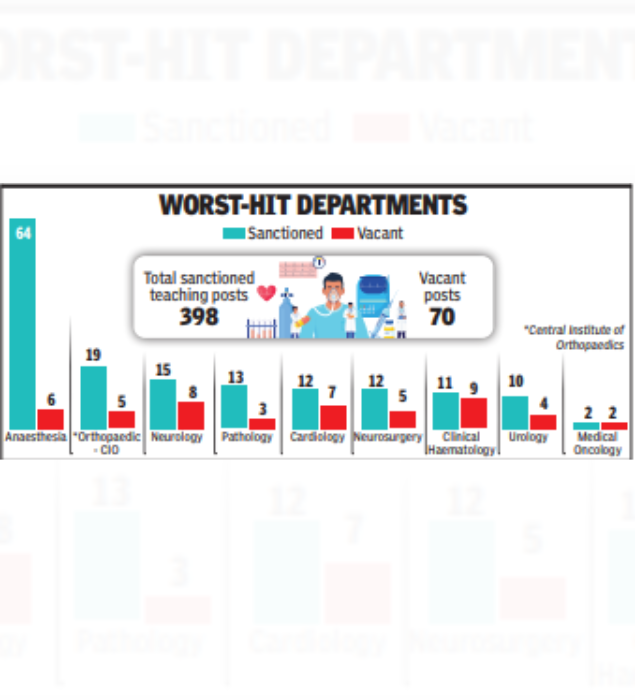
This has resulted in persistent staffing gaps in several critical departments as well as internal imbalances, rather than uniform faculty deployment. Among the core clinical disciplines facing acute shortages, clinical haematology has nine vacancies out of 11 sanctioned posts, while neurology is short of eight faculty members. Cardiology, a high-burden tertiary-care service, has seven vacancies out of 12 posts, and neurosurgery is functioning with five vacant posts. Anaesthesia, central to surgical services, has six vacancies. There are also gaps in departments linked to cancer care and advanced diagnostics. Medical oncology has two sanctioned posts but none currently in position, while nuclear medicine and urology have three and four vacancies, respectively. There are similar shortages in pathology, physiology, pulmonary medicine, endocrinology and forensic medicine, according to the RTI reply. Responding to the RTI findings, Sakshi Chhugh, public relations officer, VMMC & Safdarjung Hospital, said the hospital has a sanctioned strength of 398 teaching posts, of which 345 are presently occupied by regular faculty and 18 by contractual faculty. She said interviews for the remaining 35 posts had already been conducted, and appointments would be finalised in due course as per prescribed recruitment procedures. “The hospital continues to ensure that academic activities, teaching programmes and patient care services remain uninterrupted,” Chhugh said. Health experts warn that sustained faculty shortages in teaching hospitals can translate into longer waiting times, heavier clinician workload and reduced teaching and supervision for medical students, with direct implications for service delivery at high-volume centres like Safdarjung.