
Last Updated:
On August 21, 1639, the English East India Company acquired land in Madrasapattinam, founding Fort St. George and shaping Madras, now Chennai, into a major colonial and trade hub



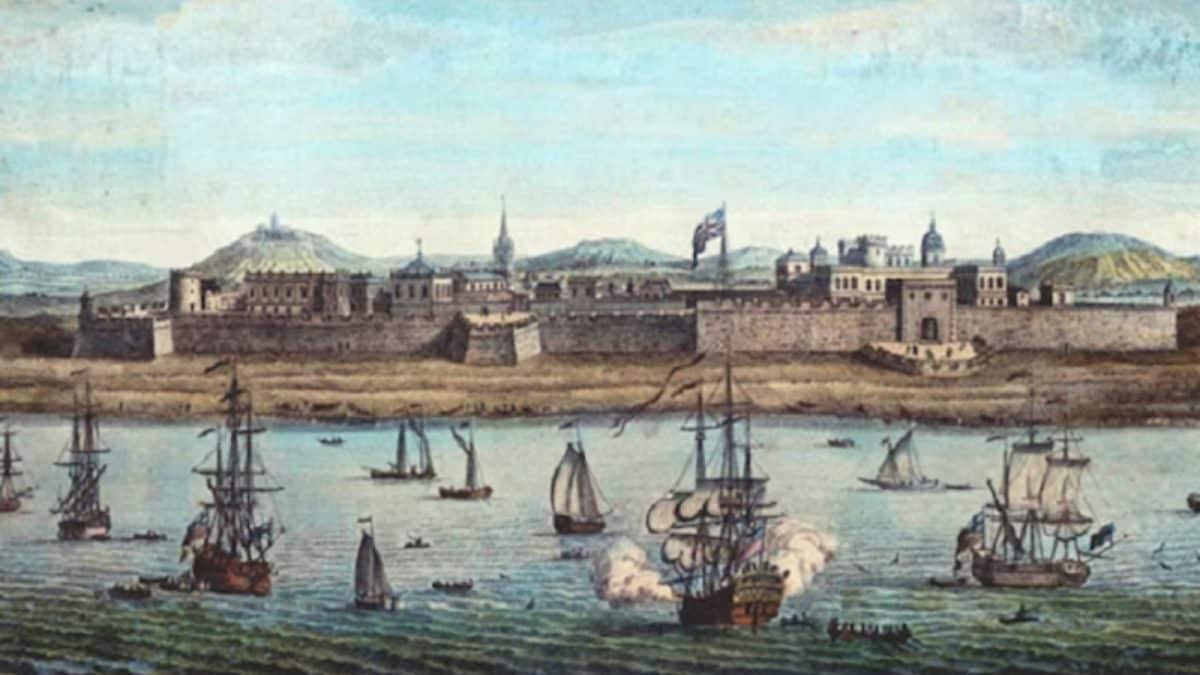
What began as a modest leasehold beside the sea grew into Fort St. George, the first major British stronghold in India. (News18 Hindi)
On August 21, 1639, a deal was struck on the Coromandel coast that would eventually alter the course of Indian history. The English East India Company acquired a narrow strip of land, roughly three square miles, in a little-known fishing village called Madrasapattinam. The land was obtained from Damarla Venkatappa Nayak, the local chieftain under the fading Vijayanagara Empire. What began as a modest leasehold beside the sea grew into Fort St. George, the first major British stronghold in India, and the nucleus of the modern city of Madras, now Chennai.
At the time, Portuguese and Dutch traders were already active along the coast, exploiting its natural harbours and thriving cloth markets. The English were latecomers but keen observers. They identified Madrasapattinam as ideal – coastal, accessible, and close to the weaving centres that produced fine muslin and calico cloth. Within a year of the purchase, the Company laid the foundation of Fort St. George in 1640, fortifying its foothold on the Indian subcontinent.
Recommended Stories
The fort, completed with bastions, walls, and a garrison, became home to British merchants, factory workers, and soldiers. Around it grew a segregated township: White Town, reserved for Protestant Europeans and lined with whitewashed buildings, and Black Town, populated by Indian traders, artisans, and settlers. By 1646, the population had swelled to nearly 19,000 as surrounding villages were absorbed into the settlement. Over time, White Town, Black Town, and the fort coalesced into the bustling colonial city of Madras.
The East India Company’s operations here were not limited to trade. Warehouses and godowns stored cotton, spices, and indigo awaiting export. Factories produced calico that attracted buyers from across the region. The Company also established schools, churches, and residential enclaves, alongside a port that drew ships from across the Indian Ocean. Gradually, Madras evolved into a dual-purpose hub, a commercial powerhouse and a strategic military centre.
Initially, the Company’s military presence was meagre. Barely 200 to 300 European guards stood watch over warehouses and goods. Recognising the need for larger forces, the British soon began recruiting locally. By the 1660s, small contingents of Tamil and Telugu soldiers, along with Muslim cavalrymen, were enlisted. These recruits, the sepoys, became the backbone of the Company’s army in the region. By the mid-18th century, the Madras Army had been formally constituted, comprising several thousand European troops but overwhelmingly dependent on tens of thousands of Indian sepoys.
Madras also became a battlefield in the great European struggle for dominance in India. During the Carnatic Wars of the 18th century, the city served as the British base of operations against the French. By the 1780s, the British had secured supremacy in southern India. In 1783, the Madras Presidency was established, encompassing present-day Tamil Nadu, parts of Andhra Pradesh, Kerala, and Karnataka. From this coastal outpost, the Company expanded its reach inland, entrenching itself across the subcontinent.
Today, August 21, is commemorated as Madras Day, marking the origins of a city whose foundations were laid not just in sand and stone but in the shifting tides of global trade and empire. Fort St. George, once the seat of Company power, still stands, now housing the Tamil Nadu Legislative Assembly and Chief Minister’s office, a reminder of how a humble fishing village became the British gateway to India.
Loading comments…
Read More