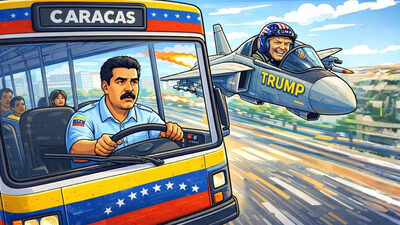
Nicolás Maduro started off as a bus driver before becoming the most powerful man in Venezuela, a trajectory so improbable that it once passed for proof of revolutionary possibility. In the end, he had to be kidnapped and extracted by plane, a final inversion that captured both the elevation he achieved and the emptiness of what he built. Between those two images, the bus and the aircraft, lies the story of a man who rose through loyalty rather than brilliance, governed through endurance rather than belief, and presided over a country that slowly emptied itself while the state remained stubbornly intact. Maduro’s life reads less like the triumph of the dispossessed and more like a warning about how power can continue long after its meaning has quietly dissolved.
The making of a loyalist
Maduro was born in Caracas in 1962 into a working-class world far removed from elite politics. His early life unfolded among trade unions, leftist organising, and the everyday logistics of urban survival. Driving a bus for the Caracas Metro, he learned politics not as theory but as discipline, hierarchy, and presence. He was never a great socialist thinker or a charismatic tribune. He was an organiser who understood how movements hold together under pressure.That instinct drew him toward Hugo Chávez, the former army officer who reshaped Venezuela after 1999. Chávez governed through spectacle, emotion, and personal magnetism. What he needed around him were loyal operators who would not fracture the movement by competing for attention. Maduro, unflashy and deferential, proved ideal. He rose steadily through parliament, became speaker, then foreign minister for six years, embedding himself deep in the machinery of the state while avoiding the rivalries that consumed others.
Chosen to preserve, not transform
When Chávez’s health failed, the question of succession threatened to tear chavismo apart. Generals, party bosses, and ideological heirs all circled. Chávez chose Maduro precisely because he was non-threatening. By naming him publicly as successor in 2012, Chávez froze internal competition and handed Maduro authority rooted in proximity rather than popularity. The revolution would continue, Chávez implied, even if the man carrying it lacked the fire that created it.Maduro entered office as a custodian. Preservation, not transformation, was his mandate.
Power without enchantment
That difference became visible immediately. Maduro won the presidency in 2013 by a narrow margin, and that narrowness shaped his entire rule. Power felt conditional. Each election hardened institutions instead of renewing them. Courts, electoral bodies, and security forces shifted from referees to buffers, absorbing pressure and redistributing it in ways that kept the centre intact. Politics became defensive. Survival replaced ambition.By the time Juan Guaidó declared himself interim president in 2019, Venezuela had entered a condition of suspended legitimacy. Competing claims to authority coexisted with a shared sense of exhaustion. Maduro endured because stalemates favour incumbents who can wait, and waiting became his governing method.
A country that slowly thinned out
Venezuela’s collapse under Maduro did not arrive as a single catastrophe. It unfolded as a slow narrowing of life. Oil production declined year after year as mismanagement and politicisation drained capacity. Inflation hollowed out wages until money lost its meaning. Hospitals improvised. Schools emptied. Markets shifted from abundance to calculation. Everyday life shrank.Millions of Venezuelans left, first as an exception, then as a rhythm, and eventually as a background condition of national existence. Leaving became the most reliable form of agency available. Maduro framed the devastation as siege and sabotage, and later sanctions deepened the damage, but the structural decay preceded them. The state stopped working in visible ways while the presidency continued to function as if continuity alone were an achievement.
How Maduro actually ruled
Maduro’s durability rested on a specific model of power. He did not rule through mass mobilisation or personal domination. He ruled through adhesion. The military was given economic roles and political insulation. Party elites were rewarded yet kept fragmented. Security services expanded alongside one another. Armed civilian groups were tolerated because continuity protected their interests.Authority functioned as a web of mutual dependence, with Maduro positioned at its centre because movement elsewhere carried risk. Inspiration mattered less than predictability. Stability, even diminished stability, became the currency of rule.
Repression as routine
Constraint replaced spectacle. Opposition figures were detained, disqualified, or worn down. Independent media contracted gradually. Elections continued as administrative rituals with foregone conclusions. Fear became predictable rather than theatrical, and predictability softened resistance into resignation. The system did not need to shock. It needed to persist.Maduro did not terrorise in waves. He normalised limitation.The comfort of absurdityInternationally, Maduro’s image drifted into caricature. His speeches became memes. His metaphors invited ridicule. This worked in his favour. Absurdity lowered expectations, and lowered expectations reduced urgency. Decline stretched over years trained observers to adjust rather than confront. Maduro endured because the world learned how to live with him.
Removal after endurance
Maduro survived elections, sanctions, protests, parallel governments, and repeated predictions of collapse because each challenge unfolded within the system he controlled. His capture in January 2026 succeeded because it bypassed that system entirely. It replaced persuasion and negotiation with extraction. With Delcy Rodríguez stepping in, Venezuela entered another pause, one defined by uncertainty rather than renewal. Institutions remain hollow. Trust remains scarce.
What Maduro leaves behind
Maduro will not be remembered as a revolutionary hero or a singular villain. He will be remembered as a study in duration, in how loyalty can substitute for competence, how habit can replace belief, and how authority can persist long after its purpose has evaporated. His fall was sudden. His rule was slow. The cost is measured in years that cannot be returned to those who waited, left, or endured. That is the arc of Nicolás Maduro, from the bus to the aircraft, from improbable ascent to empty endurance, leaving behind a country still reckoning with the time that power refused to give back. Go to Source