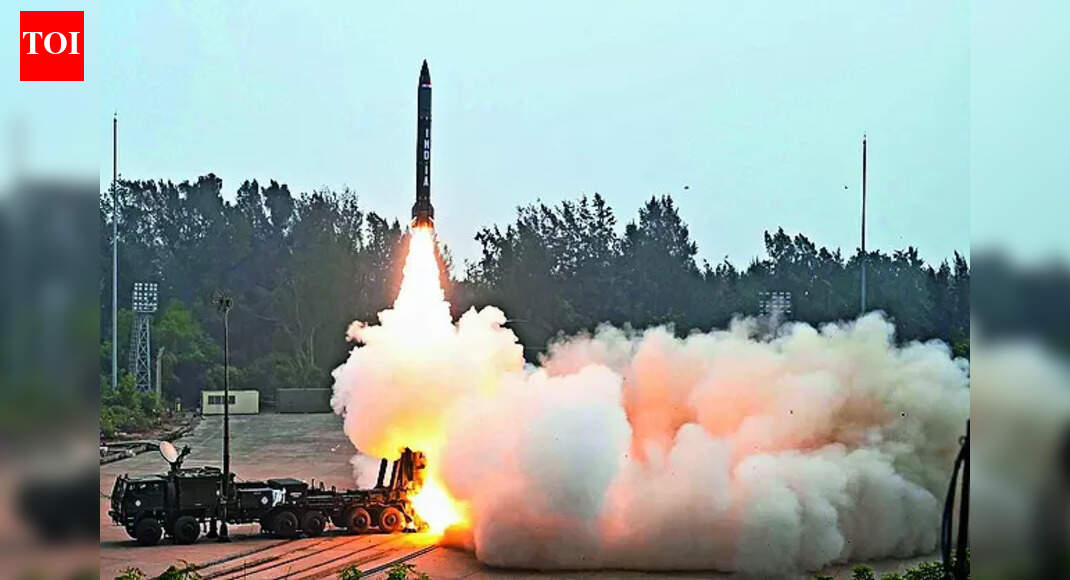

Pralay missiles being tested by DRDO
NEW DELHI: Defence Research and Development Organisation (DRDO) on Wednesday morning successfully conducted a salvo launch of two ‘Pralay’ missiles in quick succession from the same launcher at the Integrated Test Range at Chandipur, off the coast of Odisha.Defence minister Rajnath Singh has complimented DRDO, IAF, Indian Army, defence PSUs and the industry on the successful launch of the missiles in quick succession. The completion of the salvo launch (simultaneous firing) of Pralay has established the reliability of the missile, he said. Pralay is an indigenously developed solid propellant quasi-ballistic missile employing state-of-the-art guidance and navigation to ensure high precision. The missile is capable of carrying multiple types of warheads against various targets.The Pralay test came just a day after India conducted the first flight test of the Pinaka Long-Range Guided Rocket, also from Chandipur, on Monday and test-fired a 3,500-km range K-4 ballistic missile from the nuclear-powered submarine INS Arighaat in the Bay of Bengal on Dec 23. India is developing an array of missiles to reinforce its defences against hostile forces and be ready for counter-attacks.
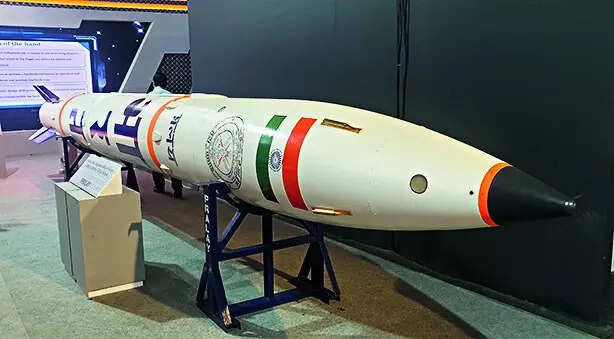
Pralay missile
According to a defence ministry’s statement, the flight test around 10.30 am was conducted as part of user evaluation trials. Both missiles followed the intended trajectory and met all flight objectives, as confirmed by tracking sensors deployed by the Integrated Test Range at Chandipur. The terminal events were confirmed by telemetry systems installed on board the ship, deployed near the impact points. DRDO chairman Samir V Kamat has congratulated the teams involved in the successful flight-tests and stated that the achievement indicates imminent readiness of induction of the system with the users.The missile has been developed by Research Centre Imarat, Hyderabad, in collaboration with other DRDO laboratories. For the tests, the systems were integrated by two development-cum-production partners.Pralay is equipped with an advanced Inertial Navigation System (INS), complemented by a radio frequency seeker to ensure accurate guidance throughout its flight. These systems enable the missile to maintain a precise trajectory and achieve a high level of target accuracy. Officials said the latest user trials were aimed at validating the missile’s navigation and precision strike capabilities under operational conditions in order to prepare it for induction into the armed forces.