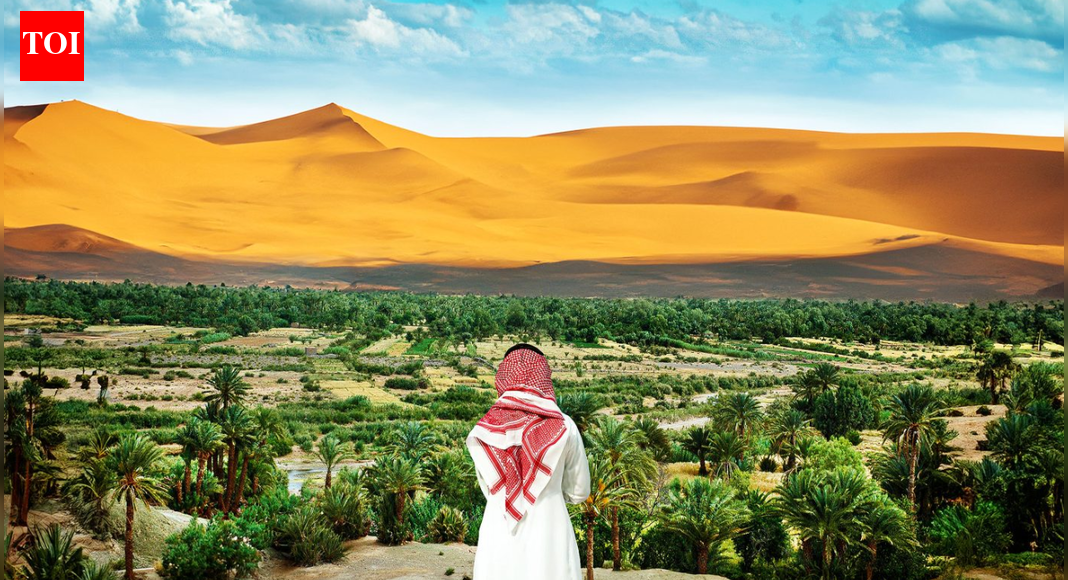

Saudi Arabia plans to plant 10 billion trees, rehabilitating 74.8 million hectares across deserts under the Saudi Green Initiative nationwide/ Image: earth.com
In a country where nearly 95 per cent of the land is desert, sand is not just terrain, it is culture. Bedouin life, camel routes, oases and long crossings have shaped Saudi Arabia’s identity so deeply that it is hard to separate the Kingdom from the desert itself. Yet history tells a different story. Long before oil, before borders, and before dunes dominated the map, large parts of what is now Saudi Arabia belonged to what scientists call “Green Arabia,” a period when rainfall was higher, vegetation spread across the peninsula, and the land could support sustained life. That lost landscape is no longer just a footnote in climate history; it is the reference point behind Saudi Arabia’s attempt to make the desert work differently this time.That contrast between past and present helps explain why Saudi Arabia’s environmental push is not about aesthetics or symbolism. The Kingdom learned long ago how to endure extreme conditions, and oil later turned that endurance into economic power. But oil did not change the land itself, and it will not define the future forever. For a country where desert still dominates the map, long-term stability depends on whether the landscape can be made more resilient, through vegetation, water management and land restoration rather than reliance on a non-renewable source of energy alone.

Saudi Arabia’s Green Initiative aims to plant 10 billion trees, restore 74.8 million hectares, combat desertification, improve ecosystems, and support long-term environmental resilience/ Image: Red Sea Corporate
That is the logic behind the Saudi Green Initiative (SGI), launched in 2021 under the patronage of Crown Prince and Prime Minister Mohammed bin Salman. At its centre is one of the most ambitious environmental pledges ever made: to plant 10 billion trees across Saudi Arabia, rehabilitating nearly 74.8 million hectares of land and reversing decades of desertification.
A landscape defined by sand
Saudi Arabia contains the Rub’ al Khali, the largest continuous sand desert on Earth. Covering roughly 650,000 square kilometres, more than twice the size of the UK, it forms the heart of the wider Arabian Desert, stretching into neighbouring Gulf states. Sand dunes, gravel plains and rocky escarpments dominate much of the Kingdom’s geography. These natural conditions make large-scale greening uniquely difficult. Rainfall, arable land and existing forest cover are all well below global averages. Yet this context is precisely what makes Saudi Arabia’s afforestation targets stand out. Planting 10 billion trees would represent about one per cent of the global greening goal and fully 20 per cent of the Middle East Green Initiative’s wider target of 50 billion trees across the region.
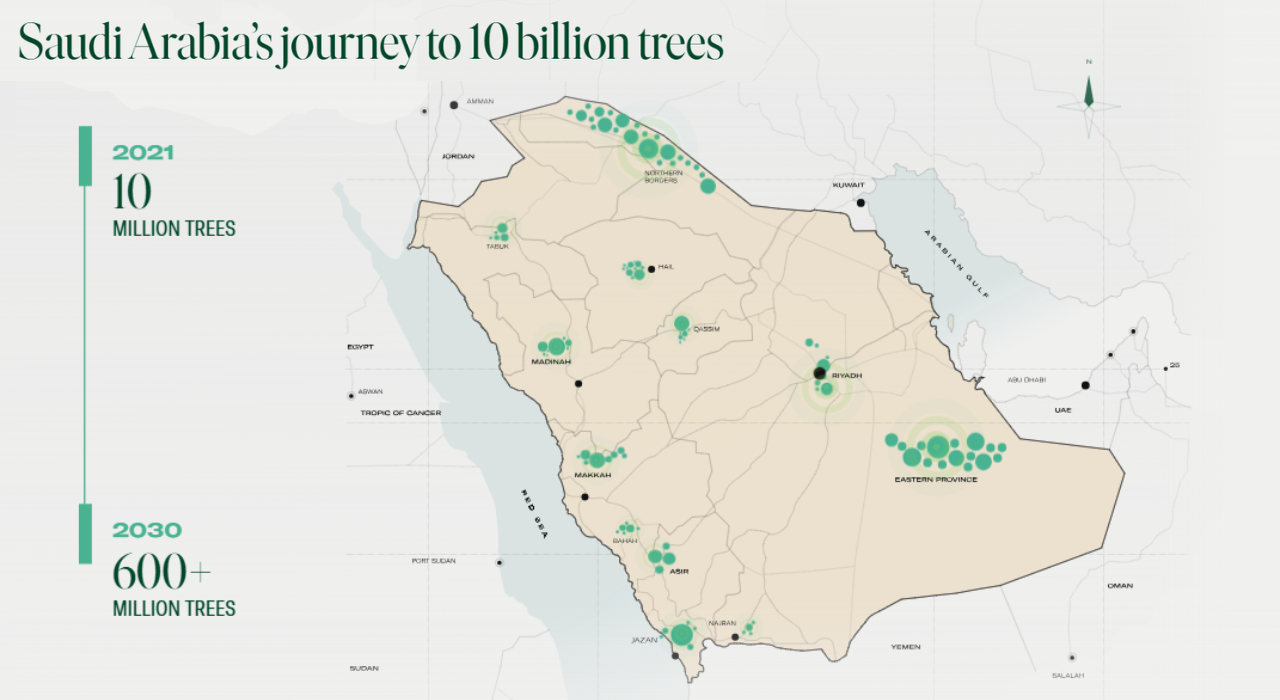
Growing 10 billion trees across Saudi Arabia is equivalent to rehabilitating over 74 million hectares of land.
By July 2025, the Kingdom had planted more than 151 million trees and rehabilitated around 500,000 hectares of land, according to Environment, Water and Agriculture Minister Abdulrahman Al-Fadley, marking steady progress toward the target of more than 600 million trees by 2030 and 10 billion over the longer term. Importantly, this momentum did not begin with the formal launch of the Saudi Green Initiative in 2021: between 2017 and 2023 alone, some 41 million trees were planted, showing that greening efforts had already been underway well before SGI was officially announced.
Science before scale: How the plan was built
Planting trees at this scale in one of the world’s most arid environments is easier to announce than to execute. Much of Saudi Arabia has been desert for centuries, with limited rainfall, fragile soils and extreme heat. Making trees survive, not just grow, requires careful scientific calibration: choosing the right species, matching them to precise locations, and ensuring long-term water support rather than short-term visual greening.That is why, before the target was formally announced, a two-year feasibility study led by the Ministry of Environment, Water and Agriculture (MEWA) and the National Center for Vegetation Development and Combating Desertification (NCVC), in collaboration with global and local experts, mapped where vegetation could realistically thrive. More than 1,150 field surveys were conducted across the Kingdom, using geospatial analysis that factored in soil composition, water availability, temperature ranges, wind patterns and elevation. Native species were prioritised to restore ecological balance, rather than introduce water-intensive or unsuitable plants.

Ahmad al-Anazi (left) of the National Center for Vegetation Cover and park director Suleiman al-Saoub inspect trees and shrubs at the Al Ghat National Park in Al Ghat in central Saudi Arabia on Feb. 8, 2023./ image: The Christian Science Monitor
The resulting roadmap, unveiled in October 2023 at MENA Climate Week in Riyadh, divides implementation into two phases. Between 2024 and 2030, the focus is on nature-based restoration across habitat zones, from cities and highways to rangelands, valleys and protected areas, supported by sustainable irrigation, urban water reuse and rainwater harvesting. From 2030 onward, a second phase will introduce more comprehensive, managed interventions. The approach builds on the Kingdom’s existing biodiversity, which spans more than 2,000 plant species across mangroves, inland marshes, mountain forests and national parks, and aims to deliver measurable benefits, including lower urban temperatures, by at least 2.2°C, improved air quality and reduced heat-related health risks.
From cities to carbon: what SGI is actually trying to do
Tree planting sits at the heart of the Saudi Green Initiative, but it is not the whole story. SGI is designed as a systems-level reset, tying land restoration to emissions, water, energy and public health under the wider framework of Vision 2030. The initiative is built around three clear pillars: cutting emissions, expanding vegetation, and protecting land and sea. By the end of this decade, Saudi Arabia has set itself a series of concrete targets. More than 600 million trees are expected to be planted by 2030, restoring roughly 3.8 million hectares of degraded land. At the same time, the Kingdom plans to place more than 30 per cent of its land and marine territory under protection, while reducing carbon emissions by 278 million tonnes each year. Half of Saudi Arabia’s electricity is targeted to come from renewable sources by 2030. Beyond that milestone lies a longer horizon. By 2060, the Kingdom aims to reach net-zero emissions through a Circular Carbon Economy approach, which balances emissions reduction with reuse, recycling and removal rather than relying on offsets alone. The idea is not abrupt decarbonisation, but managed transition, reshaping how energy, land and water systems interact in a country that will remain energy-producing for decades. That ambition is already reshaping environmental infrastructure. Protected terrestrial areas have expanded sharply, from just 4.5 per cent of Saudi territory to 18.1 per cent today, while the number of national parks has grown from 18 to 500. Marine protection has followed a similar trajectory, with more than 8,000 endangered species reintroduced into coastal and offshore habitats as protected zones expanded by 260 per cent. Monitoring capacity has grown alongside protection. Saudi Arabia now operates 240 air-quality monitoring stations nationwide, backed by advanced meteorological sensing and marine spill-response systems. These are not symbolic additions; they form the measurement backbone that allows greening efforts to be tracked, corrected and scaled. Water, inevitably, remains the hardest constraint. Saudi Arabia is now the world’s largest producer of desalinated water, with daily capacity reaching 16.6 million cubic metres by late 2024, nearly double 2016 levels. Reused water accounts for 32 per cent of total consumption, and strategic water storage capacity has increased by 600 per cent, extending average urban supply coverage from one day to three. To supplement supply, the Kingdom has also turned to atmospheric and natural capture. Officials report that 711 cloud-seeding flights have been conducted across regions, adding an estimated 6.4 million cubic metres of rainfall to support vegetation and groundwater. At the same time, 1,000 rainwater-harvesting dams are under construction, with a combined annual capacity of four million cubic metres. These efforts led the UN Water Committee to select Saudi Arabia as a global model for water sustainability, a notable endorsement for one of the driest countries on Earth.
Greening as economic and social policy
The Saudi Green Initiative is not framed solely as an environmental programme. It is also a labour strategy, an urban policy and a quality-of-life intervention. Over the coming decades, greening efforts are expected to generate jobs across seed collection, nursery management, land preparation, irrigation systems, park development, water reuse networks and environmental technologies. That intent is most visible in cities, where trees are expected to deliver immediate, lived benefits. Increased canopy cover in urban centres is projected to reduce temperatures by at least 2.2°C, improve air quality and lower exposure to heat-related illnesses, particularly respiratory and cardiovascular conditions. Riyadh has become the testing ground. Through Green Riyadh, the capital aims to increase green space coverage to nine per cent and plant 7.5 million trees by 2030, alongside wider greening projects spanning more than 437 square kilometres. At the centre of this transformation is King Salman Park, the world’s largest urban park, where more than a million trees will eventually cover 11 square kilometres of its planned 16.6-square-kilometre footprint.

Image: Green Riyadh
Greening has also been extended deliberately to religious and cultural spaces. In Makkah, the Green Qibla initiative targets the planting of 15 million trees by 2036, reshaping the urban environment of one of the most visited cities on the planet while improving thermal comfort for pilgrims. Altogether, 77 initiatives have been activated under the SGI umbrella, representing investments exceeding $186 billion. The scale is intentional. Saudi Arabia is not trying to erase its desert identity or romanticise a distant past. It is attempting something more pragmatic: to stabilise an extreme environment, reduce risk, and make daily life more resilient in a future where oil alone can no longer define national security. The desert will not disappear. But through science-led restoration, water management at scale and long-term planning, the Kingdom is attempting to make one of the world’s driest landscapes sustainably livable, not just greener on paper, but measurably healthier on the ground. Go to Source