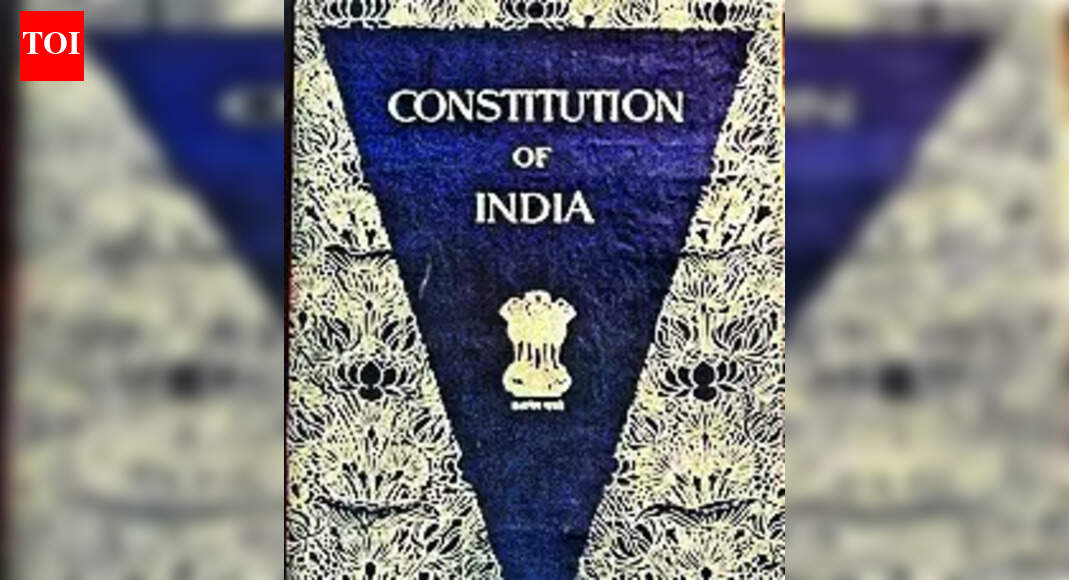

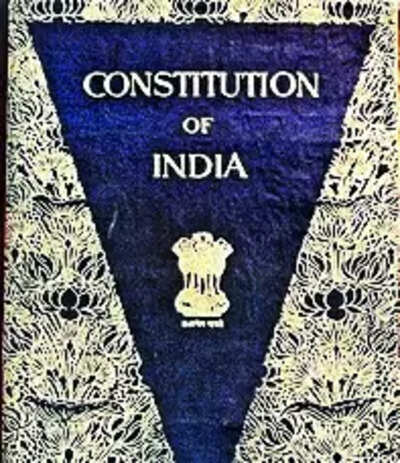
Constitution of India
SRINAGAR: For decades, scholars had tried to translate the Constitution of India into Kashmiri. That wait has now ended. The translation is now available on the Union law ministry’s website.President Droupadi Murmu released the volume in a red-bound edition decorated with Chinar leaves and traditional Kashmiri decorative art. Prof. Aejaz Mohammad Sheikh of University of Kashmir, who led a 11-member translation panel that worked on the project for over two years, described the work as a “watershed moment” for Kashmiri language.“You now have the Bible of law in Kashmiri. This is not just a transfer of knowledge. It enriches the language itself. It gives Kashmiri the legal and intellectual vocabulary needed to translate science, law and modern knowledge,” Sheikh said.Many experts believe that while Kashmiri language possesses a rich body of translated works, including classics from world literature, the translation of a foundational legal document like the Constitution marks a historic first.“A common Kashmiri can now read the Constitution in their own language. When students see that Kashmiri language can carry the language of law, not just poetry, it changes how they see their mother tongue. It proves that Kashmiri language has the grammar, lexicon and strength to express the most complex ideas. This translation has the ability to move Kashmiri language out of a confined literary circle, allowing it to reach the common masses,” said Sheikh, who is dean of School of Arts, Languages and Literature at the university.A govt official echoed the view. “By incorporating constitutional, legal and administrative terminology, the translation strengthens Kashmiri’s capacity to function as a language of governance and law.” Linguistic experts believe the text should be introduced in schools and made available through voice-based software so it can reach the wider public.Basher Bashir, another member of the translation panel, said the exactness and authenticity had been maintained in the legal text of the Constitution.The project began in Aug 2023 when National Translation Mission (NTM) of Central Institute of Indian Languages, Mysuru, approached Sheikh. Fluent in Kashmiri, Urdu and Hindi, and proficient in Sanskrit, the professor agreed to do it. He put together a multidisciplinary team of linguists, academics and legal experts from his university, Satish Vimal of All India Radio (Srinagar), and education department officials.Team members first worked individually, then met to compare and refine their drafts. This was followed by a series of intensive seven-day workshops. The first was held in Mysuru, where legal experts read the Constitution in English while linguists compared it with their Kashmiri translation.. Every term was debated, every phrase tested. Where differences arose, they were discussed until a consensus was reached before moving forward.After the fifth workshop, Sheikh carried out a final, detailed review and submitted the draft. The manuscript was placed online for public feedback for three months by the Union law ministry before the President formally released the final version on Nov 27. The translation uses the standard Kashmiri Perso-Arabic script, adopting a simpler, more accessible style.On Sept 2, 2020, the Union Cabinet had approved Jammu and Kashmir Languages Bill, 2020, recognising five official languages in the UT — Urdu, Hindi, Kashmiri, Dogri and English. Before the revocation of Article 370, Urdu was the sole official language of the erstwhile J&K state. Go to Source