


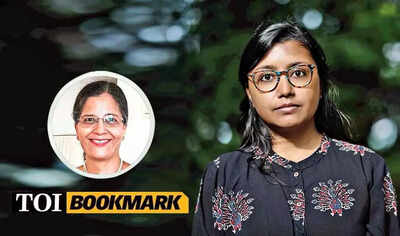
Q: Would you like to briefly encapsulate the storyline and the genesis? A: ‘A Guardian and a Thief’ is set in a near future Kolkata, which is devastated by the effects of climate change. In particular, the city is dealing with a shortage of food. And in this crisis, two families, who are each seeking to protect their own children, come into conflict. I really started thinking about this book when I was reading about how profoundly Kolkata is affected by climate change. It has already grown hotter. It is predicted to endure more severe storms. And that is such a feeling of sorrow, to read that about your hometown. And I started thinking, what will the lived experience of such a crisis be? Q: These scenarios you paint are probably pretty real for people. What did you go through while writing it? A: This book took me six years to write. And there is something really difficult about facing the material here, which is so close to us. I’m writing about a future where if you go outside on a really hot day, your shoes might stick to the melting tar of the road. We might see people agitating for the right to shade from the sun. That future, I think, is very close to us, and there is something difficult about facing it. But at the same time, the joy of writing fiction is that we get to ask the questions that matter to us. We get to think about the dilemmas that feel urgent and important to us. There is something so joyful in that asking, that art gives us a chance to rise out of our daily circumstances and to think about bigger questions. Q: What you end up doing to the reader is pounding the head with a question, what if? A: I am very interested in the question of morals. What is the right thing to do? What is the right way to live? What do we do when we are caught in huge systems and networks where we often feel powerless? What kind of choices will we then make? And for this book, in all my reading about climate change, I kept coming across declarations of hope. You would read something really dire and grim, and it would be followed by, but we must be hopeful. And I started thinking, what does this hope mean? I don’t think hope for the future is something simple or straightforward. Because what happens when my hope for my family, for my children, has a manifestation which is vicious or violent? What happens when my hope for my loved ones clashes with your hope for your loved ones? What happens when hope for a community, a nation, is not exactly aligned with hope for an individual’s life? What will we do for the people that we love? And how can we be sure that our love will be aligned with our moral being? Q: Maybe the bewilderment of the little girl, Mishti, in some ways represents the emotion that the reader or the adults are feeling. A: Becoming a mother really changed my perspective on the story I was trying to tell. Before that moment, I had been trying to work on a storyline which had more to do with a 10- or 11-year-old child. And when I became a mom, I became so interested in the perspective of the mother and I became so interested in the perspective of a very young child, a two year old, who I think in this book is such a centre of delight and brightness… We do turn to children and to young people to show us the way forward. And in this book, it felt really important to take the young children very seriously because they hold the moral centre. Q: You depict a feral, basic instinct that emerges in individuals across socioeconomic classes. A: I hope that a reader who comes to this book might find themselves encouraged to think about that question: Who would I be in a climate crisis? Who would I be in a situation of extreme heat and food shortage? If I go to the market and instead of being able to purchase cauliflower and spinach, I see that what is being sold is insect protein. What is being sold is algae. What will that do to me as a parent, as a guardian, as somebody responsible for putting a nourishing meal on the table? And I think it takes a lot of courage to face how things that we think of as beautiful, like love, can also prove to be quite harmful. And to sit with how complicated these questions are. One of the things that studying anthropology taught me, and I think this is really true of anybody studying social sciences more broadly, what they really teach you is to pay attention to the complexity of other people’s lives, and to also hold at the same time the truth that I can never understand another person’s life as fully as I would want to. So the balance of that effort to understand and the acknowledgement that you can never truly understand that balance produces a kind of humility, which I think is so valuable for a fiction writer. Because that’s what we’re doing as fiction writers, we’re conjuring characters who are complex and we are seeking to understand them. And hopefully we come right back to ourselves, and we are able to ask the questions that are truthful. Q: How many backstories did you go through? A: I started out with this character of Ma and a very clear thief in the later part of the book. And then I realised that it would be neither interesting nor truthful to have such clear figures of a mother who is a guardian and this other young man who is a thief. And I realised that the more truthful and interesting thing would be to have elements of both and shades of both in each person. And so it takes a huge amount of work. It takes a huge amount of time to build a character who rings true. The work of building a truthful character is the work of building a complicated character. If you think about the people that you know, the people that you find interesting, it’s probably because they have so many selves contained inside them. They are able to be different selves in different circumstances. They are able to be both courageous and make foolish mistakes. They are able to be principled and think about ethics while doing things that they would also consider wrong and shameful. And that intricate network of choices and decisions and circumstances and opposites, that’s what composes a person. Go to Source


