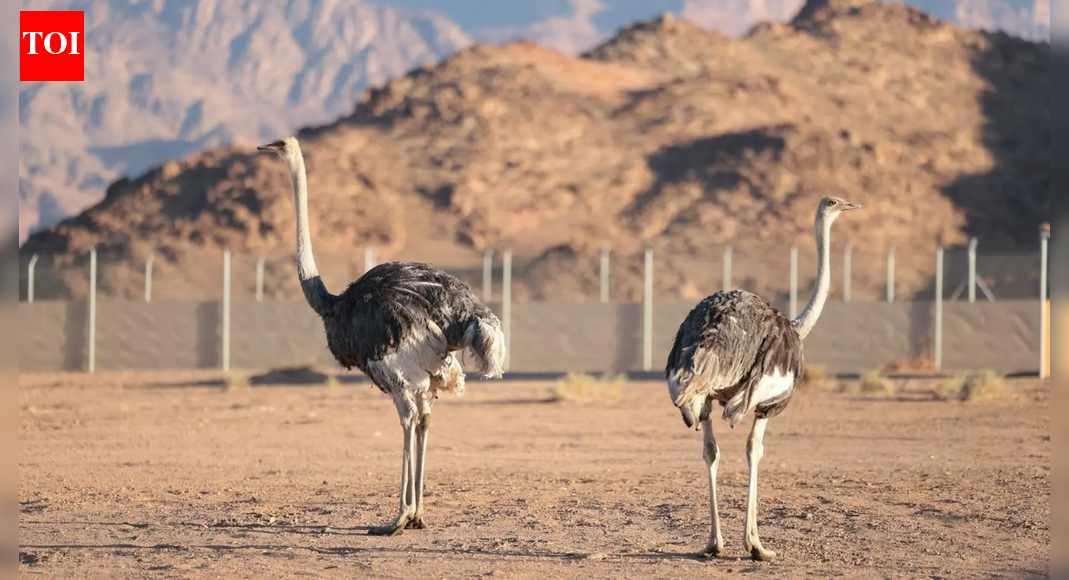

After 100 years, critically endangered ‘Camel Bird’ ostriches return to Saudi Arabia’s royal reserve/Image: SPA
After almost a century, the deserts of Saudi Arabia are welcoming back a long-lost giant. The critically endangered red-necked ostrich, historically called the “camel bird,” has been reintroduced to Prince Mohammed bin Salman Royal Reserve, restoring a species that vanished from the Arabian landscape in the early 20th century. This move marks a milestone in the Kingdom’s ambitious efforts to revive its desert ecosystems and preserve biodiversity.
‘Camel bird’ returns
Once widespread across the Arabian deserts, the Arabian ostrich, or Struthio camelus syriacus, was revered for its speed and strength and celebrated in Arabic poetry. Overhunting and habitat loss led to its extinction in the early 1900s. Today, evidence of these majestic birds survives in the form of sandstone petroglyphs scattered throughout the reserve, depicting ostrich herds and hunting scenes. Combined with scientific studies and osteological finds, these historical records have guided the reserve’s ecological restoration strategy.The red-necked ostrich, or Struthio camelus camelus, also called the North African or Barbary ostrich, has been chosen as a biological replacement. It is the closest genetic relative of the extinct Arabian ostrich and well-suited to survive in arid desert conditions. A founder population of five birds has now been reintroduced to the 24,500 km² reserve as part of a larger plan to rewild the region.
Ecological significance
Ostriches are more than striking desert inhabitants. Known for their speed, distinctive feathers, and flamboyant mating displays, they are essential ecosystem engineers. Their presence supports seed dispersal, controls insect populations, and maintains healthy rangelands, benefiting other species across the desert landscape.Currently, fewer than 1,000 red-necked ostriches survive in the wild, scattered across Africa’s Sahel region. Their reintroduction to Saudi Arabia not only revives a historic species but also strengthens ongoing national breeding and restoration programs led by the National Center for Wildlife, in collaboration with other royal reserves, NEOM, Aramco, and the AlUla Royal Commission.
The Prince Mohammed bin Salman Royal Reserve
The reserve, one of eight royal reserves in the Kingdom, spans from the lava plains of the Harrats to the Red Sea, connecting NEOM, Red Sea Global, and AlUla. Within its 24,500 km², it houses 15 distinct ecosystems and supports over 50% of Saudi Arabia’s species. Despite covering just 1% of the Kingdom’s land and 1.8% of its marine area, it is one of the most biodiverse protected regions in the Middle East.As part of its long-term ecosystem restoration strategy, the reserve has reintroduced 12 of 23 historically occurring species. Alongside the red-necked ostrich, these include the Arabian oryx, Persian onager, sand gazelle, and mountain gazelle. According to Andrew Zaloumis, CEO of the reserve, restoring lost species or their ecological equivalents is essential for fully rehabilitating desert ecosystems, and the return of the ostrich is a landmark step in achieving that goal.
Aligning conservation with national goals
The reintroduction aligns with Saudi Arabia’s Vision 2030 and the Saudi Green Initiative. These initiatives aim to protect 30% of the Kingdom’s land and sea by 2030, enhance biodiversity, and restore degraded ecosystems. The reserve’s efforts are integrated with broader sustainability programs and partnerships with other royal reserves and conservation projects across the country.By reviving species that historically shaped the landscape, the Prince Mohammed bin Salman Royal Reserve is setting a blueprint for rewilding in the Middle East. The return of the “camel bird” is more than a symbolic gesture, it represents a living connection to Arabia’s natural heritage and a significant step toward securing the Kingdom’s ecological future. Go to Source