
Bangladesh is facing a fresh wave of political violence at a highly sensitive pre-election moment, with analysts and observers warning that the unrest appears deliberately “engineered” to create fear, uncertainty, and instability. As the country inches toward national polls, growing doubts are emerging over whether the Muhammad Yunus-led interim administration can maintain law and order and conduct a credible, timely election.
Political analysts tracking developments say the deteriorating security situation is increasingly being used to argue that elections cannot be held safely. This narrative, they suggest, could pave the way for postponements while allowing radical and extremist groups to expand their street presence. Several commentators have described the current phase as one of “orchestrated instability,” where isolated incidents are swiftly politicised and amplified to mobilise large-scale protests.
Sharif Osman Hadi’s Killing Seen As A Turning Point
The killing of youth protest leader Sharif Osman Hadi on December 18 is widely viewed as a critical trigger for the current unrest. On a Friday afternoon in Dhaka at around 2:25 pm local time, just hours after the national election schedule was announced. Sharif Osman Hadi—an independent candidate contesting the Dhaka-8 constituency—was shot in the head by unidentified gunmen on a motorcycle in Bijoy Nagar, leaving him in critical condition.
After the attack, Md. Abu Shadik (Kayem), Vice-President of the Dhaka University Central Students’ Union (DUCSU), alleged that remnants of the previous regime were working to derail the polls. He said the ousted group “has already issued threats and launched programs to resist the election,” warning that violence against candidates casts serious doubt on the safety and credibility of the upcoming vote, reported The Hindu.
Intelligence and political observers note that Hadi’s death was quickly leveraged to spark coordinated demonstrations across major urban centres, including Dhaka, Chattogram, Khulna, and Rajshahi, as reported by News 18.
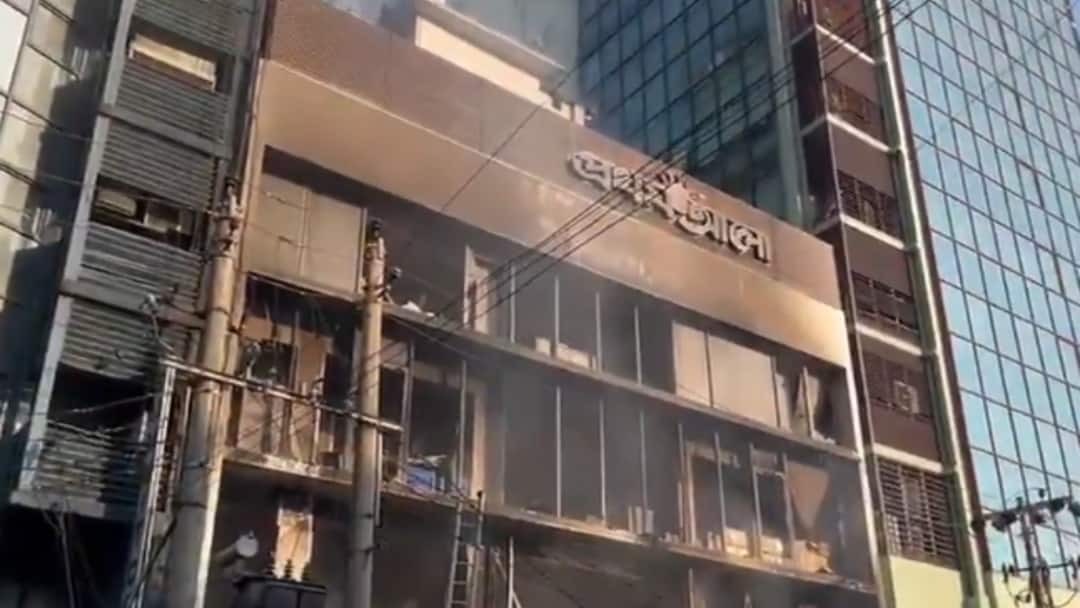
What began as protests soon spiralled into violence, with reports of arson, vandalism, and direct street confrontations. Analysts say the speed and scale of mobilisation point to advance planning, rather than spontaneous public outrage. Hadi’s status as a prominent face of last year’s uprising made his death a powerful rallying symbol for opposition and radical factions.
Anti-India Rhetoric and Diplomatic Targets
One of the most striking aspects of the unrest has been the sharp escalation in anti-India sentiment. In Chattogram, stone-pelting incidents were reported at the residence and office of the Indian Deputy High Commission, with circulating videos allegedly showing militant participation. In Dhaka, radical groups attempted to march toward the Indian High Commission, broke through police barricades, raised anti-India slogans, and issued threats before being dispersed by security forces.
Observers argue that effigy burnings, slogan-chanting, and attacks on Indian diplomatic facilities indicate a calculated attempt to internationalise the crisis and redirect public anger toward an external target. This, analysts warn, risks straining regional relations while further destabilising the internal political climate.
Questions Over Policing and Election Security
Concerns have also been raised about law enforcement conduct. Multiple sources of News 18 pointed out that police appeared conspicuously passive in certain flashpoints, while responding forcefully in others, fuelling allegations of selective enforcement and inconsistency. Such perceptions, analysts say, undermine public confidence in the state’s ability to ensure a level playing field ahead of the polls.