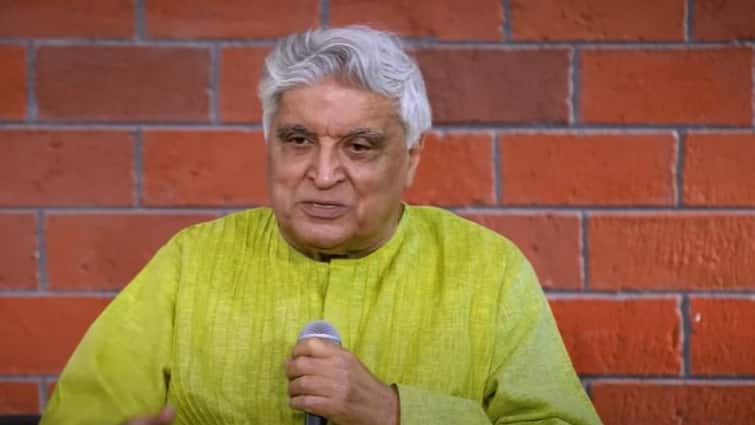

Veteran lyricist and screenwriter Javed Akhtar is known for speaking his mind, even when the subject makes people uncomfortable. At the SOA Literary Festival 2025, he did just that, raising a pointed question that immediately stirred reflection and debate: “Why should a woman be ashamed of her face?”
The remark, delivered during a thought-provoking session, set the tone for a larger conversation on women’s autonomy, social conditioning, and the fine line between choice and pressure in practices such as face-covering with burqas.
A Direct Question That Cut Through the Silence
Speaking at a session organised by the Indian Performing Rights Society and supported by the Ministry of Culture, Akhtar challenged the social logic behind expecting women to cover their faces. Addressing an audience of students and members of the public, he framed his argument not as an attack, but as an invitation to think deeply about dignity and agency.
His central concern was simple yet unsettling: if modesty is the goal, why does it extend specifically to covering a woman’s face?
Interactive Exchange Sparks Honest Conversation
The discussion gained momentum during the interactive segment when a young girl referred to Akhtar’s earlier remarks about growing up among women who did not wear burqas. She asked whether covering oneself necessarily made a woman less strong, a question that prompted an unfiltered response.
Akhtar was quick to clarify his position on decency. He emphasised that dignity in dressing applies equally to men and women. “If a man comes to an office or college in a sleeveless shirt, it’s not a good thing,” he said, adding that women, too, should dress decently.
But for Akhtar, modest clothing and face-covering are not the same.
‘What Is Undignified About a Woman’s Face?’
Drawing a sharp distinction, Akhtar questioned the reasoning behind covering the face. “What makes her cover her face?” he asked the audience. “What is so vulgar, obscene, or undignified about her face that it needs to be covered?”
By repeatedly posing this question, he urged listeners to examine whether the practice stems from personal belief, or from something far more ingrained.
Social Conditioning, Not Individual Choice?
Akhtar argued that such decisions rarely exist in a vacuum. According to him, social approval and long-standing norms play a decisive role. “This is peer pressure,” he said bluntly. “If she says she is doing it on her own, then she is brainwashed.”
He explained that validation from family, community, or social circles often shapes what is presented as “choice.” In such environments, opting out may come at the cost of acceptance, making true freedom difficult to define.
Taking the argument further, Akhtar questioned whether anyone would willingly cover their face without these pressures. “Does she hate her face? Is she ashamed of her face? Why?” he asked, leaving the audience to sit with the discomfort of the questions.
A Broader Reflection on Freedom and Agency
Akhtar’s remarks underscored a larger point: personal decisions cannot always be separated from cultural conditioning. By highlighting the invisible forces that shape behaviour, he cautioned against viewing practices like face-covering as purely individual acts without acknowledging the weight of societal expectations.
Honoured for His Literary Contribution
The festival, held at Siksha ‘O’ Anusandhan University, also celebrated Akhtar’s enduring impact on literature and the arts. He was conferred with the SOA Sahitya Samman, recognising his decades-long contribution to Indian cultural discourse.
Continuing Conversations Beyond the Festival
In a recent interview with IndiaToday.in, Akhtar reflected on his journey in Hindi cinema, his philosophy of writing, and the importance of honest storytelling. Much like his comments at the festival, those conversations continue to feed into larger debates around culture, freedom, and social norms in India.